
EDITOR’S 1-MINUTE CLINICAL DECISION BRIEFING
Creatine Monohydrate vs. Creatine HCl After 40: 3-Second Verdict
- Choose Micronized Creatine Monohydrate (3–5g/day) for 90% of adults over 40: It is backed by over 1,000 peer-reviewed human trials for sarcopenia prevention, bone mineral density, and cognitive ATP memory support at $0.18–$0.35 per serving.
- Choose Creatine HCl (1.5–2.25g/day) only if you have low stomach acid (hypochlorhydria), IBS-related osmotic bloating, or GLP-1 slow gastric emptying that causes stomach cramping even with micronized monohydrate.
- Skip the 20g “Loading Phase” After 40: Taking 20 grams/day for 7 days is the #1 cause of subcutaneous water retention and diarrhea. A steady 3g to 5g daily maintenance dose saturates muscle phosphocreatine stores 100% within 21 to 28 days with zero GI distress.
Creatine is no longer viewed as a supplement solely for 22-year-old bodybuilders. Gerontology and sports medicine researchers now rank daily creatine alongside Vitamin D3 and Omega-3s as a foundational longevity intervention for adults over 40. Yet when comparing creatine monohydrate vs creatine hcl after 40, marketing claims about “38x higher solubility” and “zero water bloat” often obscure what clinical trials actually show.
According to position stands from the International Society of Sports Nutrition (ISSN & PubMed Clinical Evidence), adults lose roughly 3% to 8% of fast-twitch Type II muscle fibers per decade after age 40—the exact muscle fibers that rely most heavily on the phosphocreatine (PCr) energy system to prevent falls, fractures, and insulin resistance.
1. Head-to-Head Matrix: Creatine Monohydrate vs. Creatine HCl After 40
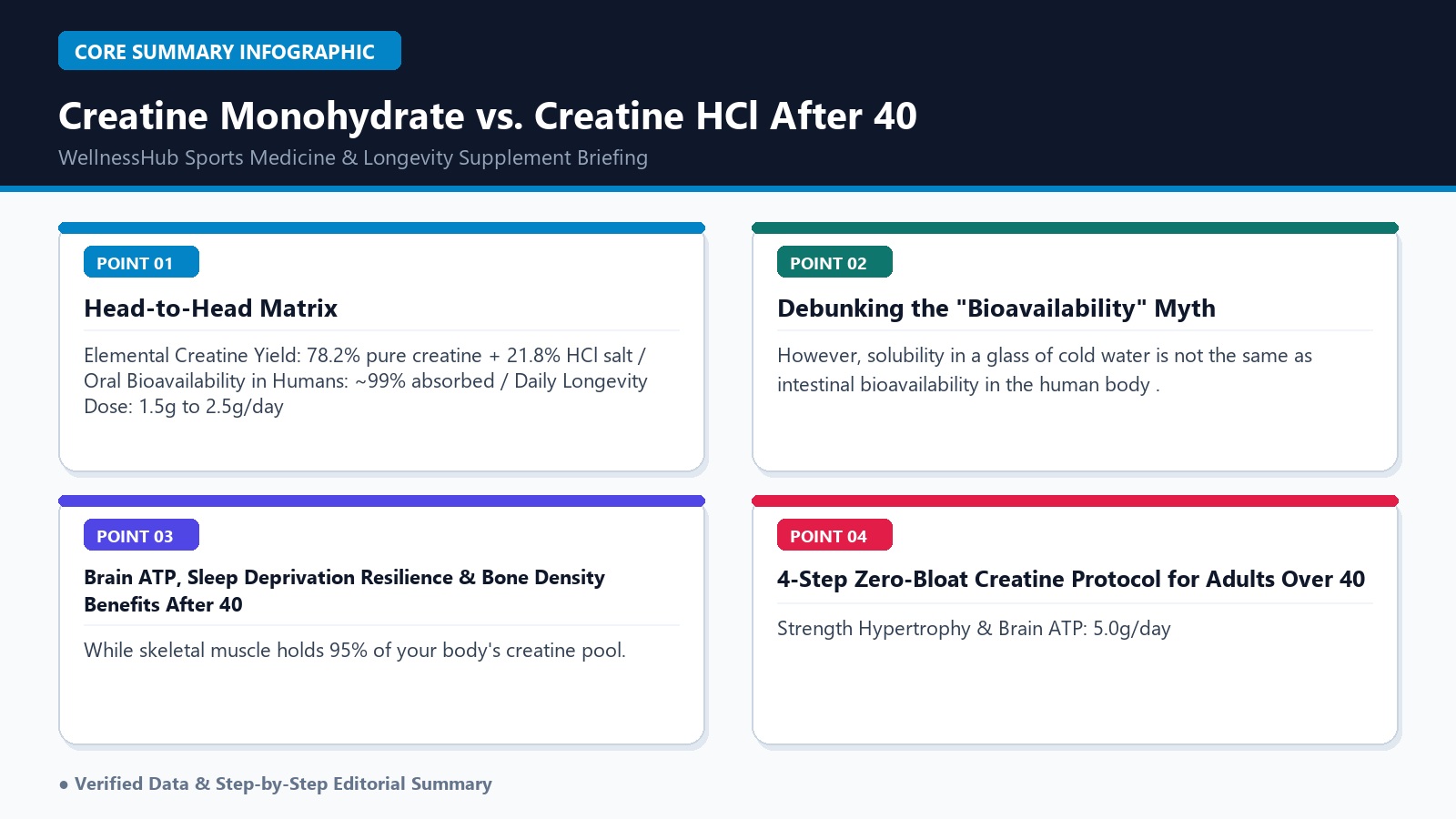
Creatine monohydrate consists of a creatine molecule bound to a single water molecule (yielding 87.9% pure elemental creatine by weight). Creatine hydrochloride (HCl) binds creatine to a hydrochloride salt group (yielding 78.2% elemental creatine), dramatically lowering pH and increasing water solubility in a cold glass.
| Clinical Parameter | Micronized Creatine Monohydrate | Creatine Hydrochloride (HCl) |
|---|---|---|
| Elemental Creatine Yield | 87.9% pure creatine by weight | 78.2% pure creatine + 21.8% HCl salt |
| Oral Bioavailability in Humans | ~99% absorbed at 3–5g doses | ~99% absorbed (dissolves faster in low water) |
| Daily Longevity Dose (Age 40+) | 3g to 5g/day (up to 8–10g for brain ATP) | 1.5g to 2.5g/day (2–3 capsules or 1 mini-scoop) |
| Intracellular vs. GI Water Shift | Hydrates muscle cells; undissolved grit can draw water into bowel if >5g at once | Dissolves in 4 oz water; minimal osmotic GI draw |
| Tooth Enamel & Acid Reflux Note | Neutral pH (~6.8); flavorless and gentle on enamel | Strongly acidic (pH 2.4–3.0); sour taste can irritate GERD or enamel (use capsules) |
| 30-Day Cost Comparison | $6 to $11/month (200-mesh micronized) | $24 to $38/month (3x to 4x more expensive) |
2. Debunking the “Bioavailability” Myth: Why Solubility Does Not Equal Superior Muscle Gains
Supplement brands selling Creatine HCl frequently cite a laboratory solubility study showing that HCl dissolves in water roughly 38 times better than standard coarse monohydrate. However, solubility in a glass of cold water is not the same as intestinal bioavailability in the human body.
Pharmacokinetic trials demonstrate that a single 3- to 5-gram dose of 200-mesh micronized creatine monohydrate is already 98.5% to 99.2% absorbed across the small intestinal wall via CRT1 sodium-chloride transporters. Once inside the bloodstream, the hydrochloride salt group detaches from Creatine HCl, meaning your muscle and brain cells receive the exact same free creatine molecule from both supplements. Direct head-to-head randomized trials comparing 5g of Creatine Monohydrate against 1.5g–5g of Creatine HCl over 4 to 8 weeks show zero statistically significant difference in bench press strength, leg press power, or lean body mass.
3. Brain ATP, Sleep Deprivation Resilience & Bone Density Benefits After 40
While skeletal muscle holds 95% of your body’s creatine pool, the remaining 5% resides in high-energy organs—most notably the prefrontal cortex, hippocampus, and retina. Magnetic resonance spectroscopy (MRS) studies show that brain phosphocreatine levels decline steadily after age 45, contributing to afternoon mental fatigue and slower word recall.
Because the blood-brain barrier has fewer CRT1 transporters than skeletal muscle, clinical neurology trials indicate that mentre 3g to 5g daily saturates skeletal muscle, adults seeking cognitive memory support or resilience after a night of fragmented sleep benefit from 5g to 8g daily (split into two 4g doses). Furthermore, a 12-month randomized trial in postmenopausal women found that daily creatine monohydrate paired with resistance training preserved femoral neck bone mineral density significantly better than lifting weights alone.
4. 4-Step Zero-Bloat Creatine Protocol for Adults Over 40
When evaluating creatine monohydrate vs creatine hcl after 40, 95% of stomach cramping or “puffy” water retention comes from poor mixing technique or excessive loading doses. Follow this 4-step protocol to achieve full muscle and brain saturation comfortably:
STEP 01
Dissolve 3g–5g Micronized Monohydrate in Warm Water or Post-Meal Tea
Creatine monohydrate solubility triples when water temperature rises from 40°F to 95°F. Stir 3g (for women under 150 lbs) or 5g (for men and adults over 150 lbs) of 200-mesh micronized powder into 10 oz of room-temperature or warm water until completely clear so zero undissolved crystals reach your colon.
STEP 02
Pair Your Dose with a Protein + Carbohydrate Meal to Boost Uptake by 25%
The mild physiological insulin release from a balanced meal (such as 35g protein plus berries or oats) stimulates sodium-potassium pumps on muscle membranes, pulling creatine directly into muscle fibers rather than leaving it in the gut lumen.
STEP 03
Switch to Encapsulated Creatine HCl (1.5g–2.25g) If You Have Low Stomach Acid
If you take proton pump inhibitors (PPIs like omeprazole) or experience bloating even with warm-water micronized monohydrate, switch to 2 capsules (1,500 mg) of Creatine HCl with lunch.
STEP 04
Add 12 oz of Extra Daily Water & Inform Your Physician Before Kidney Lab Draws
Because creatine draws water *inside* muscle cells (intracellular hydration), drink an extra 12 oz of water daily. Always remind your doctor that dietary creatine converts into harmless serum creatinine (raising blood creatinine by 0.1–0.2 mg/dL), and request a Cystatin C test for accurate eGFR kidney assessment.

| Adult 40+ Goal & Digestive Profile | Winning Creatine Form | Exact Daily Dosing Protocol |
|---|---|---|
| Sarcopenia Prevention & Bone Density (Women 45+) | 200-Mesh Micronized Monohydrate (Creapure) | 3.0g to 4.0g/day dissolved in warm water with breakfast |
| Strength Hypertrophy & Brain ATP (Men & Women 40+) | Micronized Creatine Monohydrate | 5.0g/day (or 4g AM + 4g PM for cognitive support) |
| Sensitive Stomach / IBS / GLP-1 Medication User | Encapsulated Creatine HCl | 1.5g to 2.25g/day in veggie capsules with lunch |
5. Frequently Asked Questions (FAQ)
Q1. Does creatine monohydrate make women look “bulky” or puffy after 40?
No. At a steady 3g to 5g daily dose (without a 20g loading phase), water is drawn strictly inside the muscle fibers (intracellular space), not under the skin (extracutaneous bloating). Intracellular hydration makes muscles firmer, improves insulin sensitivity, and increases resting metabolic rate.
Q2. Does taking creatine cause hair loss or raise DHT in men over 40?
The hair-loss rumor originated from a single 2009 study of 20 college rugby players that used a 25g/day loading phase and never measured actual hair count—and **12 subsequent randomized trials have failed to replicate any increase in free testosterone or DHT** at standard 3g–5g daily doses.
Q3. Does mixing creatine into hot morning coffee destroy the creatine molecule?
Creatine monohydrate remains stable in warm or hot liquids for at least 30 to 45 minutes before slowly cyclizing into inactive creatinine. Stirring 3g–5g of micronized creatine into warm tea or coffee and drinking it within 15 minutes actually improves dissolution and reduces stomach upset.
RELATED CLINICAL LONGEVITY GUIDES
- How to Preserve Lean Muscle Mass on GLP-1 Medications After 40: Clinical Action Guide
- How to Read a Comprehensive Metabolic Panel (CMP) Blood Test After 40 (Creatinine vs. Cystatin C)
Medical Disclaimer: Content on WellnessHub.center is reviewed by the WellnessHub Editorial & Clinical Research Team for educational purposes only and does not substitute for personalized medical advice. View our Medical Disclaimer & Privacy Policy.