

EDITOR’S 1-MINUTE PREVENTIVE LAB BRIEFING
Decoding Your CMP Blood Test After 40: 3 Critical Takeaways
- “Normal” Is Not Optimal: Standard reference intervals represent the middle 95% of an increasingly metabolically unwell population. Optimal longevity targets for adults over 40 are significantly tighter—such as fasting glucose at 75–88 mg/dL rather than 99 mg/dL.
- Liver Enzymes (ALT & AST): Lab sheets often allow ALT up to 40–45 U/L, but clinical hepatology guidelines flag subclinical fatty liver (MASLD) when ALT exceeds 25 U/L in women or 33 U/L in men.
- Kidney Filtration Warning: If you lift weights or take creatine monohydrate, serum creatinine can look falsely elevated (1.2–1.35 mg/dL); always request a Cystatin C blood test to confirm true kidney filtration.
Every annual physical includes a 14-marker blood test called the CMP, yet most patients are told “everything looks normal” as long as no numbers trigger an electronic red flag. Knowing how to read a comprehensive metabolic panel blood test after 40 empowers you to spot insulin resistance, mild dehydration, fatty liver accumulation, and protein insufficiency 5 to 10 years before they cross the disease threshold.
Because Quest Diagnostics and Labcorp calculate their “normal” reference ranges from the statistical average of adults visiting diagnostic clinics, a result at the upper edge of normal often signals early metabolic drift. Below is the clinical action guide to interpreting all 14 CMP biomarkers through a preventive longevity lens.
1. Standard Lab Reference Ranges vs. Optimal Longevity Targets After 40
A Comprehensive Metabolic Panel evaluates four interconnected organ systems: blood sugar regulation, hepatic (liver) enzyme integrity, renal (kidney) filtration, and serum electrolyte balance. Use this side-by-side table to compare your portal numbers against Preventive Medicine and American College of Gastroenterology (ACG Clinical Guidelines) optimal ranges:
| CMP Biomarker | Standard Lab Range | Optimal 40+ Longevity Range | What Drifting Outside Optimal Means |
|---|---|---|---|
| Fasting Glucose | 65–99 mg/dL | 75–88 mg/dL | 90–99 mg/dL indicates early hepatic insulin resistance |
| ALT (Alanine Transaminase) | 7–45 U/L | 10–23 U/L (W) · 12–29 U/L (M) | >25 U/L (W) or >33 U/L (M) signals visceral liver fat |
| AST (Aspartate Transaminase) | 8–40 U/L | 12–24 U/L | Can rise 15–30 U/L for 48 hours after heavy weight lifting |
| eGFR (Kidney Filtration) | >60 mL/min/1.73m² | >85 mL/min/1.73m² | 60–80 warrants checking hydration & Cystatin C |
| BUN (Blood Urea Nitrogen) | 7–25 mg/dL | 11–18 mg/dL | >20 mg/dL with normal creatinine points to morning dehydration |
| Serum Albumin | 3.5–5.2 g/dL | 4.3–4.9 g/dL | <4.1 g/dL correlates with low dietary protein or inflammation |
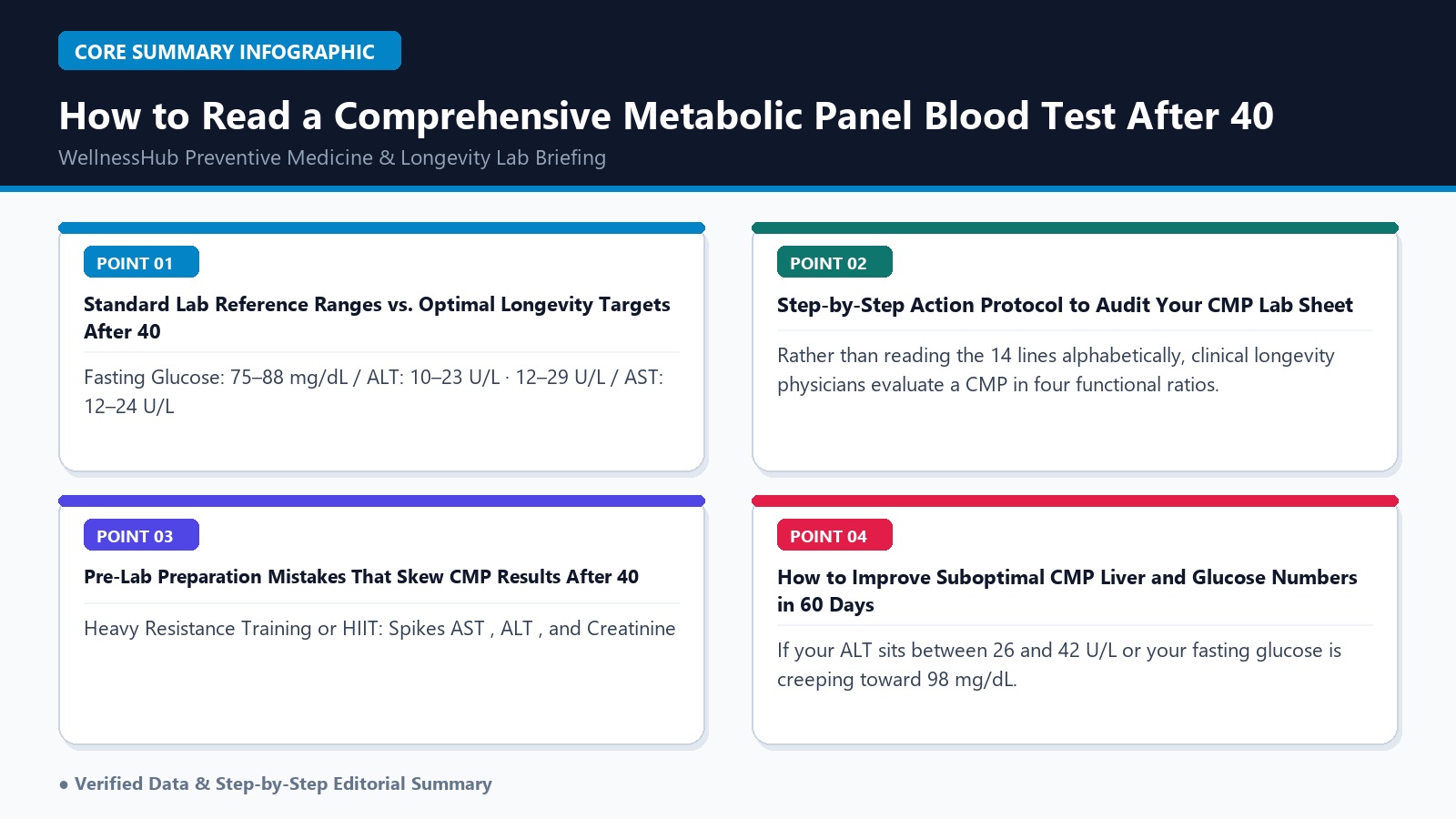
2. Step-by-Step Action Protocol to Audit Your CMP Lab Sheet
Rather than reading the 14 lines alphabetically, clinical longevity physicians evaluate a CMP in four functional ratios. Follow this step-by-step audit when reviewing your results in your patient portal:
STEP 01
Check Your AST-to-ALT Ratio to Distinguish Muscle Soreness from Liver Fat
If your ALT is higher than your AST (an AST:ALT ratio below 0.8) and ALT exceeds 25 U/L, excess dietary fructose and visceral fat are stressing liver hepatocytes. Conversely, if AST is elevated while ALT is under 22 U/L, the spike almost always comes from strenuous exercise within 48 hours of your blood draw.
STEP 02
Calculate Your BUN-to-Creatinine Ratio (Target: 10:1 to 16:1)
Divide your BUN by your serum creatinine. A ratio above 20:1 on a fasting morning blood draw almost always reflects overnight dehydration combined with a high-protein diet rather than intrinsic kidney disease. Drink 16 oz of plain water 60 minutes before your lab appointment.
STEP 03
Verify Serum Albumin and Albumin-to-Globulin Ratio (≥4.3 g/dL)
Serum albumin is one of the strongest independent predictors of biological aging in adults over 40. An albumin level between 4.4 and 4.8 g/dL confirms robust hepatic protein synthesis, strong antioxidant capacity, and low systemic inflammation.
STEP 04
Pair Fasting Glucose (89–99 mg/dL) with Fasting Insulin and HbA1c
Because the pancreas can over-secrete insulin for years to keep morning glucose at 94 mg/dL, request a $25 add-on Fasting Insulin test whenever your CMP glucose sits between 89 and 99 mg/dL.
3. Pre-Lab Preparation Mistakes That Skew CMP Results After 40
Nearly 30% of abnormal CMP follow-up retests turn out to be preparation artifacts. Before learning how to read a comprehensive metabolic panel blood test after 40, make sure your blood draw was not distorted by these four common triggers:

| Pre-Test Habit (48 Hours Prior) | Artificially Skewed CMP Marker | Correct 48-Hour Pre-Lab Protocol |
|---|---|---|
| Heavy Resistance Training or HIIT | Spikes AST (+40%), ALT (+20%), and Creatinine (+15%) | Rest or do light walking only for 48 hours before blood draw |
| Fasting Without Drinking Plain Water | Elevates BUN, Creatinine, Calcium, and lowers eGFR | Drink 16–20 oz of plain water upon waking before the draw |
| Black Coffee 1 Hour Before Lab Draw | Cortisol & adrenaline raise fasting glucose by 8–14 mg/dL | Hold all caffeine until immediately after your blood sample |
| 5g Creatine Supplement Morning of Test | Raises serum creatinine by 0.15–0.25 mg/dL (lowers calculated eGFR) | Pause creatine for 48 hours or ask physician for Cystatin C |
4. How to Improve Suboptimal CMP Liver and Glucose Numbers in 60 Days
If your ALT sits between 26 and 42 U/L or your fasting glucose is creeping toward 98 mg/dL, the liver responds remarkably fast to targeted nutritional interventions. Eliminating liquid sugars and alcohol for 8 weeks, increasing daily dietary choline (found in pasture-raised egg yolks and wild salmon) to 450–550 mg/day, and performing 150 minutes of Zone 2 aerobic exercise plus 2 weekly strength sessions reduces intrahepatic triglyceride fat by 30% and typically lowers ALT by 8 to 14 U/L.
5. Frequently Asked Questions (FAQ)
Q1. Why is my serum potassium slightly high (5.2–5.4 mmol/L) when I feel completely fine?
The most common cause of mildly elevated potassium in a healthy adult is in-vitro hemolysis or fist-clenching during the blood draw, which causes red blood cells to leak potassium into the test tube. If your eGFR is normal (>80), ask for a repeat draw without a tight tourniquet or fist pumping.
Q2. What does mildly elevated total bilirubin (1.3–1.8 mg/dL) with normal ALT and AST mean?
When total bilirubin rises slightly after overnight fasting while ALT, AST, and Alkaline Phosphatase are completely optimal, it is almost always Gilbert’s syndrome—a harmless genetic trait present in 5% to 8% of adults that slows bilirubin conjugation. Interestingly, mildly elevated bilirubin in Gilbert’s syndrome acts as a potent vascular antioxidant linked to lower cardiovascular disease risk.
Q3. When should a slightly high serum calcium (>10.2 mg/dL) on a CMP be investigated?
In adults over 40—particularly postmenopausal women—a serum calcium persistently above 10.2 mg/dL should never be ignored as simple dehydration. Request a simultaneous intact parathyroid hormone (PTH) and 25-OH Vitamin D blood test to rule out benign primary hyperparathyroidism, which silently leaches calcium from bone density.
RELATED CLINICAL LONGEVITY GUIDES
- Probiotic Side Effects After 40: 5 Warning Signs to Skip or Switch Strains
- Berberine vs. Inositol for Insulin Resistance After 40: Clinical Comparison
Medical Disclaimer: Content on WellnessHub.center is reviewed by the WellnessHub Editorial & Clinical Research Team for educational purposes only and does not substitute for personalized medical advice. Always consult your physician before changing supplements or medications. View our Medical Disclaimer & Privacy Policy.