
EDITOR’S 1-MINUTE CLINICAL DECISION BRIEFING
Berberine vs. Myo-Inositol After 40: 3-Second Selection Verdict
- Choose Berberine HCl (500 mg 2–3x/day) if your primary lab markers are elevated fasting glucose (>100 mg/dL), HbA1c (5.7%–6.4%), and high LDL-C/triglycerides driven by visceral liver fat.
- Choose Myo-Inositol (2,000–4,000 mg/day, 40:1 ratio) if you experience intense afternoon carbohydrate cravings, perimenopausal hormone shifts, sleep fragmentation, or sensitive digestion that cannot tolerate berberine.
- Clinical Combination Rule: Both compounds act on completely separate cellular pathways (AMPK vs. PI3K/IPG signaling) and can be stacked safely when introduced 14 days apart.
After age 40, declining skeletal muscle mass and shifting sex hormones reduce peripheral glucose uptake by roughly 15% to 25% per decade. When diet and resistance training alone do not bring fasting insulin below 8.0 uIU/mL or HbA1c below 5.6%, two evidence-backed nutraceuticals dominate clinical endocrinology discussions: berberine vs inositol for insulin resistance after 40.
While both compounds improve HOMA-IR scores in randomized controlled trials indexed on PubMed and reviewed by Endocrine Society researchers, they work through entirely different intracellular mechanisms. Choosing the wrong one for your metabolic phenotype can lead to unnecessary gastrointestinal cramping or stalled lab results.
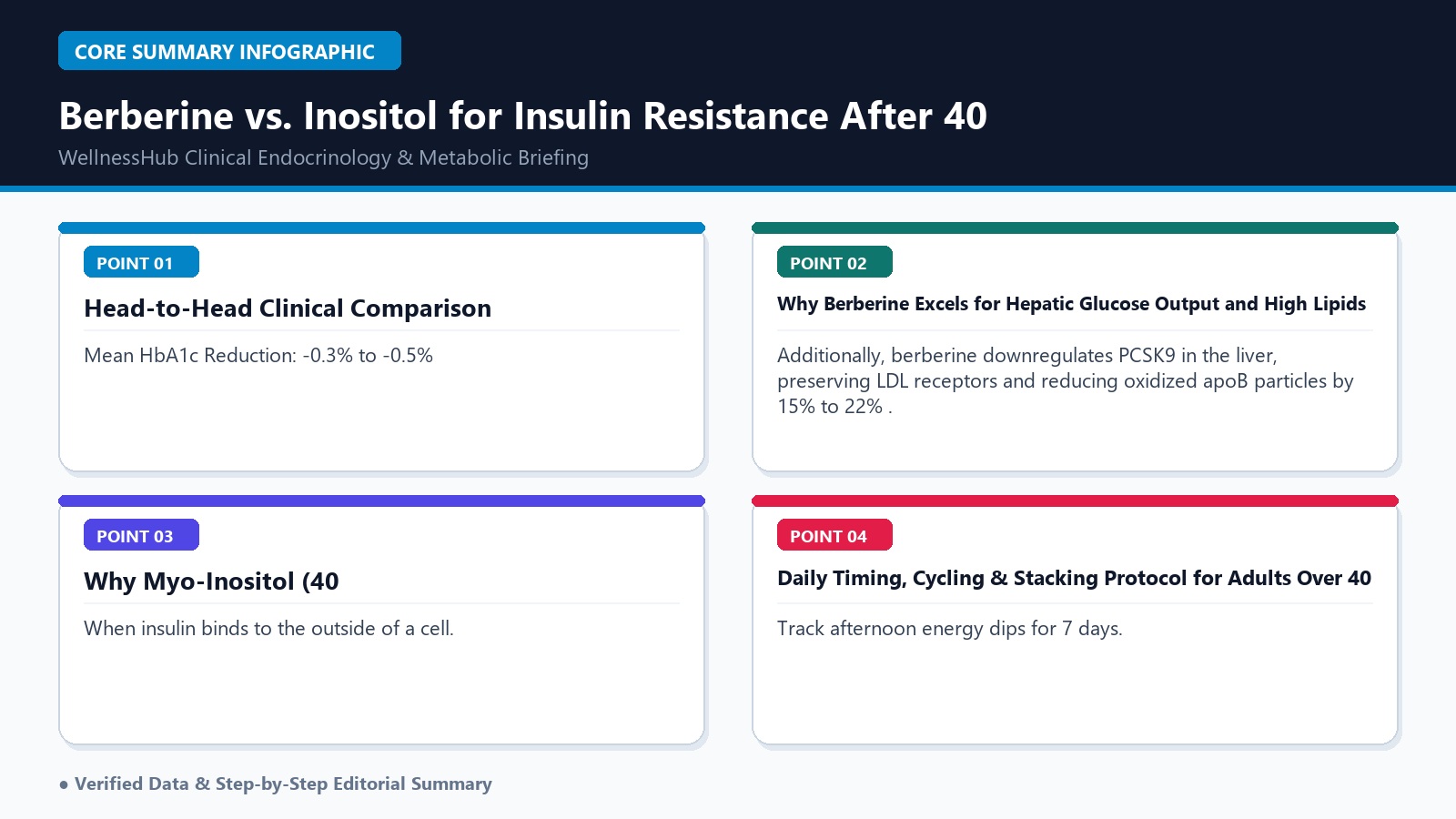
1. Head-to-Head Clinical Comparison: Berberine vs. Myo-Inositol
Berberine is a plant isoquinoline alkaloid that activates AMP-activated protein kinase (AMPK) in liver and muscle cells—the exact same master metabolic switch targeted by prescription metformin. Myo-inositol and D-chiro-inositol are vitamin-like cyclitols that serve as structural building blocks for inositol phosphoglycan (IPG) second messengers inside the insulin receptor cascade.
| Clinical Parameter | Berberine HCl / Phytosome | Myo-Inositol + D-Chiro (40:1) |
|---|---|---|
| Primary Cellular Target | Hepatic & muscle AMPK activation; PCSK9 inhibition | Insulin receptor IPG second-messenger & GLUT4 translocation |
| Mean HbA1c Reduction (12 Wks) | -0.5% to -0.9% (strongest in prediabetes) | -0.3% to -0.5% (strongest in HOMA-IR & fasting insulin) |
| Lipid & Triglyceride Impact | Lowers LDL-C by 15%–20% and triglycerides by 22% | Lowers triglycerides by 10%–14%; modest LDL change |
| Evidence-Based Daily Dose | 1,000–1,500 mg/day (500 mg before 2–3 meals) | 2,000–4,000 mg/day (2,000 mg morning & evening) |
| GI Tolerance & Side Effects | Moderate risk of cramping or loose stools above 500 mg/dose | Excellent GI tolerance up to 4,000 mg/day; mild calming effect |
| Drug Interaction Profile | Inhibits CYP2D6 & CYP3A4 enzymes (check statins/beta-blockers) | Minimal hepatic CYP450 interaction; safe with thyroid meds |
2. Why Berberine Excels for Hepatic Glucose Output and High Lipids
If you wake up with a fasting blood glucose reading between 102 and 124 mg/dL despite eating a low-carbohydrate dinner, the culprit is usually overnight hepatic gluconeogenesis—your liver releasing excess stored glucose into the bloodstream under the influence of morning cortisol and visceral fat inflammation.
Clinical trials published in Metabolism and reviewed by the National Institutes of Health (PubMed Clinical Database) demonstrate that 500 mg of Berberine HCl taken 3 times daily suppresses hepatic gluconeogenesis and increases insulin receptor expression on skeletal muscle membranes within 4 to 8 weeks. Additionally, berberine downregulates PCSK9 in the liver, preserving LDL receptors and reducing oxidized apoB particles by 15% to 22%.
3. Why Myo-Inositol (40:1) Wins for Hormone-Driven Insulin Resistance
When insulin binds to the outside of a cell, it relies on intracellular myo-inositol and D-chiro-inositol to relay the signal that opens GLUT4 glucose channels. Under chronic stress or declining estrogen and progesterone levels after age 40, urinary excretion of inositol increases sharply, leaving cells “deaf” to insulin’s signal even when the pancreas secretes plenty of insulin.
Restoring intracellular reserves with 2,000 mg of Myo-Inositol plus 50 mg of D-Chiro-Inositol (the physiological 40:1 plasma ratio) twice daily lowers fasting insulin by 20% to 32% over 12 weeks. Because myo-inositol also acts as a second messenger for serotonin and GABA receptors in the brain, taking the evening 2,000 mg dose 60 minutes before bed simultaneously calms evening sugar cravings and improves slow-wave sleep architecture.
4. Daily Timing, Cycling & Stacking Protocol for Adults Over 40
When evaluating berberine vs inositol for insulin resistance after 40, proper meal timing and cycling determine whether you achieve smooth post-meal glucose curves or experience digestive fatigue. Follow this 4-step clinical dosing blueprint:
STEP 01
Days 1–7: Start with Morning & Evening Myo-Inositol (2,000 mg 2x/day)
Dissolve 2,000 mg of unflavored micronized myo-inositol powder (40:1 ratio) in 8 oz of water 15 minutes before breakfast and 60 minutes before dinner or bedtime. Track afternoon energy dips for 7 days.
STEP 02
Days 8–14: Introduce Single-Dose Berberine Before Your Largest Meal (500 mg)
If fasting glucose remains above 100 mg/dL, add 500 mg of Berberine HCl or 550 mg of Berberine Phytosome 15 to 20 minutes before your highest-carbohydrate meal of the day to blunt the post-prandial spike by 25%.
STEP 03
Weeks 3–12: Titrate to 500 mg Berberine Twice Daily + 15-Minute Post-Meal Walk
Once GI tolerance is confirmed after 7 days, increase berberine to 500 mg before lunch and 500 mg before dinner (1,000 mg/day total) while pairing dinner with a 15-minute brisk walk to double non-insulin-dependent muscle glucose uptake.
STEP 04
Follow the 8-Weeks-On, 2-Weeks-Off Microbiome Cycle for Berberine
Because berberine has mild antimicrobial activity in the gut lumen, cycle off berberine for 14 days after every 8 to 12 weeks of continuous use while continuing daily myo-inositol year-round without interruption.

| Metabolic Phenotype (Age 40+) | Primary Supplement Protocol | Target Lab Biomarker to Re-Test at 90 Days |
|---|---|---|
| High Fasting Glucose (>100 mg/dL) + High LDL/TG | Berberine HCl 500 mg 2x/day before meals | HbA1c, Fasting Glucose, ApoB, Triglyceride:HDL ratio (<2.0) |
| Perimenopause Belly Weight + Afternoon Sugar Cravings | Myo-Inositol 2,000 mg 2x/day (40:1 ratio) | Fasting Insulin (<7 uIU/mL) & HOMA-IR (<1.5) |
| Stubborn Prediabetes (HbA1c 5.9%–6.4%) | Dual Stack: Berberine 500 mg 2x/day + Myo-Inositol 2,000 mg PM | 90-Day HbA1c reduction of 0.5%–0.8% & waist circumference |
5. Frequently Asked Questions (FAQ)
Q1. Does berberine blunting exercise adaptations if taken right before strength training?
Because potent AMPK activation can transiently inhibit mTOR signaling immediately after lifting weights, separate your 500 mg berberine dose by at least 3 to 4 hours away from heavy resistance training sessions. Taking berberine before your non-workout meals preserves full muscle hypertrophy while still controlling daily blood sugar.
Q2. Why is the 40:1 Myo-Inositol to D-Chiro-Inositol ratio important?
Healthy human plasma naturally maintains a 40:1 ratio of myo-inositol to D-chiro-inositol. High standalone doses of D-chiro-inositol (>500 mg/day without myo-inositol) can actually impair ovarian and peripheral tissue sensitivity, whereas the physiological 40:1 blend restores insulin signaling safely.
Q3. Can I take berberine or inositol alongside prescription GLP-1 medications or metformin?
Myo-inositol rarely causes hypoglycemia and is frequently paired with GLP-1 receptor agonists. However, combining berberine with metformin or sulfonylureas creates overlapping AMPK activation that can drop blood glucose too low (<70 mg/dL) or amplify GI distress. Always consult your prescribing physician before combining berberine with diabetes medications.
Q4. What is Berberine Phytosome, and is it worth the higher price for sensitive stomachs?
Standard Berberine HCl has roughly 5% oral bioavailability, leaving 95% of the dose in the intestinal tract where it can irritate the gut lining. Phospholipid-bound Berberine Phytosome increases absorption 4- to 6-fold, allowing a single 550 mg capsule to match the glycemic control of 1,000–1,500 mg of standard HCl with minimal stomach upset.