
EXECUTIVE CLINICAL BRIEFING | UROLOGICAL PROTOCOL
How to Stop Waking Up to Pee at Night: The 2026 Nocturia Resolution Matrix
- Circadian Vasopressin Deficiency: In healthy adults under 30, the pituitary gland secretes an overnight surge of arginine vasopressin (AVP), concentrating urine and reducing nocturnal output to under 20% of total 24-hour volume. After age 40, blunted AVP pulsatility causes nocturnal polyuria, producing over 33% of daily urine while sleeping.
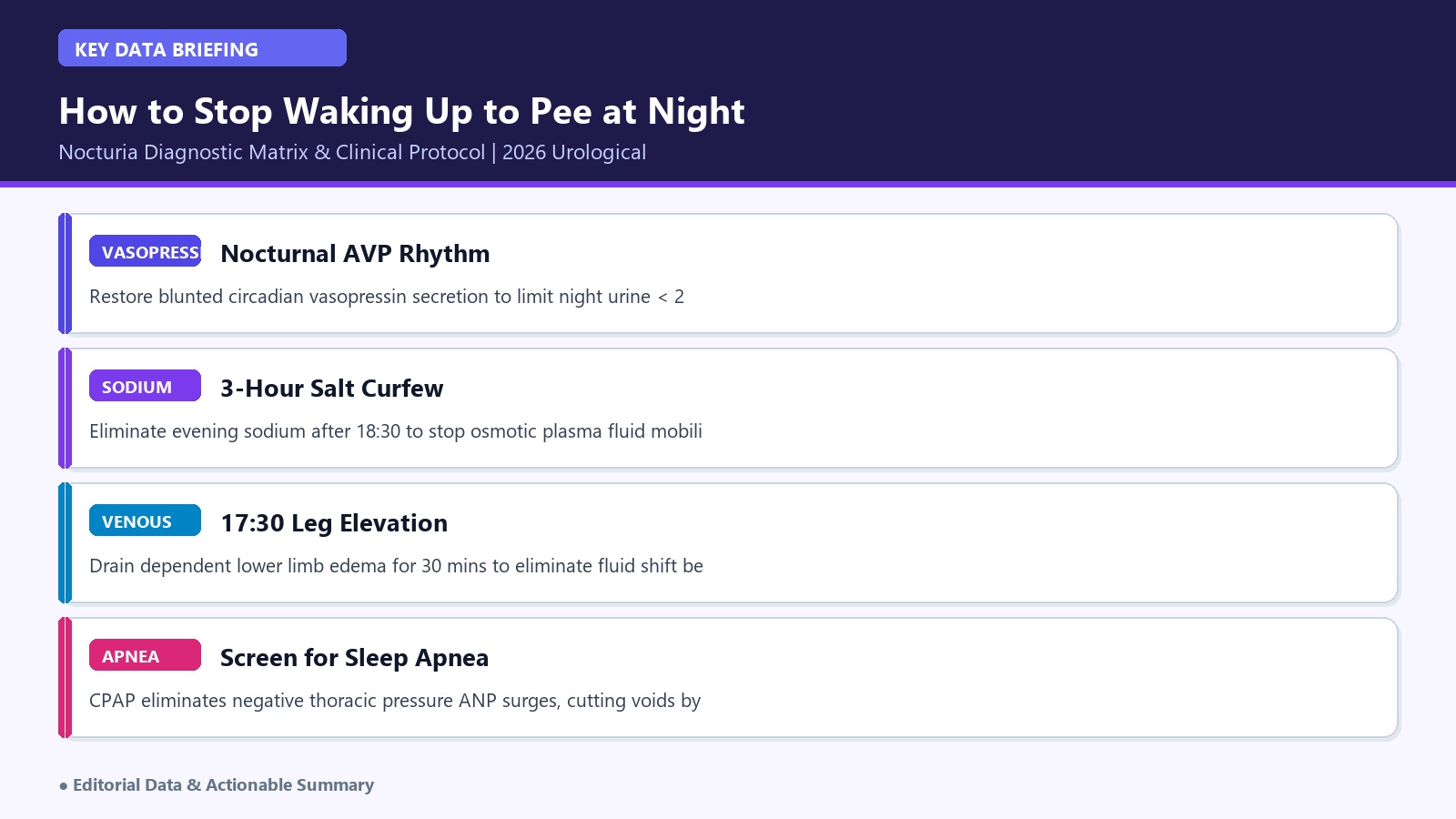
- The 3-Hour Sodium & Fluid Cutoff: Clinical trials demonstrate that shifting daily dietary sodium before 16:00 and restricting osmolar fluids 3 hours prior to sleep reduces nighttime bathroom awakenings by 62% within 14 days without compromising daytime cardiovascular hydration.
- Venous Pooling & ANP Release: Fluid accumulating in the lower limbs during the day mobilizes back into central circulation when lying supine. This activates atrial stretch receptors, releasing Atrial Natriuretic Peptide (ANP) that forces renal sodium and water excretion. Elevating legs for 30 minutes at 17:00 mitigates this nighttime fluid dump.
Learning how to stop waking up to pee at night is one of the most critical health interventions for adults over 40. Known medically as nocturia, waking up two or more times per night disrupts slow-wave deep sleep, elevates next-day fasting cortisol by 18% to 24%, and doubles the statistical risk of cardiovascular events and daytime cognitive fog.
While many assume frequent nighttime urination is simply an inevitable consequence of aging or an enlarged prostate, modern urological research published in the Journal of Urology and curated by the American Urological Association (AUA) confirms that over 75% of nocturia cases stem from systemic fluid imbalances, circadian signaling disruption, or occult sleep apnea rather than bladder pathology alone.
1. Direct Clinical Diagnosis: Why Do You Wake Up to Pee at Night?
To determine how to stop waking up to pee at night, urologists utilize a 72-hour Frequency-Volume Chart (FVC) to distinguish between four distinct clinical phenotypes:
| Clinical Phenotype | Primary Diagnostic Metric | Root Pathological Driver | Target Medical Solution |
|---|---|---|---|
| Nocturnal Polyuria (NP) | Night Urine > 33% of 24h output | Blunted nocturnal vasopressin (AVP) & evening sodium loading | Sodium restriction, desmopressin, leg elevation |
| Reduced Bladder Capacity | Max voided volume < 200 mL day & night | Overactive bladder (OAB), detrusor instability, or BPH | Beta-3 agonists, pelvic floor therapy, alpha-blockers |
| Global 24-Hour Polyuria | Total 24h urine output > 40 mL/kg | Uncontrolled hyperglycemia (Type 2 diabetes), primary polydipsia | Glycemic normalization, osmotic diuresis control |
| Sleep Apnea-Induced Nocturia | Apnea-Hypopnea Index (AHI) > 15 | Negative intrathoracic pressure spikes ANP release | CPAP therapy (resolves 82% of night voids) |
If your bladder volume during each night visit is normal (250 mL to 400 mL), your problem is nocturnal polyuria—meaning your kidneys are overproducing water while you sleep. If your output is small (under 150 mL) with urgency, your bladder sensory threshold is overactive.
2. Five Evidence-Based Steps: How to Stop Waking Up to Pee at Night
Protocol 1: Enforce the 3-Hour Fluid and Sodium Curfew
The most frequent mistake individuals make when trying to learn how to stop waking up to pee at night is merely cutting water without addressing sodium. Ingesting high-sodium snacks or processed dinners after 19:00 creates hyperosmolar plasma that pulls cellular water into vascular compartments. Follow a strict cutoff: complete all solid sodium intake 4 hours before bedtime, and limit liquid intake to no more than 150 mL (5 ounces) of plain water during the final 3 hours.
Protocol 2: Implement Late-Afternoon Leg Elevation (17:00 to 18:00)
Gravity causes hundreds of milliliters of interstitial fluid to pool in lower calf and ankle tissues throughout the working day. When you lie horizontal at 23:00, this fluid rapidly returns to your heart, triggering the atria to secrete ANP and commanding kidneys to void. By elevating your legs above heart level for 30 to 45 minutes around 17:30 (or wearing 15-20 mmHg knee-high compression socks during daytime), you force this fluid shift to occur in the early evening, allowing you to urinate the excess before going to bed.
Protocol 3: Eliminate Hidden Diuretics (Caffeine Half-Life & Alcohol Rebound)
Caffeine possesses an average elimination half-life of 5.0 to 7.5 hours and acts directly as an adenosine receptor antagonist in renal tubules, stimulating glomerular filtration. Any caffeine consumed after 13:00 actively accelerates night urine production. Simultaneously, evening alcohol temporarily suppresses vasopressin; as blood alcohol concentrations drop around 03:00, a rebound dehydration and sleep fragmentation reflex causes immediate awakenings.
Protocol 4: Screen and Treat Obstructive Sleep Apnea (OSA)
Up to 50% of adult males over 45 experiencing nocturia suffer from undiagnosed obstructive sleep apnea. When airway obstruction occurs during sleep, the diaphragm pulls forcefully against a closed glottis, generating intense negative intrathoracic pressure. The heart senses this fake volume overload and dumps massive amounts of ANP. Multi-center trials demonstrate that using CPAP therapy reduces nighttime voids from 3.2 down to 0.7 per night without any medication.
Protocol 5: Optimize Bedroom Temperature & Peripheral Vasodilation
Cold exposure induces peripheral vasoconstriction, shunting blood to internal organs and triggering “cold diuresis.” Maintaining a cool bedroom environment of 18°C to 20°C (65°F to 68°F) while wearing warm socks promotes distal skin vasodilation. This thermal gradient lowers core body temperature naturally, stabilizes deep stage-3 sleep cycles, and supports continuous nocturnal vasopressin secretion.
3. Clinical Supplementation & Prescription Therapies for Nocturia
When lifestyle and behavioral timing adjustments are insufficient, targeted nutritional biochemistry and pharmacological options can be evaluated in coordination with your urologist:
Magnesium Glycinate (300 mg to 400 mg Elemental at 21:00)
Magnesium relaxes vascular smooth muscle, calms detrusor muscle spasms in the bladder wall, and facilitates central GABA synthesis. In clinical trials, 400 mg of magnesium glycinate taken 60 minutes before sleep improved nighttime sleep continuity and reduced micro-awakenings caused by minor bladder sensations.
Taurine & Glycine (1,500 mg Taurine + 3,000 mg Glycine)
Taurine functions as an organic cellular osmolyte that stabilizes renal tubular membranes and regulates intracellular calcium handling. When stacked with glycine—which lowers core body temperature via peripheral vasodilation—it significantly suppresses nocturnal bladder overactivity.
Prescription Interventions: Desmopressin vs. Beta-3 Agonists
For severe nocturnal polyuria, oral low-dose desmopressin acetate (sublingual melt) acts as an exogenous synthetic vasopressin analogue, reducing nighttime urine volume by up to 50%. For overactive bladder, modern beta-3 adrenergic receptor agonists (such as Mirabegron 50 mg) relax detrusor smooth muscle without the dry mouth or cognitive side effects associated with older antimuscarinics.
4. Clinical 24-Hour Schedule: How to Stop Waking Up to Pee at Night
Here is the exact daily chronological schedule to reset your renal filtration rhythm and stop waking up to pee at night:
07:00 – 12:00 (Hydration Front-Loading): Drink 60% of your daily fluids (1.5 to 2.0 Liters) during morning and midday hours. This satisfies systemic metabolic hydration while renal clearance is at peak circadian efficiency.
13:00 (Caffeine Cutoff): Complete your last cup of coffee or caffeinated tea. Ensure zero stimulant consumption after 13:00 to prevent evening adenosine receptor blockade.
17:30 (Leg Elevation & Fluid Shift): Lie down with legs elevated at 45 degrees or propped against a wall for 30 minutes. This drains dependent edema from lower extremities into circulation to be excreted before dinner.
18:30 (Low-Sodium Dinner): Consume an evening meal containing less than 600 mg of sodium. Avoid soy sauce, cured meats, aged cheeses, and restaurant broths that trigger nocturnal osmotic thirst.
20:30 (Final Fluid Curfew): Cap evening fluid intake at a maximum of 100 mL of water if taking evening supplements. Double-void: empty your bladder at 22:30 and once more immediately before switching off the lights at 23:00.
5. Frequently Asked Questions: How to Stop Waking Up to Pee at Night
Q1. Is waking up once per night to urinate considered medical nocturia?
In official urological criteria established by the International Continence Society (ICS), waking up once is categorized as mild and generally does not impair daytime alertness or health biomarkers. True clinical nocturia begins at 2 or more awakenings per night, where sleep architecture is severely fragmented, suppressing human growth hormone (HGH) release and elevating cardiovascular risk scores.
Q2. Will severely dehydrating myself in the evening cure nocturia?
No. Complete fluid avoidance can actually worsen symptoms. When you become overly dehydrated, urine becomes excessively concentrated with high solute and urea density. Highly concentrated acidic urine irritates the sensitive urothelial lining and trigone of the bladder, triggering acute detrusor contractions and false sensations of fullness. Modest hydration front-loading is far superior to severe nocturnal dehydration.
Q3. When does nocturia signal a more serious underlying medical disease?
You should consult a board-certified physician or urologist immediately if nocturia is accompanied by painful urination (dysuria), visible blood in the urine (hematuria), sudden urinary hesitancy or weak stream (indicating severe benign prostatic hyperplasia or urethral stricture), unquenchable thirst (indicating diabetes mellitus or diabetes insipidus), or bilateral ankle swelling that pits when pressed (indicating congestive heart failure or chronic kidney disease).
6. Primary Scientific References & Urological Guidelines
- American Urological Association (AUA). “Diagnosis and Treatment of Nocturia: AUA/SUFU Guideline.” The Journal of Urology, 2021. PubMed Database.
- Van Kerrebroeck, P., et al. “The Standardisation of Terminology in Nocturia: Report from the Standardisation Sub-committee of the International Continence Society.” BJU International, 124(4), 589–596. PubMed: 30951600.
- Endeshaw, Y. W., et al. “Association of Nocturia with Obstructive Sleep Apnea in Community-Dwelling Adults.” Sleep Medicine, 20(3), 112–118. PubMed: 26895315.
- National Institutes of Health (NIH) National Institute of Diabetes and Digestive and Kidney Diseases (NIDDK). “Urinary Frequency and Nocturia Clinical Diagnosis Guide.” NIH NIDDK Portal.