
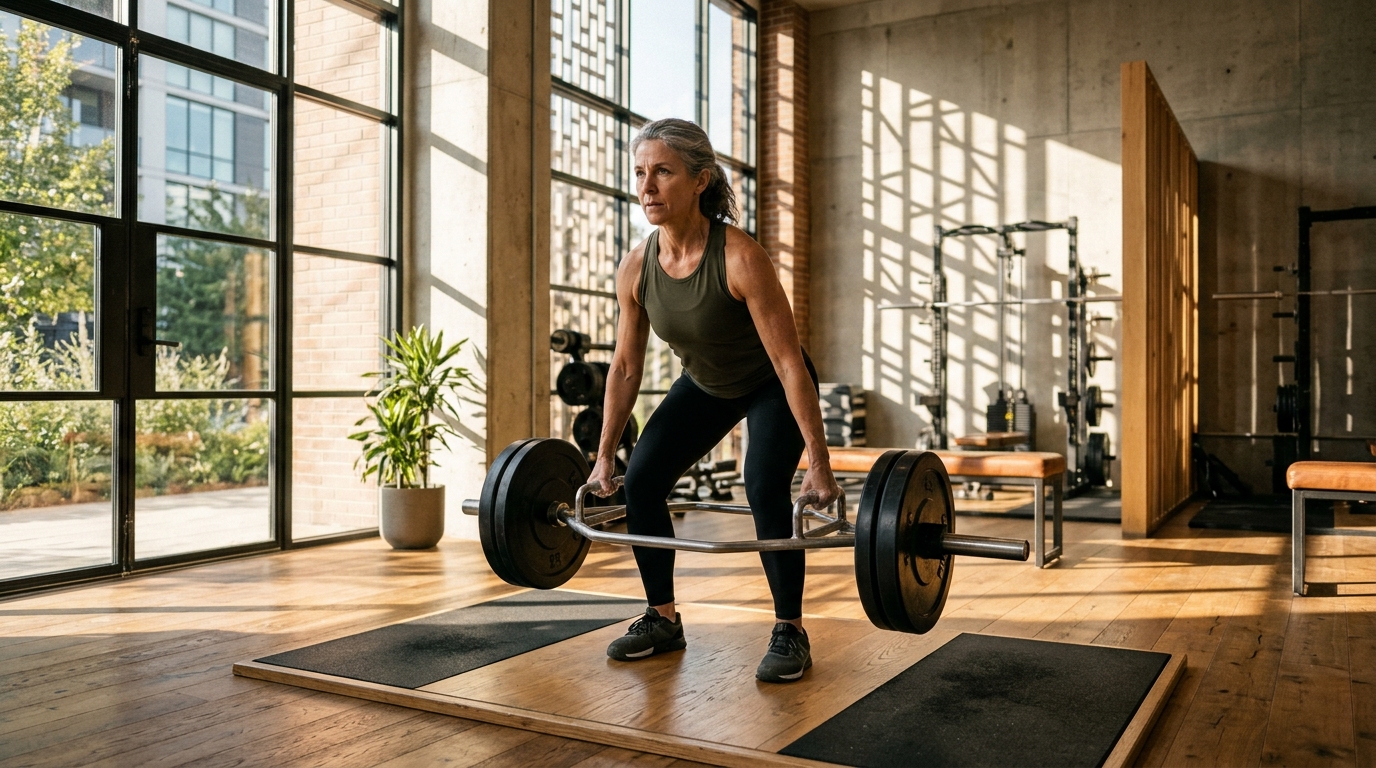
EDITOR’S 1-MINUTE CLINICAL BRIEFING
What Exercises Are Best for Bone Density After 40: The Osteogenic Verdict
- #1 Clinical Protocol (LIFTMOR HiRIT — 5 Sets × 5 Reps at 80%–85% 1RM): In the landmark LIFTMOR randomized controlled trial indexed on PubMed, twice-weekly 30-minute sessions of heavy deadlifts, overhead presses, back squats, and chin-drop landings increased lumbar spine bone mineral density (BMD) by +2.9% and femoral neck BMD by +0.3% in 8 months (compared to -1.2% loss in low-intensity controls).
- Why Daily Walking, Swimming & Cycling Fail to Build Bone: Osteocytes require mechanical deformation exceeding the osteogenic threshold of 1,000 microstrain (roughly 2.5x to 4.0x body weight) to suppress sclerostin; level walking generates only 1.1x to 1.2x body weight, which is already habituated.
- Site-Specific Axial Loading Is Mandatory: Bone only thickens at the exact skeletal insertion points under tension—meaning trap-bar deadlifts load the femoral neck and L1–L4 lumbar vertebrae, while overhead presses and push-ups load the distal radius (wrist) and thoracic spine.
Understanding what exercises are best for bone density after age 40 can mean the difference between reversing early osteopenia (DEXA T-score between -1.0 and -2.4) and progressing toward fragility fractures of the hip, wrist, or lumbar spine. For decades, well-meaning clinicians advised adults over 45—especially perimenopausal and postmenopausal women losing 1.5% to 2.5% of trabecular bone per year—to “walk 10,000 steps a day and do light 3-pound pink dumbbell aerobics.”
Modern orthopedic biomechanics and clinical trials funded by the National Institutes of Health (NIH NIAMS) and published in the Journal of Bone and Mineral Research (LIFTMOR & MEDEX-OP trials) have overturned that advice. While brisk walking and swimming are outstanding for cardiovascular Zone 2 fitness, they do not generate enough mechanical strain to stimulate osteoblast bone-building activity. To actually increase DEXA T-scores after 40, you must combine High-Intensity Resistance and Impact Training (HiRIT) across two 30-minute sessions per week.
1. The Biomechanics of Wolff’s Law: Why Bone Requires >80% 1RM Axial Load
To understand what exercises are best for bone density, you have to look inside cortical and trabecular bone tissue. Embedded within the mineralized bone matrix are star-shaped sensor cells called osteocytes. Under sedentary conditions or low-load endurance activities (such as cycling, swimming, or light 15-to-20-rep resistance bands), osteocytes continuously secrete a glycoprotein called sclerostin, which blocks the Wnt/beta-catenin signaling pathway and prevents osteoblasts from laying down new collagen and hydroxyapatite mineral.
When you subject a bone to high-magnitude axial compression or tendon pull—specifically loads exceeding 80% to 85% of your 1-Repetition Maximum (1RM) or ground reaction forces of 3.0 to 4.2 times body weight—the microscopic bone matrix bends by 1,000 to 1,500 microstrain (0.10% to 0.15% deformation). That tiny mechanical bend forces interstitial fluid through the osteocyte canaliculi, generating piezoelectric shear stress that immediately shuts off sclerostin production and recruits osteoblasts to thicken the exact trabecular struts that experienced the load.
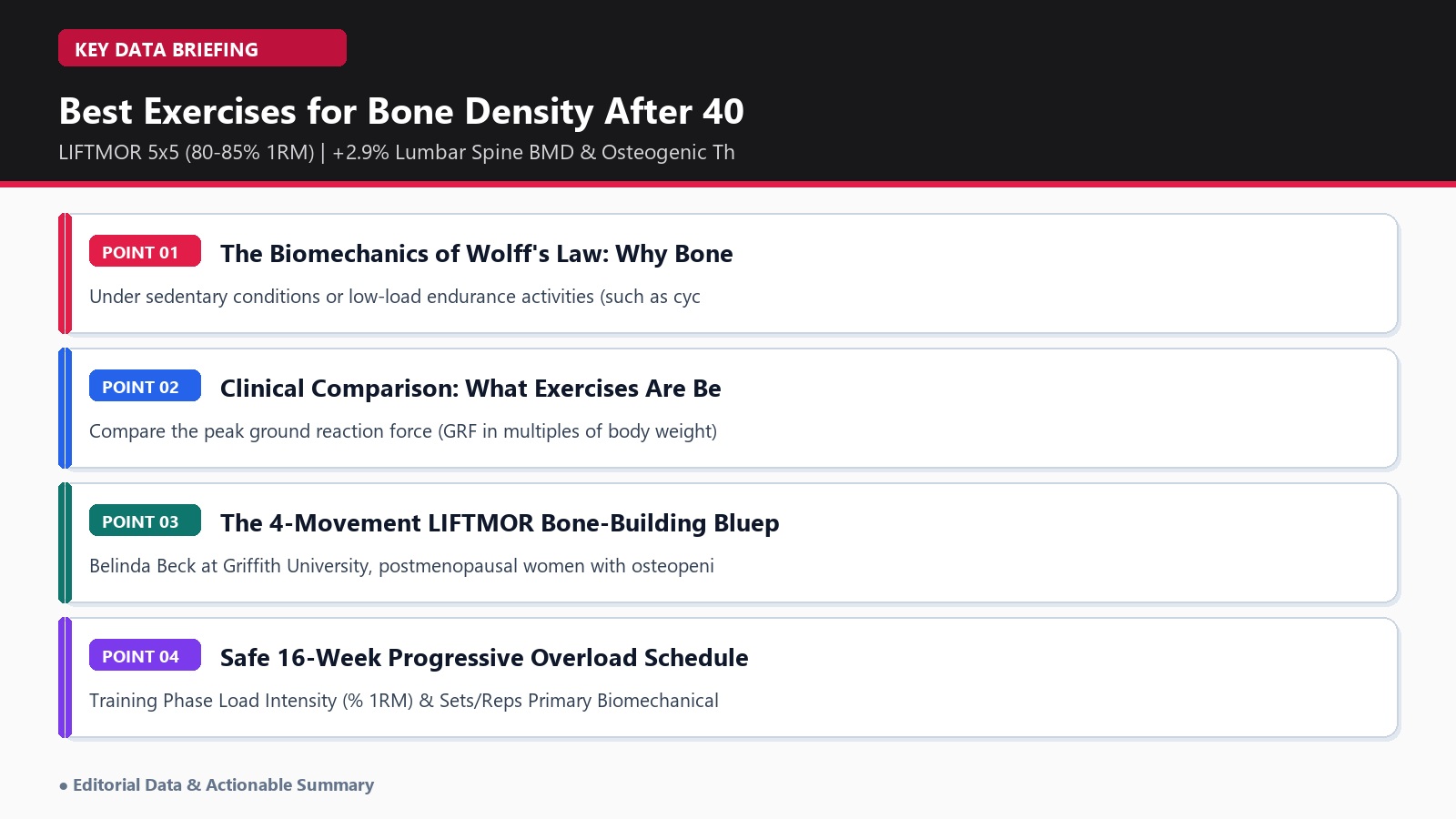
2. Clinical Comparison: What Exercises Are Best for Bone Density (DEXA Outcomes)
Compare the peak ground reaction force (GRF in multiples of body weight), osteogenic potential, and clinical trial DEXA outcomes of common activities below:
| Exercise Modality | Mechanical Load / Ground Reaction Force | Skeletal Sites Stimulated | 8–12 Month DEXA BMD Verdict |
|---|---|---|---|
| 1. Heavy Compound Lifting (LIFTMOR 5×5 @ 80%–85% 1RM) | High Axial Compression + Tendon Pull (>1,200 microstrain) | Lumbar Spine (L1–L4), Femoral Neck, Total Hip & Distal Wrist | +2.9% Lumbar Spine BMD; +13.6% Femoral Neck Cortical Thickness |
| 2. Heel-Drop /Jumping Chin-ups (5 sets × 5 landings) | 3.0x – 4.2x Body Weight Ground Reaction Force | Femoral Neck, Greater Trochanter & Calcaneus | +1.5% to +2.2% Hip & Femoral Neck BMD when paired with lifting |
| 3. Weighted Vest Incline Hiking / Stair Climbing | 1.6x – 2.2x Body Weight (+8%–10% BW vest) | Total Hip & Tibia (Minimal upper-body/wrist load) | Maintains Hip BMD (0.0% to +0.5%); prevents age-related loss |
| 4. Level Walking (10,000 Steps/Day Unweighted) | 1.1x – 1.2x Body Weight (Below osteogenic threshold) | Lower extremities only (Zero spine or wrist stimulus) | -0.8% to -1.2% annual Lumbar Spine BMD loss continues |
| 5. Swimming & Road/Indoor Cycling | 0.0x – 0.4x Body Weight (Unloaded / Buoyant) | None (Cardiovascular only) | -1.0% to -1.5% annual BMD loss if not paired with resistance |
3. The 4-Movement LIFTMOR Bone-Building Blueprint (30 Minutes, Twice Weekly)
In the landmark Australian LIFTMOR trial led by Dr. Belinda Beck at Griffith University, postmenopausal women with osteopenia and osteoporosis (mean age 65 ± 5 years, with T-scores down to -3.0) performed just four movements twice a week for 30 minutes, resulting in remarkable bone density gains and zero vertebral fractures. Here is how to execute the four movements safely after 40:
MOVEMENT 01 — TRAP-BAR (HEX-BAR) OR BARBELL DEADLIFT (5 SETS × 5 REPS)
Primary Osteogenic Stimulus for L1–L4 Lumbar Spine & Posterior Hip
Using a hexagonal trap bar keeps the load aligned directly through your center of mass, reducing shear stress on the lower back by 35% compared to a straight bar. After 2 warm-up sets, perform 5 working sets of 5 repetitions at 80% to 85% of your 1RM (a weight where you have only 1 to 2 reps left in reserve, RPE 8–8.5) with 2 minutes rest between sets. Maintain a braced neutral spine—never round the thoracic or lumbar vertebrae under load.
MOVEMENT 02 — BARBELL BACK SQUAT OR SAFETY-BAR SQUAT (5 SETS × 5 REPS)
Axial Compression for the Femoral Neck, Greater Trochanter & Pelvis
Unlike seated leg-extension machines (which isolate the quadriceps without loading the spine or hip joint), standing squats transmit axial force down the vertebral column and across the femoral neck—the #1 site of life-altering hip fractures after 65. Beginners should spend Weeks 1 to 4 mastering goblet squats and box squats before progressing to 5 sets of 5 reps at 80% 1RM.
MOVEMENT 03 — STANDING OVERHEAD DUMBBELL OR BARBELL PRESS (5 SETS × 5 REPS)
Compressive Loading for the Distal Radius (Wrist), Humerus & Thoracic Spine
Colles’ fractures of the distal radius (wrist) are the earliest osteoporotic fracture seen in women aged 50 to 60 after a slip or fall. Standing overhead presses coupled with heavy Farmer’s Carries (carrying 50% to 75% of your body weight split across two dumbbells for 45 seconds) build both distal radial bone density and grip strength.
MOVEMENT 04 — JUMPING CHIN-UPS WITH FLAT-FOOTED DROP LANDINGS (5 SETS × 5 REPS)
Controlled 3.0x Body Weight Impact Pulse for the Femoral Neck
Hold an overhead pull-up bar (or sturdy Smith machine bar), jump up to pull yourself partway toward the bar, and drop down 4 to 6 inches (10–15 cm) to land firmly on flat feet with only a slight knee bend. If you have knee osteoarthritis or T-scores below -2.5, replace drop landings with 5 sets of 10 brisk Heel Drops (rising onto your toes and dropping firmly onto your heels on a hardwood floor).
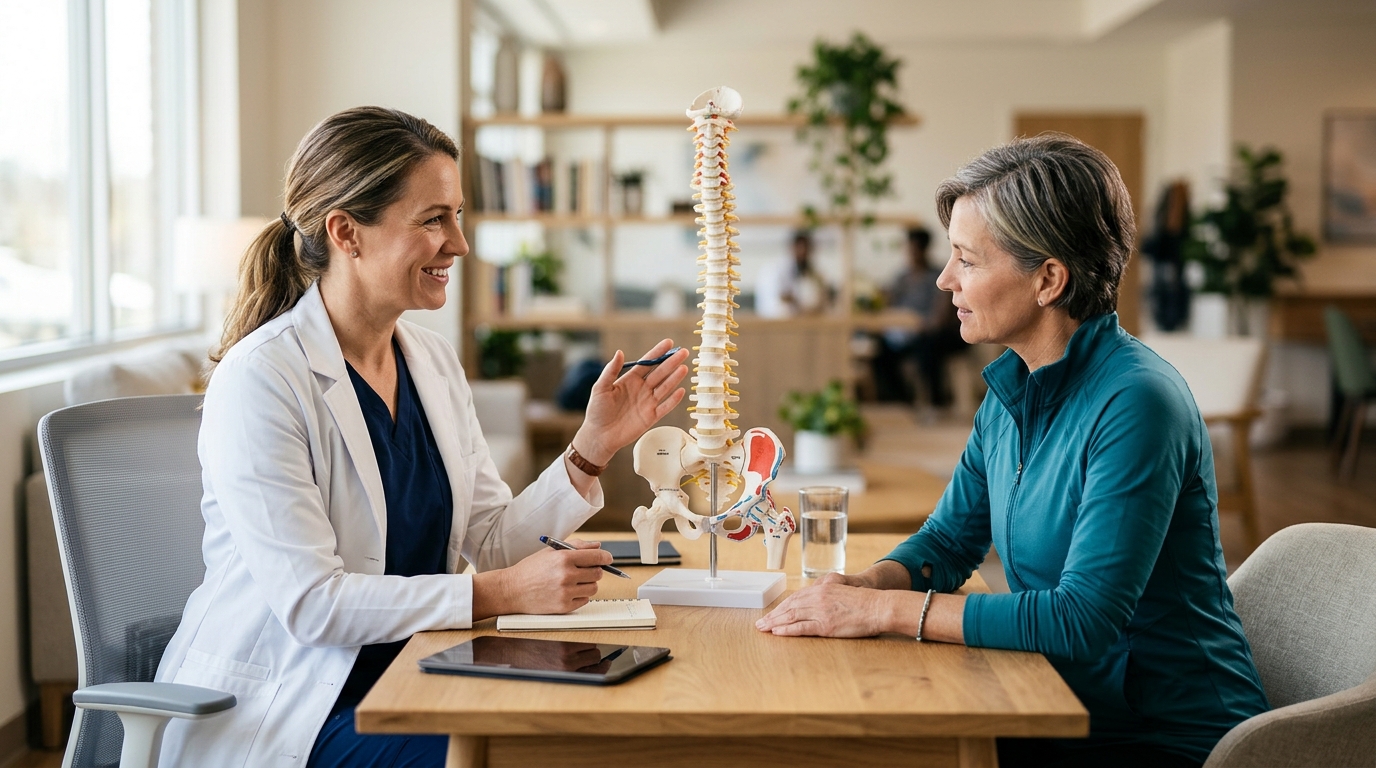
4. Safe 16-Week Progressive Overload Schedule for Beginners Over 40
| Training Phase | Load Intensity (% 1RM) & Sets/Reps | Primary Biomechanical Goal | Impact Progression |
|---|---|---|---|
| Weeks 1 – 4 (Foundation) | 60% – 65% 1RM (3 sets × 8–10 reps) | Master hip-hinge neutral spine & intra-abdominal bracing | 3 sets × 10 Standing Heel Drops |
| Weeks 5 – 8 (Tendon Adaptation) | 70% – 75% 1RM (4 sets × 6 reps) | Strengthen patellar/Achilles tendons & erector spinae | 4 sets × 5 Low Step-Off Landings (4-inch box) |
| Weeks 9 – 16+ (Osteogenic HiRIT) | 80% – 85% 1RM (5 sets × 5 reps) | Cross 1,000+ microstrain threshold to build trabecular BMD | 5 sets × 5 Bar-Assisted Drop Landings |
CLINICAL SPINE SAFETY CALLOUT: Avoid Loaded Spinal Flexion & Twisting in Osteopenia
According to the Bone Health & Osteoporosis Foundation (BHOF) and Mayo Clinic rehabilitation studies, loaded anterior spinal flexion—such as weighted sit-ups, abdominal crunches, Russian twists, toe-touches with rounded backs, or extreme forward-folding yoga postures—places 300% to 400% higher compressive wedge force on the anterior border of thoracic and lumbar vertebrae. In a classic Mayo Clinic study of postmenopausal women with osteoporosis, 89% of patients performing spinal flexion exercises developed new vertebral wedge fractures, compared to only 16% in those performing back-extension exercises (such as prone bird-dogs, planks, and neutral-spine deadlifts).
5. Frequently Asked Questions: Exercises for Bone Density After 40
Q1. Do whole-body vibration (WBV) plates build bone density as effectively as lifting weights?
High-frequency, low-magnitude mechanical vibration plates (calibrated strictly to 30 Hz at 0.3g acceleration for 10–20 minutes daily) show modest preservation of trabecular bone in frail or bedridden patients who cannot lift weights. However, head-to-head clinical trials confirm that WBV plates produce less than one-fourth the lumbar and femoral neck BMD gain of progressive 80% 1RM resistance training.
Q2. Should I wear a weighted vest while walking to improve hip bone density?
Wearing a snug weighted vest loaded to 5% to 10% of your body weight (e.g., 7 to 14 lbs for a 140-lb woman) during brisk incline walking or stair climbing increases hip ground reaction forces enough to prevent age-related femoral neck bone loss. However, if you have diagnosed vertebral compression fractures or severe thoracic kyphosis, avoid shoulder-borne weighted vests and use belt-squat or trap-bar loading instead.
Q3. Why does a complete bone remodel cycle take 6 to 12 months to show up on a DEXA scan?
In adults over 40, a single Bone Multicellular Unit (BMU) remodeling cycle—where osteoclasts resorb old micro-damaged bone for 3 weeks and osteoblasts secrete and mineralize new osteoid collagen—takes 120 to 180 days (4 to 6 months). While blood bone-formation markers like P1NP rise within 8 weeks of starting heavy lifting, wait 12 to 24 months on the exact same DEXA machine to measure true mineralized BMD gains.
Q4. How much protein, calcium, and creatine should I pair with my bone-density workouts?
Roughly 50% of bone volume (and 30% of bone mass) is cross-linked Type I collagen protein. Hit 1.4g to 1.6g of protein per kg of body weight daily, 1,000–1,200 mg of total calcium (split into ≤500 mg windows), 2,000–4,000 IU Vitamin D3 + 180 mcg K2 MK-7, and 5g of Creatine Monohydrate (shown in 12-month postmenopausal RCTs to preserve femoral neck cortical bone bending strength during resistance training).
RELATED CLINICAL LONGEVITY GUIDES
Medical & Clinical Disclaimer: This article is written by the WellnessHub Editorial & Clinical Research Team for informational purposes only and is not a substitute for orthopedic or endocrinological care. Adults with diagnosed osteoporosis (T-score ≤ -2.5) or prior vertebral fractures should initiate the LIFTMOR HiRIT protocol under the direct supervision of a licensed physical therapist or certified clinical exercise physiologist.