
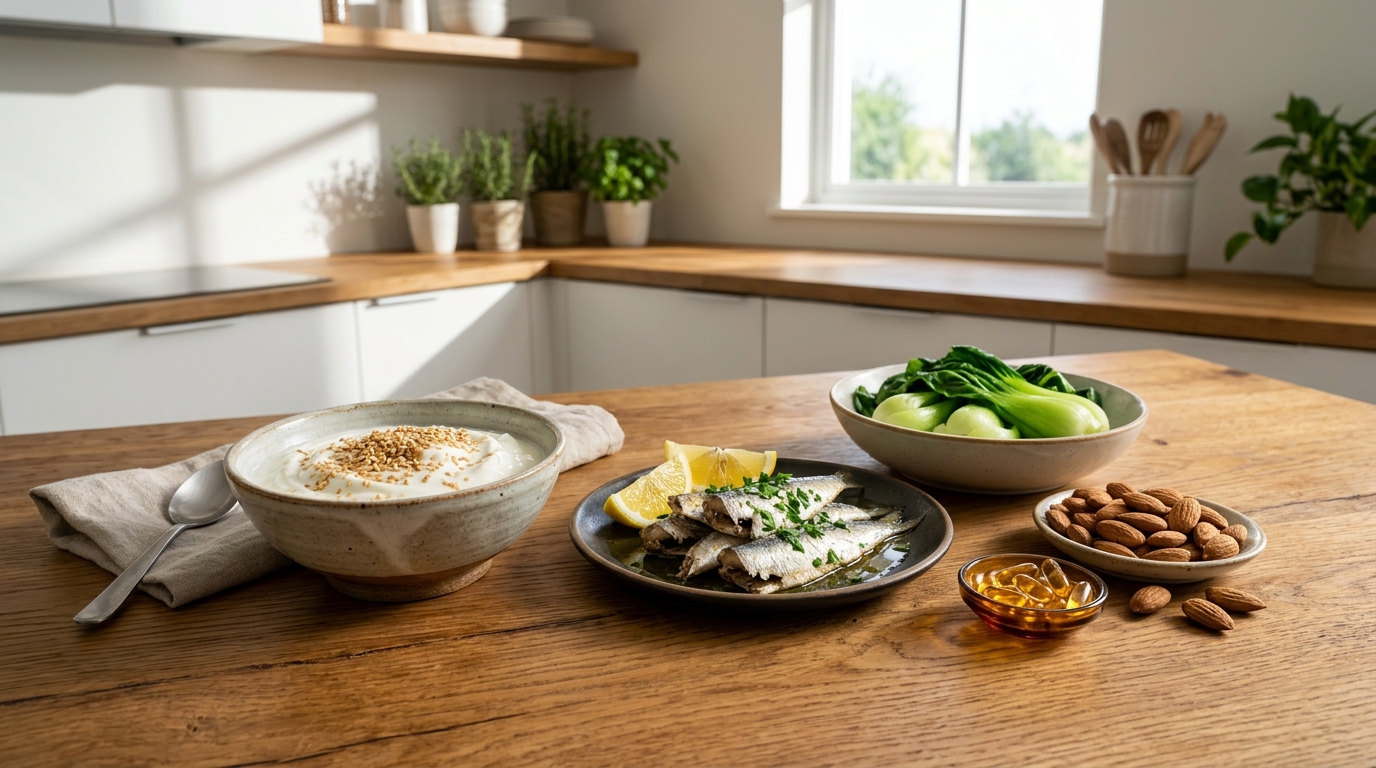
EDITOR’S 1-MINUTE CLINICAL BRIEFING
How to Enhance Calcium Absorption After 40: 3 Core Rules
- Never Exceed 500 mg Elemental Calcium at Once: Active duodenal calcium transport channels (TRPV6 and calbindin-D9k) saturate at 400 mg to 500 mg per meal; taking a single 1,000 mg dose drops fractional absorption from 35% down to 18% and spikes urinary calcium excretion.
- Choose Calcium Citrate Over Carbonate After Age 45: Calcium carbonate requires strong gastric acid (pH < 2.5) and loses 45% to 65% of its bioavailability in adults with age-related low stomach acid or on PPIs, whereas calcium citrate absorbs at 30% to 35% with or without food.
- Pair With Vitamin D3 (2,000 IU) + K2 MK-7 (100–180 mcg): Calcitriol (active vitamin D) unlocks intestinal absorption, while vitamin K2 (MK-7) carboxylates osteocalcin and Matrix Gla Protein (MGP) so absorbed calcium is deposited into trabecular bone rather than coronary arteries.
Knowing how to enhance calcium absorption after 40 is critical because bone mineral density (BMD) declines by 0.5% to 1.0% per year in both men and women starting in the fourth decade of life, accelerating to 2.0% to 3.0% per year during the first five years of menopause. Yet clinical data from the NIH Office of Dietary Supplements reveals a widespread paradox: millions of adults over 40 swallow 1,000 mg to 1,200 mg of elemental calcium daily, yet still develop osteopenia (DEXA T-score between -1.0 and -2.5) while facing higher rates of kidney stones and vascular calcification.
The problem is rarely total calcium intake alone—it is fractional intestinal absorption and skeletal routing. Between age 30 and age 60, net intestinal calcium absorption efficiency drops from roughly 35%–40% down to 20%–25% due to declining gastric hydrochloric acid, reduced renal conversion of 25-hydroxyvitamin D into active 1,25-dihydroxyvitamin D (calcitriol), and estrogen-related downregulation of duodenal calcium transporters. Below is the step-by-step clinical protocol to maximize every milligram of dietary and supplemental calcium you consume.
1. The 4-Step Protocol: How to Enhance Calcium Absorption After 40
STEP 01 — RESPECT THE 500 MG TRANSPORTER CEILING
Split Your Daily 1,000–1,200 mg Target Into 300–450 mg Windows
Active transcellular calcium absorption in the duodenum relies on saturable TRPV6 apical channels and the transport protein calbindin-D9k. Clinical pharmacokinetic tracer studies prove that fractional absorption peaks at 34% to 38% when a single dose is 300 mg to 450 mg, but plummets below 20% when you consume 800 mg to 1,000 mg in one sitting. Aim for 700 mg to 800 mg from whole foods split across breakfast and lunch, and add no more than 300 mg to 400 mg of supplemental calcium at dinner if needed to reach the 1,000 mg (men 40–70) or 1,200 mg (women 51+) RDA.
STEP 02 — OPTIMIZE SERUM 25(OH)D TO 40–60 NG/ML
Unlock Intestinal Calbindin Synthesis With Vitamin D3 + Magnesium
Without sufficient active vitamin D, your small intestine absorbs only 10% to 15% of dietary calcium via passive paracellular diffusion. Maintaining serum 25(OH)D between 40 and 60 ng/mL (typically requiring 2,000 IU to 4,000 IU of Vitamin D3 daily with a fat-containing meal) increases intestinal calcium absorption by 2.5-fold (up to 35%–40%). Crucially, the liver and kidney enzymes that activate vitamin D (25-hydroxylase and 1-alpha-hydroxylase) are 100% magnesium-dependent—pair your protocol with 250 mg to 350 mg of elemental magnesium glycinate taken at least 2 hours apart from large calcium boluses.
STEP 03 — ACTIVATE OSTEOCALCIN & MGP WITH VITAMIN K2 (MK-7)
Direct Absorbed Calcium Into Trabecular Bone Instead of Arteries
Enhancing intestinal absorption is only half the equation; once calcium enters the bloodstream, it must be bound to bone matrix. Osteoblasts secrete a hormone called osteocalcin, while vascular smooth muscle cells secrete Matrix Gla Protein (MGP). Both proteins remain inactive (undercarboxylated) unless activated by 100 mcg to 180 mcg of Vitamin K2 (menaquinone-7, MK-7) daily. In a 3-year randomized controlled trial of 244 postmenopausal women, 180 mcg/day of MK-7 significantly reduced age-related bone mineral loss at the lumbar spine and femoral neck while improving arterial elasticity.
STEP 04 — SEPARATE PHYTATES, OXALATES, CAFFEINE & IRON BY 2 HOURS
Eliminate Intraluminal Chelation and Urinary Calcium Wasting
Oxalic acid (in raw spinach, rhubarb, and beet greens) and phytic acid (in unsoaked wheat bran) bind ionic calcium in the gut lumen to form insoluble salts: fractional calcium absorption from raw spinach is just 5.1%, compared to 52.6% to 58.8% from low-oxalate bok choy, kale, and broccoli. In addition, consuming more than 300 mg of caffeine or 2,300 mg of sodium daily increases renal urinary calcium loss by 15 mg to 40 mg per day.
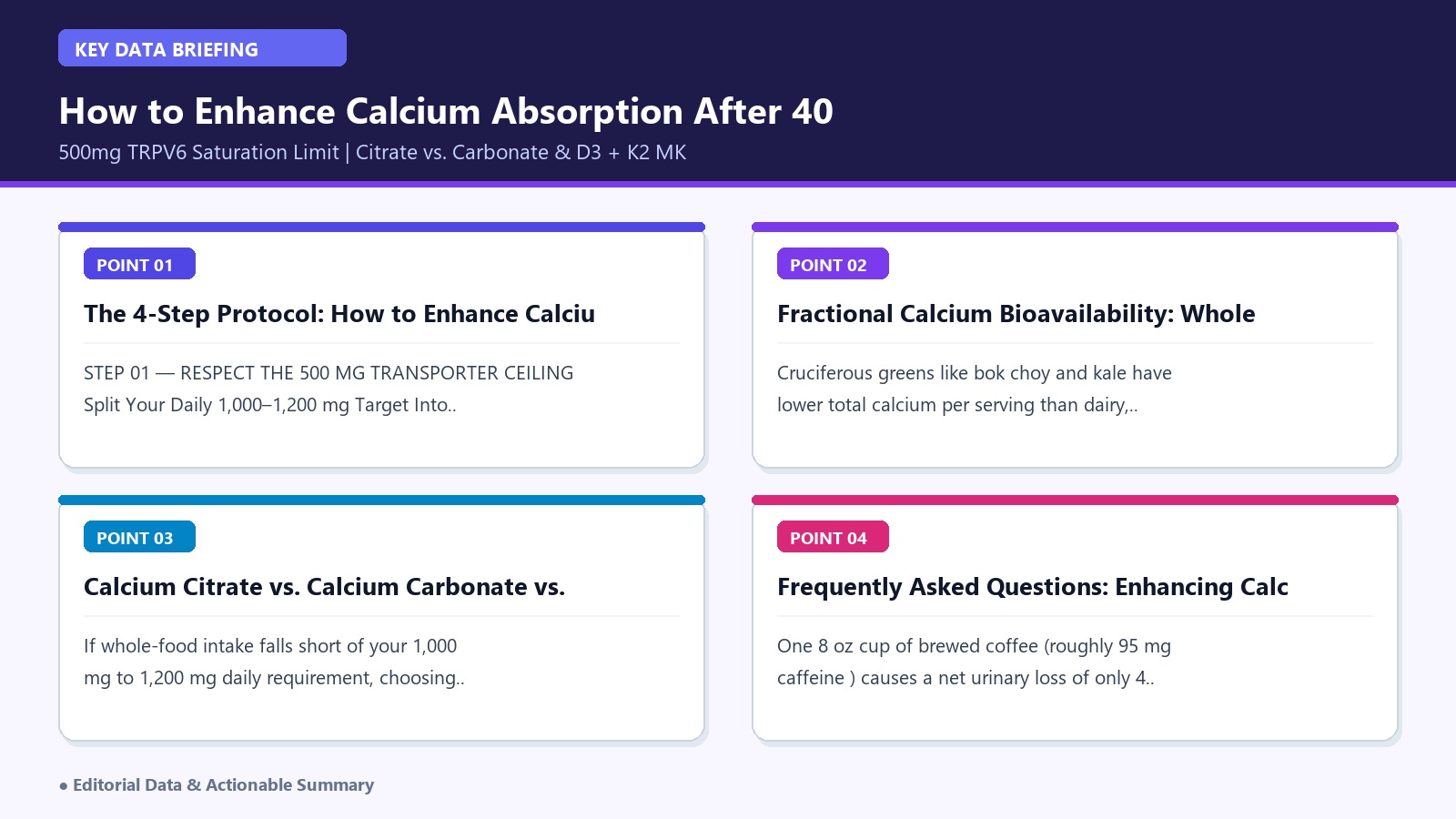
2. Fractional Calcium Bioavailability: Whole Foods vs. Supplements Compared
A food’s milligram label does not equal the milligrams absorbed into your bloodstream. Cruciferous greens like bok choy and kale have lower total calcium per serving than dairy, yet their 50%+ fractional absorption rate delivers almost as much net bioavailable calcium as a glass of milk—without lactose or saturated fat. Compare the clinical absorption metrics below from Harvard Health and NIH metabolic balance studies:
| Calcium Source & Serving Size | Total Elemental Calcium | Fractional Absorption (%) | Net Absorbed Calcium (mg) |
|---|---|---|---|
| 1. Steamed Bok Choy / Kale (1 cup / 150g) | 160 mg | 52.6% – 58.8% (Ultra-Low Oxalate) | 84 mg – 94 mg |
| 2. Canned Wild Sardines With Bones (85g) | 325 mg (+ 180 IU Vitamin D3) | 33.0% – 36.0% (Natural Microcrystalline) | 107 mg – 117 mg |
| 3. Plain Greek Yogurt / Kefir (200g) | 230 mg – 260 mg | 32.1% (Lactic Acid + Casein Peptides) | 74 mg – 83 mg |
| 4. Calcium Set Tofu (1/2 cup / 125g) | 350 mg (+ Soy Isoflavones) | 31.0% | 108 mg |
| 5. Cooked Spinach (1 cup / 180g) | 245 mg | 5.1% (Blocked by 750 mg Oxalate) | Only 12.5 mg |
3. Calcium Citrate vs. Calcium Carbonate vs. MCHA After Age 40
If whole-food intake falls short of your 1,000 mg to 1,200 mg daily requirement, choosing the right supplemental salt determines whether the mineral enters your bone matrix or causes bloating, constipation, and renal stones. Because basal gastric acid output declines by 25% to 40% in adults over 50, acid-independent forms outperform standard calcium carbonate:
| Supplement Form | Elemental Calcium % | Stomach Acid Dependency & GI Tolerance | Best Clinical Use Case After 40 |
|---|---|---|---|
| Calcium Citrate | 21% Elemental | Acid-independent; absorbs fasting or with meals; urinary citrate inhibits kidney stones | 1st Choice for adults 45+, PPI users, and stone formers (300–400 mg dose) |
| Microcrystalline Hydroxyapatite (MCHA) | 22% – 25% Elemental (+ Phosphorus & Type I Collagen) | Slower, sustained release without acute serum calcium spikes | 1st Choice for postmenopausal osteopenia/osteoporosis bone matrix support |
| Calcium Carbonate | 40% Elemental | Requires gastric pH < 2.5; causes CO2 gas, bloating, and constipation | Must be taken strictly mid-meal with acidic food; avoid if taking acid blockers |

CLINICAL DRUG INTERACTION CALLOUT: Levothyroxine, Iron & Antibiotics
Divalent calcium ions (Ca2+) directly chelate thyroid hormone medications and several classes of antibiotics in the digestive tract. According to FDA and Mayo Clinic clinical pharmacology standards, you must separate calcium supplements by at least 4 hours from levothyroxine (Synthroid), 2 to 4 hours from fluoroquinolone or tetracycline antibiotics, and 2 hours from oral iron or zinc supplements.
4. Frequently Asked Questions: Enhancing Calcium Absorption After 40
Q1. Does drinking morning coffee block calcium absorption?
One 8 oz cup of brewed coffee (roughly 95 mg caffeine) causes a net urinary loss of only 4 to 6 mg of calcium, which is easily offset by adding 2 tablespoons (30 mL) of milk or yogurt. However, exceeding 350 mg to 400 mg of caffeine per day (4+ cups) without hitting at least 800 mg of dietary calcium measurably accelerates femoral neck bone loss in postmenopausal women. Wait 60 minutes after morning coffee before taking a calcium supplement.
Q2. Should I take calcium and magnesium together at night?
In small whole-food amounts, calcium and magnesium absorb well together. However, when taking concentrated supplements, a high bolus of calcium (>500 mg) competes with magnesium for paracellular intestinal transport and renal tubular reabsorption. For maximum bioavailability, take your 300–400 mg calcium citrate with lunch or dinner, and take 250–350 mg magnesium glycinate 60 minutes before bedtime.
Q3. How do prebiotic fibers like inulin enhance calcium absorption in the colon?
While 85% of calcium absorption occurs in the upper small intestine, roughly 10% to 15% can be rescued in the cecum and ascending colon. Soluble prebiotic fibers (such as 5g to 8g of chicory inulin, garlic, leeks, and asparagus) are fermented by Bifidobacteria into short-chain fatty acids (butyrate and propionate), which lower colonic pH, re-ionize unabsorbed calcium precipitates, and boost net calcium retention by an additional 8% to 12%.
Q4. Why is resistance training essential for calcium retention in bone after 40?
According to Wolff’s Law of bone remodeling, osteocytes embedded in cortical and trabecular bone require mechanical strain (weight-bearing impact and progressive resistance loading at 70% to 80% of 1-rep max, 2 to 3 times weekly) to suppress sclerostin and stimulate osteoblast mineralization. Without mechanical loading, even optimal intestinal calcium absorption cannot increase hip or lumbar spine DEXA T-scores.
RELATED CLINICAL LONGEVITY GUIDES
Medical & Clinical Disclaimer: This guide is published by the WellnessHub Editorial & Clinical Research Team for informational purposes only and is not a substitute for individualized medical advice, DEXA bone density evaluation, or parathyroid workup. Always consult your physician before starting calcium or vitamin D3/K2 supplementation, particularly if you have hypercalcemia, chronic kidney disease, or take prescription thyroid or cardiac medications.