
EDITOR’S 1-MINUTE CLINICAL BRIEFING
Soluble Fiber Foods for High Cholesterol: Key Lipid-Lowering Numbers
- Clinical Target (10g to 15g Viscous Soluble Fiber/Day): While total fiber recommendations are 25g to 38g/day, meta-analyses indexed on PubMed prove that every 5g to 10g of viscous soluble fiber from soluble fiber foods for high cholesterol lowers LDL-C by 5.5% to 14.8% and Apolipoprotein B (ApoB) by 6% to 12% within 4 to 6 weeks.
- Viscosity Matters More Than Total Fiber Grams: Non-viscous soluble fibers (like wheat dextrin or inulin) do not lower LDL cholesterol; you must consume gel-forming viscous fibers—specifically psyllium arabinoxylan, oat/barley beta-glucan, ground flaxseed mucilage, and legume pectin.
- Bile Acid Sequestration Without CoQ10 Depletion: Viscous soluble fiber traps cholesterol-rich bile acids in the terminal ileum, forcing the liver to upregulate CYP7A1 and hepatic LDL receptors to pull atherogenic LDL particles out of circulation.
Prioritizing targeted soluble fiber foods for high cholesterol is the single most effective dietary intervention for lowering low-density lipoprotein cholesterol (LDL-C), non-HDL cholesterol, and Apolipoprotein B (ApoB) after age 40. Between ages 40 and 60, hepatic LDL-receptor expression slows by roughly 15% to 25%—driven by declining estrogen in perimenopausal women, reduced thyroid T3 signaling, and age-related changes in bile acid synthesis. As a result, atherogenic LDL particles circulate in the bloodstream for 3.5 to 4.5 days instead of the youthful 2.0 days, increasing the probability that particles penetrate the arterial endothelium.
Yet most adults over 40 who try to “eat more fiber” for high cholesterol consume primarily insoluble cellulose (such as wheat bran, celery stalks, or leafy greens). While insoluble fiber increases stool bulk, clinical trials reviewed by the American Heart Association (AHA) and FDA confirm that insoluble fiber has virtually zero effect on serum LDL-C. To clear cholesterol from your blood, you need high-molecular-weight viscous soluble fiber that forms a thick, bile-trapping hydrogel in your small intestine.
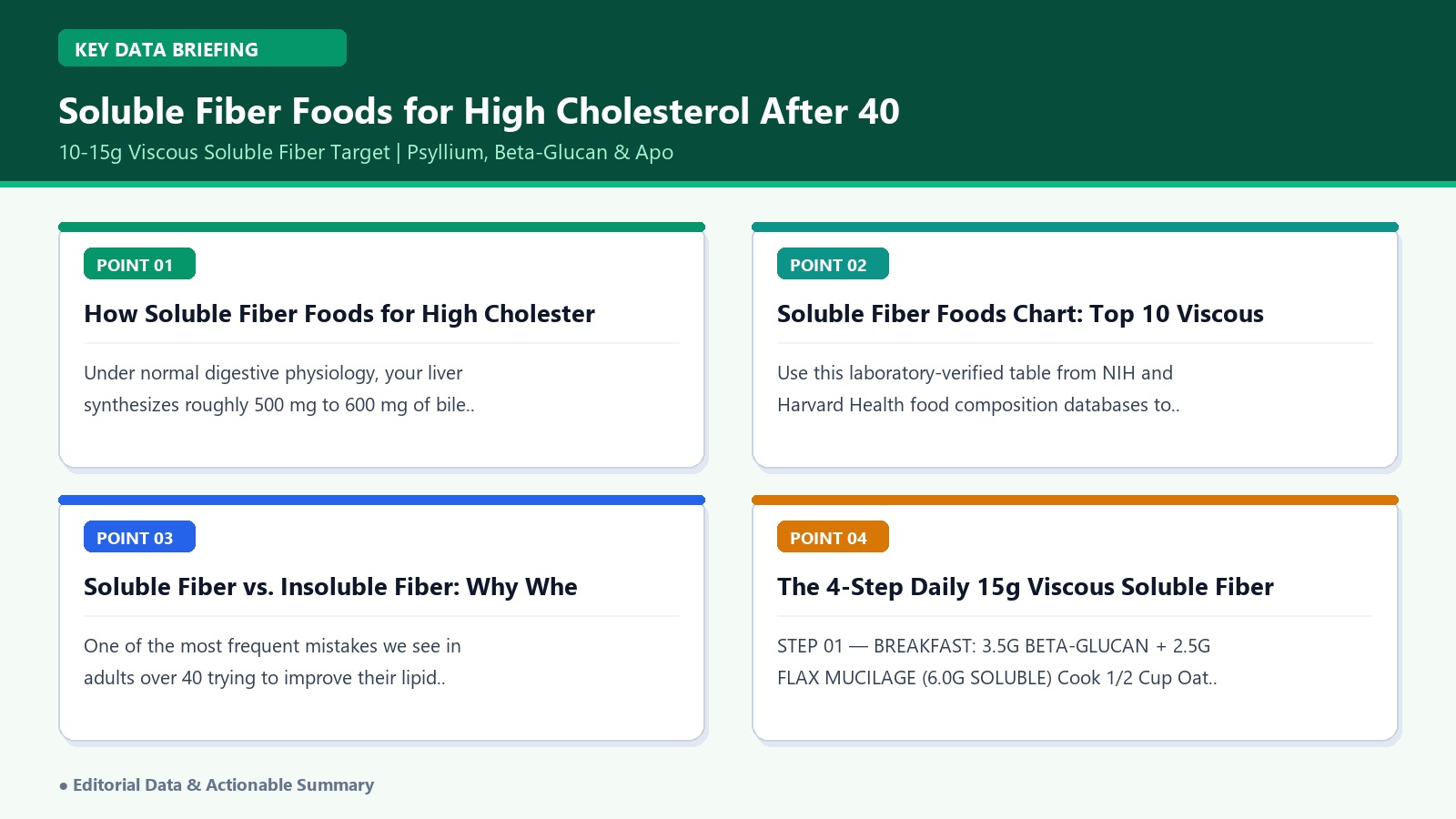
1. How Soluble Fiber Foods for High Cholesterol Clear ApoB via Bile Acid Interruption
Under normal digestive physiology, your liver synthesizes roughly 500 mg to 600 mg of bile acids every day using intrahepatic cholesterol as the raw building block. Those bile acids are secreted via the gallbladder into the duodenum to emulsify dietary fats. Once fat digestion is complete, 95% of bile acids are reabsorbed in the terminal ileum via the apical sodium-dependent bile acid transporter (ASBT) and recycled back to the liver (enterohepatic circulation).
When you consume 10g to 15g per day of gel-forming soluble fiber from soluble fiber foods for high cholesterol, the hydrated polysaccharide matrix physically entraps both bile acids and dietary cholesterol micelles in the jejunum and ileum, increasing fecal bile acid excretion by 40% to 80%. Starved of recycled bile acids, hepatocytes activate the rate-limiting enzyme cholesterol 7-alpha-hydroxylase (CYP7A1) and express more surface LDL receptors (LDLR) to pull ApoB-containing LDL particles out of your bloodstream—the exact same downstream clearance mechanism used by prescription bile acid sequestrants and ezetimibe, without gastrointestinal toxicity.
2. Soluble Fiber Foods Chart: Top 10 Viscous Sources & Exact Grams Per Serving
Nutrition facts labels in the United States often list only “Total Dietary Fiber,” hiding how much of that fiber is actually viscous soluble fiber. Use this laboratory-verified table from NIH and Harvard Health food composition databases to hit your daily 12g to 15g viscous soluble fiber target:
| Food Source & Standard Serving | Viscous Soluble Fiber (g) | Total Fiber (g) | Bioactive Gel Polymer & Clinical Effect |
|---|---|---|---|
| 1. Whole Psyllium Husk (1.5 tbsp / 10g) | 7.0 g Soluble | 8.5 g Total | Arabinoxylan hydrogel; 10g/day lowers LDL-C by 10%–14% & ApoB by 8% |
| 2. Cooked Black Beans or Navy Beans (1 cup / 172g) | 4.8 g Soluble | 15.0 g Total | Pectin + resistant starch; colonic propionate inhibits hepatic HMG-CoA |
| 3. Hulled Barley or Oat Bran (1/2 cup dry / 48g) | 3.2 g – 3.8 g Soluble | 7.2 g Total | (1→3)(1→4)-Beta-D-Glucan; hits full 3.0g FDA cardioprotective threshold |
| 4. Ripe Hass Avocado (1 medium / 150g) | 3.0 g – 3.4 g Soluble | 10.0 g Total | Soluble hemicellulose + 114 mg beta-sitosterol; clears small dense LDL |
| 5. Freshly Ground Flaxseed (2 tbsp / 20g) | 2.2 g – 2.6 g Soluble | 5.6 g Total | Mucilage gum + SDG lignans; lowers Lp(a) by 8%–10% and LDL-C by 12% |
| 6. Chia Seeds Hydrated in Liquid (2 tbsp / 24g) | 2.0 g – 2.4 g Soluble | 8.2 g Total | Exudes viscous glucuronic acid capsule when soaked 15 mins in water |
| 7. Steamed Brussels Sprouts or Okra (1 cup / 156g) | 2.0 g – 2.5 g Soluble | 4.5 g Total | Rhamnogalacturonan mucilage; steaming increases bile binding by 30% |
3. Soluble Fiber vs. Insoluble Fiber: Why Wheat Bran & Inulin Do Not Lower LDL-C
One of the most frequent mistakes we see in adults over 40 trying to improve their lipid panel is buying processed “high-fiber” bars or powders loaded with chicory root inulin, soluble corn fiber (maltodextrin), or wheat dextrin (Benefiber). While these fibers dissolve in water—technically qualifying as “soluble” on a food label—they are non-viscous: they do not form a thick gel in the small intestine and therefore cannot trap bile acids.
| Fiber Category | Representative Sources | Small Intestine Gel Viscosity | Clinical LDL-C & ApoB Reduction |
|---|---|---|---|
| 1. Viscous, Gel-Forming Soluble Fiber | Psyllium husk, Oat/Barley beta-glucan, Flaxseed, Okra, Beans, Apple Pectin | High (Traps bile acids & slows glucose absorption) | -10% to -22% LDL-C (When combined with 2g plant sterols) |
| 2. Non-Viscous Fermentable Soluble Fiber | Wheat dextrin, Chicory inulin, Acacia gum, Polydextrose | Zero Viscosity (Liquid-thin in gut lumen) | 0% to -2% (Prebiotic only; negligible bile binding) |
| 3. Insoluble Structural Fiber | Wheat bran, Celery, Cauliflower stems, Vegetable skins | Zero Viscosity (Mechanical laxative effect) | 0% LDL-C change (Improves transit time only) |

4. The 4-Step Daily 15g Viscous Soluble Fiber Protocol (Without Bloating)
STEP 01 — BREAKFAST: 3.5G BETA-GLUCAN + 2.5G FLAX MUCILAGE (6.0G SOLUBLE)
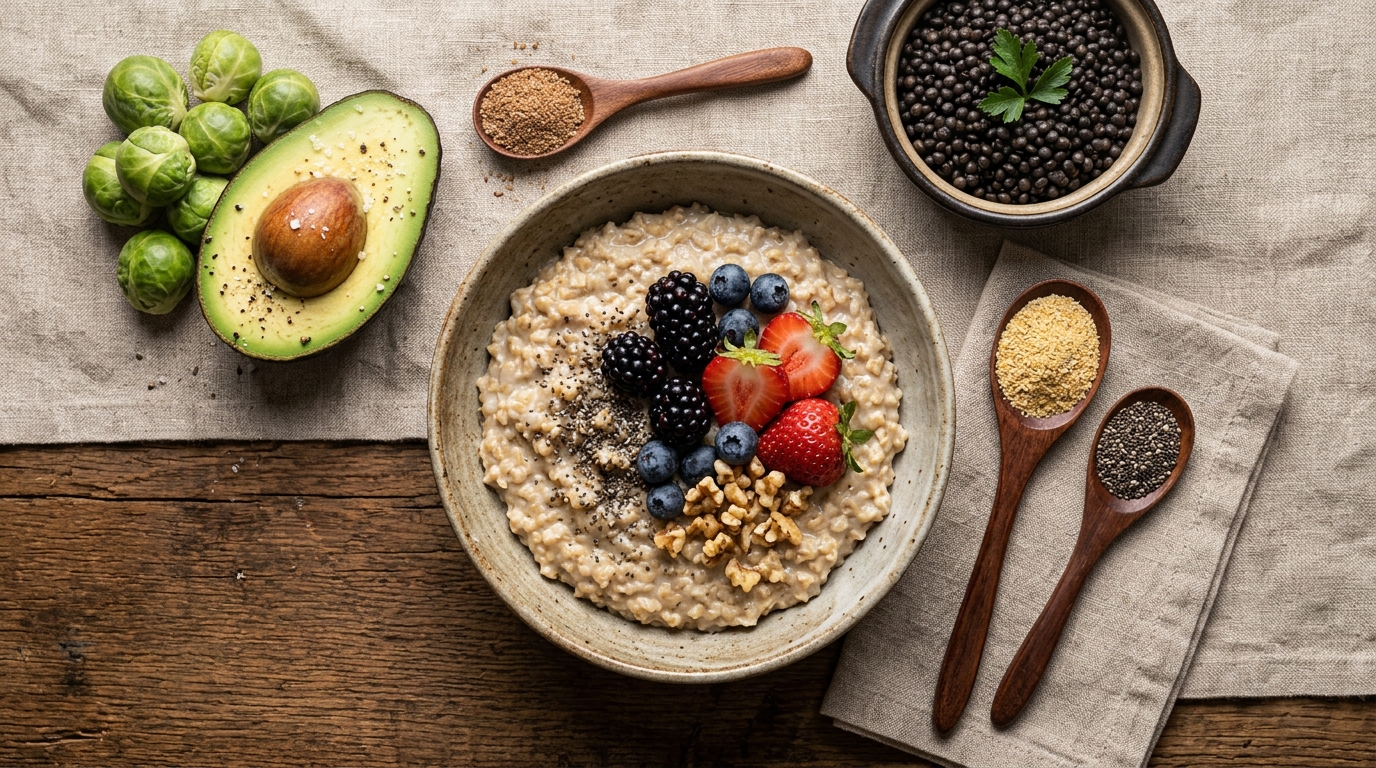
Cook 1/2 Cup Oat Bran or Steel-Cut Oats Topped With 2 Tbsp Ground Flaxseed
Avoid instant flavored oatmeal packets, where mechanical rolling and high-heat processing cleave long-chain beta-glucan polymers and lower viscosity by 40%. Simmer 48g of oat bran or steel-cut oats for 8 to 15 minutes until creamy, then stir in 20g of freshly ground golden flaxseed and 100g of blackberries. This single meal delivers 6.0g of viscous soluble fiber before 9:00 AM.
STEP 02 — LUNCH: 1 CUP BLACK BEANS OR LENTILS + 1/2 AVOCADO (5.2G SOLUBLE)
Pair Canned Rinsed Legumes With Monounsaturated Phytosterols
To eliminate oligosaccharide gas (raffinose and stachyose) from beans, rinse canned black beans or lentils under cold running water for 30 seconds until the foam disappears—removing 45% of gas-forming FODMAP sugars while preserving 100% of the intracellular pectin soluble fiber.
STEP 03 — PRE-DINNER: 5G WHOLE PSYLLIUM HUSK IN 300 ML WATER (3.5G SOLUBLE)
Time Psyllium 10 Minutes Before Dinner When Gallbladder Contraction Peaks
Because bile acid secretion into the duodenum is triggered by cholecystokinin (CCK) during fat-containing meals, drinking 1 rounded teaspoon (5g) of whole psyllium husk stirred into 300 mL of water 10 minutes before dinner places the hydrogel in the small intestine at the exact moment your gallbladder empties.
STEP 04 — TITRATE BY +3G PER WEEK WITH 35 ML/KG HYDRATION
Prevent Constipation & Keep Medications 2 Hours Away From Psyllium
Jumping from 3g to 15g of soluble fiber overnight without extra water causes abdominal cramping and slow transit. Increase soluble fiber by 3g every 5 to 7 days while drinking an extra 250 mL of water per 5g of fiber, and separate psyllium husk by at least 2 hours from prescription statins, thyroid hormone, and fat-soluble vitamins (D3, K2, CoQ10).
CLINICAL SAFETY CALLOUT: Heavy Metal (Lead) Testing in Psyllium Husk Brands
Plantago ovata (psyllium) plants grown in contaminated soils can bioaccumulate inorganic lead in the outer seed coat. Independent third-party laboratory testing (such as ConsumerLab analyses) has found lead levels ranging from 0.4 mcg to over 8.5 mcg per 10g serving across commercial psyllium products. Choose organic whole psyllium husk brands that publish batch-specific Certificates of Analysis (COA) verifying lead < 0.5 mcg per serving, or rotate psyllium with oat beta-glucan and ground flaxseed.
5. Frequently Asked Questions: Soluble Fiber Foods for High Cholesterol
Q1. Can soluble fiber lower cholesterol as much as a low-dose statin, or can they be combined?
On its own, 10g to 15g/day of viscous soluble fiber lowers LDL-C by 10% to 15%, and when combined with 2g plant sterols and 45g almonds (the Portfolio Diet), LDL-C drops by 25% to 29%—equivalent to 20 mg of lovastatin. Furthermore, in clinical trials published in JAMA Internal Medicine, adding 10g/day of psyllium to a 10 mg statin produced the same LDL-C reduction as doubling the statin to 20 mg, allowing patients to avoid high-dose statin muscle myalgia.
Q2. Does blending fruit or oats in a high-speed smoothie destroy soluble fiber?
No—in fact, mechanical blending of seeded fruits (like blackberries, raspberries, and apples) or flax/chia seeds ruptures intact plant cell walls and releases more soluble pectin and mucilage into the liquid phase, which actually flattens the postprandial glucose and triglyceride curve compared to eating whole unchewed seeds.
Q3. How long does it take to see a drop in LDL-C and ApoB on a blood test after increasing soluble fiber?
Because the circulating half-life of plasma LDL particles is 3 to 4 days, measurable reductions in serum LDL-C and ApoB begin within 14 days and reach maximal steady-state reduction at 4 to 6 weeks. Schedule your follow-up fasting lipid panel and ApoB blood test after 6 weeks of consistent 12g–15g daily viscous soluble fiber intake.
Q4. Does soluble fiber also lower high triglycerides and fasting blood sugar after 40?
Yes. By increasing the viscosity of chyme in the duodenum, soluble fiber slows alpha-amylase starch digestion, reducing post-meal glucose spikes by 20% to 35% and blunting hepatic de novo lipogenesis (the conversion of excess carbohydrate into VLDL triglycerides).
RELATED CLINICAL LONGEVITY GUIDES
Medical & Clinical Disclaimer: This article is prepared by the WellnessHub Editorial & Clinical Research Team for informational purposes only and is not a substitute for personalized medical advice or lipid-lowering pharmacotherapy. Individuals with familial hypercholesterolemia (LDL-C >190 mg/dL), elevated Lp(a), or bowel strictures should consult their cardiologist or gastroenterologist before modifying therapy, per American Heart Association guidelines.