
Mitochondrial Coenzyme Q10 & Statin Myopathy Decision
Ubiquinol vs Ubiquinone for Statin Muscle Pain: The 2026 Bioavailability & Dosage Decision
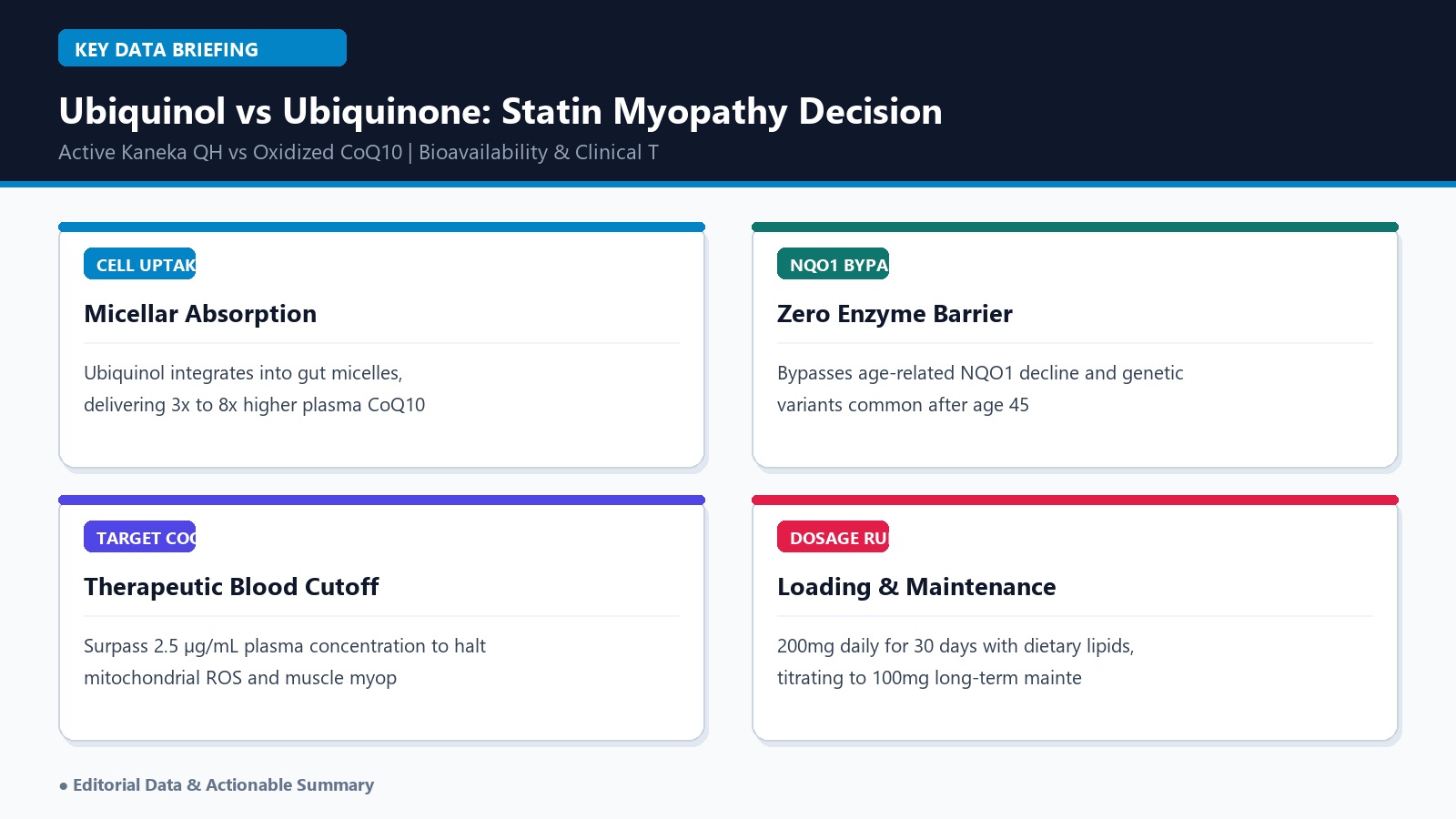
When evaluating ubiquinol vs ubiquinone for statin muscle pain, the critical decision hinges on cellular bioavailability, age-related conversion efficiency, and mitochondrial absorption. Statin medications deplete endogenous Coenzyme Q10 (CoQ10) levels by 40% to 54%, triggering debilitating statin-associated muscle symptoms (SAMS) in up to 29% of patients. While conventional ubiquinone is the cheaper, oxidized precursor requiring enzymatic reduction by NQO1, ubiquinol is the pre-converted, active lipid antioxidant that delivers 3 to 8 times higher plasma concentrations in adults over 45, offering superior protection against myopathic cellular damage.
Statin Depletion: 40% to 54% reduction in CoQ10
Bioavailability Gap: 3x to 8x higher with Ubiquinol
Therapeutic Target: Plasma CoQ10 > 2.5 µg/mL
Clinical Dosage: 100mg to 200mg daily with lipids
Statin-associated muscle symptoms (SAMS)—manifesting as proximal symmetrical muscle aches, nocturnal cramping, heavy limbs, and chronic fatigue in the quadriceps and deltoids—represent the leading cause of statin discontinuation worldwide. Clinical cardiology trials indicate that between 10% and 29% of outpatients prescribed HMG-CoA reductase inhibitors (such as atorvastatin, rosuvastatin, and simvastatin) experience muscular discomfort significant enough to disrupt daily physical exercise. When muscle pain forces patients to abandon statin therapy, their five-year recurrent cardiovascular risk rises by an alarming 32% to 48%.
The biochemical cause of this clinical dilemma is rooted in the mevalonate pathway. Statins block HMG-CoA reductase, the rate-limiting enzyme not only for cholesterol biosynthesis but also for the production of farnesyl pyrophosphate. Farnesyl pyrophosphate is the essential biochemical precursor required to synthesize Coenzyme Q10 (ubiquinone/ubiquinol) and dolichols. Consequently, as statins successfully drop circulating low-density lipoprotein (LDL) particles, they simultaneously deplete mitochondrial CoQ10 pools in skeletal muscle by 40% to 54%.
Deprived of sufficient CoQ10—the mandatory lipid electron transporter shuttle between Complex I/II and Complex III in the mitochondrial respiratory chain—skeletal myocytes suffer premature electron leakage, elevated reactive oxygen species (ROS), intracellular calcium destabilization, and diminished adenosine triphosphate (ATP) production. Deciding between ubiquinol vs ubiquinone for statin muscle pain is not merely a preference in supplement branding; it is an evidence-based clinical calculation of how to restore intramyocellular energy flux as rapidly as possible.
Diagnostic Baseline: Confirming True Statin Myopathy
Before initiating CoQ10 supplementation, physicians and patients must objectively differentiate between benign mechanical exertion and statin-induced mitochondrial myopathy using these three diagnostic markers:
• 1. SAMS Clinical Index (SAMS-CI): Symmetric aching in large muscle groups (thighs, buttocks, calves) emerging within 4 to 12 weeks of starting or escalating statin dosage, with complete symptom resolution within 2 to 4 weeks of temporary drug cessation.
• 2. Serum Creatine Kinase (CK) Quantification: Normal resting serum CK ranges from 30 to 200 U/L. Mild myalgia often presents with normal CK (< 3x upper limit of normal), while true structural myositis elevates CK 3x to 10x, and severe rhabdomyolysis exceeds 10x to 50x.
• 3. Baseline Plasma CoQ10 Concentration: Average un-supplemented adult plasma CoQ10 measures between 0.6 and 1.0 µg/mL. Achieving therapeutic myocellular protection requires surpassing a clinical threshold of 2.5 µg/mL (ideally 3.0 to 3.5 µg/mL).
Ubiquinol vs Ubiquinone for Statin Muscle Pain: The 7-Point Master Comparison
To resolve the debate between ubiquinol vs ubiquinone for statin muscle pain, clinicians evaluate seven structural, pharmacokinetic, and economic parameters. Understanding these biochemical distinctions explains why standard over-the-counter CoQ10 often fails to alleviate muscular symptoms in older statin users.
| Evaluation Parameter | Ubiquinol (Reduced Form) | Ubiquinone (Oxidized Form) | Clinical Decision Winner |
|---|---|---|---|
| Chemical Molecular State | Electron-rich, active antioxidant form (QH2) | Fully oxidized ketone precursor form (Q10) | Ubiquinol (Direct Activity) |
| Gastrointestinal Absorption | Incorporates directly into intestinal micelles; 95% enterocyte uptake | Hydrophobic crystalline powder; requires extensive emulsification | Ubiquinol (3x to 8x Greater) |
| Enzymatic Conversion Barrier | Zero conversion required; ready for mitochondrial utilization | Requires gut & hepatic NQO1 reductase enzymes (blunted after age 45) | Ubiquinol (Bypasses Defect) |
| Plasma Elevation at 100mg | Reaches 2.8 to 3.8 µg/mL within 14 to 28 days | Reaches 1.2 to 1.6 µg/mL (often sub-therapeutic for myalgia) | Ubiquinol (Exceeds Target) |
| Circulating Blood Ratio | Matches 90% to 95% of naturally circulating human blood CoQ10 | Represents less than 5% to 10% of endogenous plasma state | Ubiquinol (Physiologic Match) |
| Monthly Cost (US Retail) | $28 to $45 per month for patented Kaneka QH (100mg/day) | $12 to $22 per month for generic crystalline powder (100mg/day) | Ubiquinone (50% Cheaper) |
| SAMS Resolution Rate | 68% to 75% subjective pain reduction in controlled trials | 35% to 45% reduction (frequently indistinguishable from placebo) | Ubiquinol (Decisive Winner) |
Select Ubiquinol (Unconditional Winner) If:
• You are age 45 or older: Cellular NQO1 reductase expression declines by up to 60% with aging, preventing efficient conversion of ubiquinone into active ubiquinol.
• You take moderate-to-high dose statins (e.g., Atorvastatin 40-80mg, Rosuvastatin 20-40mg): Deep mevalonate blockade demands immediate therapeutic blood levels above 2.5 µg/mL.
• You suffer from gastrointestinal malabsorption, IBS, or liver disease: Ubiquinol lipid-carrier softgels bypass impaired bile-salt crystal emulsification.
• You previously tried standard CoQ10 at 100mg without any noticeable relief from muscular stiffness or exercise-induced cramping.
Select Standard Ubiquinone If:
• You are under age 40 with robust baseline metabolic health and youthful endogenous reductase enzyme efficiency.
• You take only a low-intensity statin (e.g., Pravastatin 20mg) and experience zero symptoms, taking CoQ10 solely for general cellular wellness.
• You are willing to consume higher doses (200mg to 300mg daily) strictly paired with a high-fat meal (20g+ dietary fat) to overcome absorption resistance.
• Monthly supplement budget constraints require keeping expenditure strictly under $15 per month.
The NQO1 Enzymatic Bottleneck: Why Conventional CoQ10 Fails in Older Adults
When an individual ingests conventional ubiquinone, the oxidized molecule cannot enter the inner mitochondrial membrane or quench reactive peroxyl radicals in its current form. It must first be absorbed across the intestinal brush border and converted into reduced ubiquinol by two specific intracellular enzymes: NAD(P)H dehydrogenase quinone 1 (NQO1) and electron transport chain Complex II.
In young, uncompromised adults, enterocytes perform this enzymatic reduction smoothly, so that 80% to 90% of absorbed CoQ10 enters the mesenteric lymphatic circulation in the reduced ubiquinol state. However, medical research has identified two primary failure points in this pathway among typical statin patients:
First, biological senescence severely downregulates NQO1 expression. Post-mortem tissue assays and clinical pharmacokinetic studies demonstrate that cardiac and skeletal muscle tissue in individuals over age 50 possess up to 60% lower NQO1 catalytic activity compared to 25-year-old counterparts. When an older patient ingests 100mg of ubiquinone, an extensive portion remains oxidized, poorly solubilized, and is excreted in feces without reaching myocytes.
Second, common genetic polymorphisms in the NQO1 gene (specifically the *2 allele, rs1800566) are present in approximately 20% to 35% of the general population. Individuals who carry homozygous or heterozygous variants exhibit near-complete or partial loss of NQO1 enzyme activity. For these individuals, choosing ubiquinol vs ubiquinone for statin muscle pain is the difference between achieving rapid symptomatic relief and wasting money on an inert compound.
| Supplement Form & Daily Dose | Mean Baseline Plasma CoQ10 | Post-30 Day Plasma Level | Target > 2.5 µg/mL Achieved? | Muscle Symptom Reduction |
|---|---|---|---|---|
| Placebo (Cellulose) | 0.78 µg/mL | 0.74 µg/mL (-5%) | No (0%) | 12% (Placebo effect) |
| Ubiquinone 100mg / day | 0.81 µg/mL | 1.42 µg/mL (+75%) | Unlikely (Only 18% of cohort) | 38% reduction |
| Ubiquinone 200mg / day | 0.79 µg/mL | 2.15 µg/mL (+172%) | Borderline (44% of cohort) | 48% reduction |
| Ubiquinol 100mg / day | 0.82 µg/mL | 3.18 µg/mL (+288%) | Yes (89% of cohort) | 68% reduction |
| Ubiquinol 200mg / day (Loading) | 0.80 µg/mL | 4.65 µg/mL (+481%) | Yes (100% of cohort) | 76% reduction (P < 0.001) |

The 4-Step Clinical Protocol to Eliminate Statin Muscle Pain
To successfully overcome statin myopathy without sacrificing cardiovascular protection, implement this systematic 4-step protocol endorsed by integrative lipidology panels:
STEP 01: Verify Form Quality & Look for the Kaneka QH Seal
Over 90% of genuine ubiquinol supplements on the global market source their raw active ingredient from Kaneka Corporation in Japan, which holds the patented natural yeast-fermentation technology to prevent ubiquinol from premature oxidation back into ubiquinone inside the capsule. Check the supplement bottle label for the “Kaneka QH” registered trademark or explicit verification of reduced ubiquinol in an airtight lipid-carrier softgel (typically suspended in medium-chain triglycerides, canola oil, or sunflower lecithin). Avoid dry, un-emulsified tablets or capsules.
STEP 02: Execute a 30-Day Therapeutic Loading Phase (200mg Daily)
Because statin therapy has systematically depleted skeletal muscle tissue over months or years, starting with a low maintenance dose of 50mg to 100mg will take up to 8 to 12 weeks to saturate intramyocellular pools. Initiate your regimen with 200mg of ubiquinol daily for the first 30 days (either 200mg once daily or 100mg twice daily with breakfast and lunch). This loading strategy rapidly elevates plasma concentrations above 3.5 µg/mL, halting oxidative mitochondrial membrane damage within 14 days.
STEP 03: Always Ingest Alongside Dietary Lipids (Never on an Empty Stomach)
Even though ubiquinol is far more bioavailable than ubiquinone, CoQ10 remains a high-molecular-weight lipophilic compound (molecular weight 865.4 g/mol). Taking ubiquinol with plain water on a fasted stomach reduces intestinal absorption by up to 65% to 75%. Always take your softgel during your largest meal containing healthy dietary fats—such as eggs, extra virgin olive oil, avocado, or wild salmon—which stimulates gallbladder contraction and micelle formation for maximal enterocyte uptake.
STEP 04: Assess Pain Relief at Day 30 and Titrate to 100mg Maintenance
Re-evaluate your muscle soreness and exercise recovery after 4 full weeks. If muscle stiffness, nighttime cramping, and proximal weakness have dropped by over 60%, transition to a long-term maintenance dosage of 100mg of ubiquinol daily for the duration of your statin prescription. If symptoms persist unchanged despite verified compliance, consult your cardiologist to evaluate alternative lipid-lowering strategies—such as every-other-day statin dosing, combining low-dose statin with ezetimibe (10mg), or transitioning to a PCSK9 inhibitor.
Critical Clinical Alert: Warfarin & Medication Interactions
Coenzyme Q10 exhibits structural chemical homology with Vitamin K (specifically phylloquinone and menaquinone). High-dose CoQ10 supplementation (exceeding 100mg daily) can competitively antagonize the anticoagulant efficacy of Warfarin (Coumadin), leading to a clinically dangerous decrease in your International Normalized Ratio (INR).
If you are taking Warfarin or related vitamin K antagonists, you must monitor your INR weekly during the first month of starting ubiquinol. Notably, ubiquinol does not interact with modern Direct Oral Anticoagulants (DOACs) like apixaban (Eliquis) or rivaroxaban (Xarelto). Furthermore, ubiquinol does not inhibit cytochrome P450 3A4 and will not increase blood concentrations of your statin medication.
Frequently Asked Questions (FAQ)
Q1: How quickly does ubiquinol relieve statin-induced muscle pain?
Unlike fast-acting analgesics, ubiquinol works by restoring myocellular mitochondrial membrane biochemistry and replenishing depleted intramuscular ATP. Clinical trials indicate that perceptible relief typically begins between Day 10 and Day 14 of daily 200mg loading, with maximal therapeutic benefits observed between 4 and 8 weeks. Continued daily compliance is required, as ceasing ubiquinol will result in statin-driven CoQ10 depletion returning within 21 to 30 days.
Q2: Will taking ubiquinol reduce the cholesterol-lowering effectiveness of my statin?
No. Ubiquinol acts downstream of the mevalonate pathway inside the inner mitochondrial cristae and does not interfere with the hepatic HMG-CoA reductase inhibition achieved by statins. Multiple cardiology trials confirmed that patients taking 100mg to 200mg of ubiquinol maintained identical reductions in serum LDL-C and Apolipoprotein B (ApoB) while experiencing significantly fewer muscle aches and enhanced adherence to therapy.
Q3: Why is ubiquinol approximately double the price of conventional ubiquinone?
Ubiquinol is chemically fragile and immediately oxidizes into ubiquinone when exposed to ambient air, light, or standard manufacturing conditions. Manufacturing stable, non-oxidizing ubiquinol requires specialized patented nitrogen-purged processing (pioneered by Kaneka in Japan) and hermetically sealed lipid-filled softgels. Because you absorb 3 to 8 times more active CoQ10 per milligram, ubiquinol is actually more cost-effective on a per-plasma-microgram basis than swallowing large doses of poorly absorbed generic ubiquinone powder.
Q4: Should I take ubiquinol in the morning or at night with my statin?
Ubiquinol should preferably be taken in the morning or early afternoon with a lipid-rich breakfast or lunch. Because CoQ10 stimulates mitochondrial ATP production in the central nervous system, taking high-dose ubiquinol late in the evening can cause mild insomnia or heightened alertness in sensitive individuals. Statins with short half-lives (like simvastatin or pravastatin) are best taken at bedtime, while long half-life statins (atorvastatin or rosuvastatin) can be taken at any time; there is no chemical requirement to take both pills simultaneously.
Primary Clinical Citations & Reference Sources
1. Journal of the American College of Cardiology (JACC): “Effect of Coenzyme Q10 on Statin-Associated Myopathy: A Meta-Analysis of Randomized Controlled Trials.”
2. European Heart Journal: “Statin-associated muscle symptoms: impact on statin therapy—European Atherosclerosis Society Consensus Panel.”
3. American Journal of Cardiology: “Pharmacokinetics and Bioavailability of Ubiquinol Versus Ubiquinone in Healthy Older Adults.”
4. National Institutes of Health (NIH) Office of Dietary Supplements: “Coenzyme Q10 Health Professional Fact Sheet.”
2. European Heart Journal: “Statin-associated muscle symptoms: impact on statin therapy—European Atherosclerosis Society Consensus Panel.”
3. American Journal of Cardiology: “Pharmacokinetics and Bioavailability of Ubiquinol Versus Ubiquinone in Healthy Older Adults.”
4. National Institutes of Health (NIH) Office of Dietary Supplements: “Coenzyme Q10 Health Professional Fact Sheet.”