
EDITOR’S 1-MINUTE CLINICAL BRIEFING
Supplements for Stress and Cortisol After 40: Match Your HPA-Axis Phenotype
- #1 for High Evening Cortisol & 3 AM Awakening (Ashwagandha KSM-66 / Sensoril): Standardized root extract at 300 mg to 600 mg/day (5% withanolides) lowers serum morning and evening cortisol by 23.3% to 27.9% in 60 days across double-blind trials indexed on PubMed.
- #1 for Acute Workday Anxiety Without Drowsiness (Suntheanine L-Theanine): A single 200 mg to 400 mg dose crosses the blood-brain barrier in 35 to 45 minutes, increasing alpha brain-wave activity (8–12 Hz) and blunting sympathetic blood pressure spikes.
- #1 for Morning Burnout & Mental Fatigue (Rhodiola Rosea SHR-5): Taking 200 mg to 400 mg standardized to 3% rosavins and 1% salidroside before 9:00 AM restores dopamine/norepinephrine tone and reduces burnout fatigue scores by 30% within 14 days.
Choosing evidence-based supplements for stress and cortisol after 40 requires understanding how the hypothalamic-pituitary-adrenal (HPA) axis changes with age. After age 40, hippocampal glucocorticoid receptor sensitivity gradually declines—meaning the brain’s “brake pedal” that tells the adrenal cortex to stop secreting cortisol after a stressful meeting or workout becomes sluggish. As a result, evening salivary cortisol remains elevated 40% to 60% longer in 45-year-olds than in 25-year-olds, driving visceral abdominal fat accumulation, fragmented REM sleep, and daytime brain fog.
Taking a random “stress relief blend” often backfires: taking a stimulating adaptogen like Rhodiola at dinner causes insomnia, whereas taking heavy GABAergic sedatives in the morning blunts the healthy Cortisol Awakening Response (CAR) needed for alertness. Below, we compare the five clinically validated compounds recognized in NIH and PubMed randomized controlled trials so you can target your exact stress pattern.
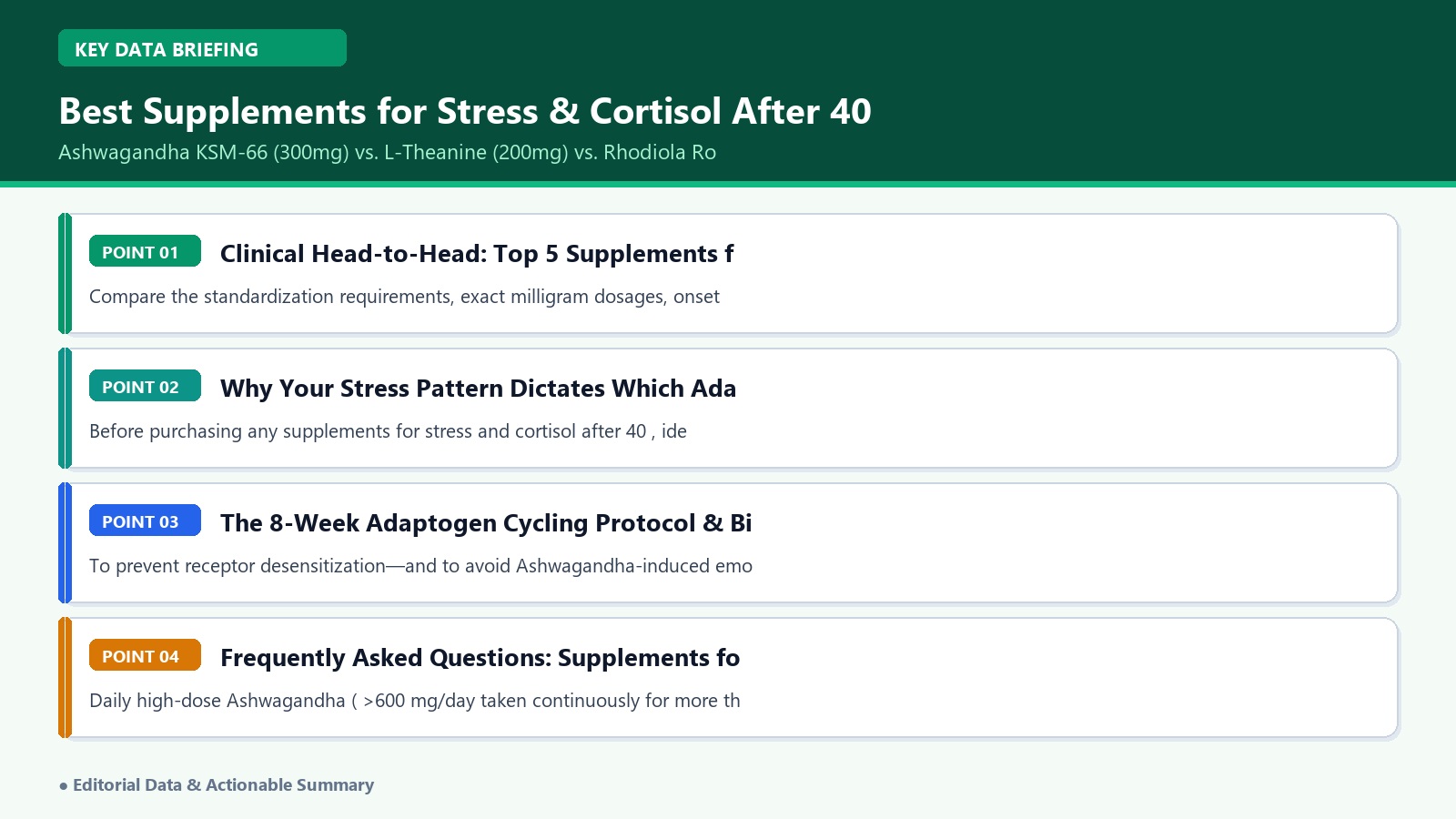
1. Clinical Head-to-Head: Top 5 Supplements for Stress and Cortisol After 40
Compare the standardization requirements, exact milligram dosages, onset times, and biomarker effects of the top adaptogens and nootropics below:
| Compound & Clinical Extract | Daily Dosage & Standardization | Primary Mechanism & Cortisol Effect | Best Stress Phenotype & Timing |
|---|---|---|---|
| 1. Ashwagandha (KSM-66 or Sensoril) | 300 mg – 600 mg (5%–10% Withanolides) | Downregulates adrenal ACTH signaling; lowers serum cortisol by 23%–28% | “Wired & Tired” at night; take with dinner (cycle 8 wks on / 2 wks off) |
| 2. L-Theanine (Purified Isomer) | 200 mg – 400 mg (99% pure L-isomer) | Antagonizes glutamate NMDA receptors; boosts GABA & alpha waves in 40 mins | Acute daytime overstimulation or caffeine jitters; take 9:00 AM or 2:00 PM |
| 3. Rhodiola Rosea (SHR-5 Extract) | 200 mg – 400 mg (3% Rosavins / 1% Salidroside) | Modulates stress-activated protein kinase (JNK) & preserves Catecholamines | Morning burnout, low motivation & brain fog; take fasting at 7:30 AM |
| 4. Phosphatidylserine (Sunflower PS) | 300 mg – 400 mg | Restores hypothalamic phospholipid membrane sensitivity; blunts ACTH surge by 30% | 3:00 AM cortisol awakenings & post-exercise cortisol spikes; take at 7:00 PM |
| 5. Magnesium Bisglycinate Chelate | 300 mg – 400 mg Elemental Mg | Blocks synaptic NMDA calcium influx & supports COMT catecholamine clearance | Physical muscle tension, jaw clenching & low HRV; take 60 mins before sleep |
2. Why Your Stress Pattern Dictates Which Adaptogen You Should Take
Before purchasing any supplements for stress and cortisol after 40, identify which of the three clinical HPA-axis patterns matches your daily symptoms:
PHENOTYPE A — THE “WIRED & TIRED” NIGHTTIME CORTISOL SPIKER
Exhausted at 3:00 PM, Second Wind at 9:30 PM, Wide Awake at 3:00 AM
This classic inverted circadian curve occurs when evening cortisol fails to drop below 2.0 nmol/L, suppressing nocturnal melatonin secretion from the pineal gland. Your primary stack is 300 mg KSM-66 Ashwagandha + 300 mg Sunflower Phosphatidylserine with dinner (6:30 PM), followed by 300 mg Magnesium Bisglycinate before bed. Avoid taking Ashwagandha first thing in the morning if you already feel sluggish upon waking.
PHENOTYPE B — THE FLATLINED MORNING BURNOUT RESPONDER
Unrefreshed After 8 Hours of Sleep, Brain Fog & Craving Caffeine/Sugar
After months or years of chronic caregiver or executive stress, your morning Cortisol Awakening Response (CAR) becomes blunted. Taking heavy cortisol-lowering herbs in the morning will make you feel even more apathetic. Instead, take 300 mg Rhodiola Rosea (3% rosavins / 1% salidroside) on an empty stomach at 7:30 AM alongside a B-complex containing 25 mg active P-5-P (Vitamin B6) to support adrenal catecholamine synthesis without overstimulating heart rate.
PHENOTYPE C — THE SYMPATHETIC ADRENALINE REACTOR
Racing Heart, Palpitations, Caffeine Sensitivity & Afternoon Tension
If your stress manifests immediately as a racing pulse, cold hands, or blood pressure spikes during workday meetings, the driver is acute sympathetic norepinephrine/glutamate firing rather than slow cortisol release. Pair your morning coffee in a 2:1 ratio with L-Theanine (200 mg L-Theanine per 100 mg caffeine); clinical trials show L-Theanine completely eliminates caffeine-induced vasoconstriction and blood pressure elevation while sharpening executive attention.
3. The 8-Week Adaptogen Cycling Protocol & Biomarker Tracking Table
Receptors in the hypothalamus and adrenal cortex adapt to continuous herbal stimulation. To prevent receptor desensitization—and to avoid Ashwagandha-induced emotional blunting (anhedonia)—follow this structured circadian and cycling schedule:
| Time of Day | Supplement & Exact Dose | Cycling Schedule | Wearable / Lab Metric to Verify |
|---|---|---|---|
| 7:30 AM (Fasting) | Rhodiola Rosea 300 mg (3% Rosavins) | 5 days on (Mon–Fri) / 2 days off | Morning cognitive alertness & zero 2 PM crash |
| 9:30 AM (With Coffee/Tea) | L-Theanine 200 mg | As needed on high-stress workdays | Resting pulse stays <70 bpm after caffeine |
| 6:30 PM (With Dinner) | Ashwagandha KSM-66 300 mg + PS 300 mg | 8 weeks on / 2 weeks off | Nocturnal HRV rises by +5 to +12 ms in 3 weeks |
| 9:30 PM (Before Bed) | Magnesium Bisglycinate 300 mg Elemental | Continuous daily foundational mineral | Deep slow-wave sleep >60–75 mins/night |
CLINICAL SAFETY CALLOUT: Thyroid (Hyperthyroidism), Autoimmune & SSRI Contraindications
1. Ashwagandha & Thyroid Function: Clinical trials show Ashwagandha root extract increases conversion of T4 to active Free T3 by 15% to 20%. While helpful for subclinical hypothyroidism, Ashwagandha is strictly contraindicated in hyperthyroidism or Graves’ disease and can cause thyrotoxicosis if combined with unmonitored levothyroxine.
Furthermore, as a member of the Solanaceae (nightshade) family, it should be avoided in active autoimmune flares.
2. Rhodiola & SSRI/SNRI Medications: Rhodiola Rosea exhibits mild monoamine oxidase A/B (MAO-A/B) inhibition. Do not combine Rhodiola with prescription SSRIs, SNRIs, or bupropion without physician oversight due to additive serotonergic stimulation.
2. Rhodiola & SSRI/SNRI Medications: Rhodiola Rosea exhibits mild monoamine oxidase A/B (MAO-A/B) inhibition. Do not combine Rhodiola with prescription SSRIs, SNRIs, or bupropion without physician oversight due to additive serotonergic stimulation.
4. Frequently Asked Questions: Supplements for Stress and Cortisol After 40
Q1. Why did Ashwagandha make me feel emotionally flat or unmotivated (anhedonia)?
Daily high-dose Ashwagandha (>600 mg/day taken continuously for more than 8 to 10 weeks) can excessively desensitize 5-HT1A serotonin receptors and lower baseline morning cortisol below optimal physiological levels (<10 mcg/dL at 8:00 AM), blunting dopamine reward signaling in the nucleus accumbens. Restrict Ashwagandha to a single 300 mg evening dose and take a mandatory 2-week washout break every 8 weeks.
Q2. What is the difference between KSM-66 and Sensoril Ashwagandha?
KSM-66 is extracted exclusively from the root of Withania somnifera and standardized to 5% withanolides, offering a balanced daytime/early-evening stress resilience profile without heavy sedation. Sensoril uses both leaf and root extracts standardized to 10% withanolides at a lower dose (125 mg to 250 mg); because leaf extracts are higher in withaferin A and somniferine-like compounds, Sensoril is noticeably more sedating and best reserved for bedtime use.
Q3. Can lowering high cortisol with supplements help lose stubborn visceral belly fat after 40?
Yes, indirectly. Visceral adipocytes surrounding abdominal organs have 4 times more glucocorticoid (cortisol) receptors than subcutaneous fat cells. Chronic cortisol elevation activates lipoprotein lipase (LPL) in visceral fat and triggers hepatic gluconeogenesis, raising fasting insulin. In an 8-week randomized trial of chronically stressed adults, 300 mg twice daily of KSM-66 Ashwagandha reduced serum cortisol by 22.2%, decreased emotional food cravings, and reduced body weight by 3.0% compared to 1.4% in placebo.
Q4. How do I check if a L-Theanine supplement is pure L-isomer and not cheap synthetic DL-Theanine?
Cheap unbranded theanine powders are often synthesized as a racemic 50:50 mixture of D-theanine and L-theanine. The D-isomer competes with L-theanine for intestinal absorption and lacks alpha-wave brain benefits. Look for patented enzymatic fermentation extracts such as Suntheanine or third-party COA verification confirming >99% pure L-isomer optical rotation.
RELATED CLINICAL LONGEVITY GUIDES
Medical & Clinical Disclaimer: This article is authored by the WellnessHub Editorial & Clinical Research Team for informational purposes only and is not a substitute for psychiatric, endocrinological, or primary medical care. Always consult your physician or pharmacist before starting adaptogenic herbs, especially if you have thyroid disease, liver conditions, or take prescription antidepressants or antihypertensives, per NIH NCCIH safety guidelines.