

EDITOR’S 1-MINUTE CLINICAL BRIEFING
Zone 2 Cardio Heart Rate for a 40-Year-Old: Exact Numbers & Targets
- Exact BPM for Age 40 (126–144 bpm via Karvonen): For a healthy 40-year-old with an estimated max heart rate of 180 bpm (TANAKA formula:
208 - 0.7 × 40) and resting heart rate of 60 bpm, true metabolic Zone 2 sits at 126 to 144 bpm (60%–70% Heart Rate Reserve) or 135 to 140 bpm using the clinical Maffetone (180 - Age) ceiling. - Metabolic Definition (1.7 to 1.9 mmol/L Blood Lactate): Physiologically, Zone 2 is the highest aerobic power output where Type I slow-twitch muscle fibers clear lactate via MCT1 transporters as fast as it is produced, keeping capillary blood lactate below 2.0 mmol/L and maximizing mitochondrial fat oxidation (0.5 to 0.8 grams of fat per minute).
- Weekly Longevity Dose (150 to 180 Minutes Across 3–4 Sessions): Performing 3 to 4 sessions of 45 minutes per week in strict Zone 2 increases skeletal muscle mitochondrial density by 25% to 40% and lowers fasting insulin by 18% to 24% in 12 weeks without spiking cortisol.
Determining the exact zone 2 cardio heart rate 40 year old athletes and longevity seekers should maintain is the foundation of metabolic health after 40. Most recreational runners and cyclists over 40 inadvertently train in “Zone 3 gray-zone intensity” (148 to 162 bpm)—an intensity too high to stimulate maximal Type I mitochondrial fatty-acid beta-oxidation (FATmax), yet too low to trigger maximal stroke-volume VO2 max adaptations. Worse, chronic Zone 3 training after age 40 elevates circulating cortisol, depletes muscle glycogen, and leaves you fatigued for resistance training.
According to exercise physiology research indexed on PubMed and cardiovascular exercise guidelines from the American Heart Association (AHA), staying strictly inside your individual Zone 2 heart rate window stimulates peroxisome proliferator-activated receptor gamma coactivator 1-alpha (PGC-1α)—the master genetic switch for mitochondrial biogenesis—while expanding capillary beds around slow-twitch muscle fibers and improving left ventricular eccentric compliance.
1. Why the Standard “220 Minus Age” Formula Fails for a Zone 2 Cardio Heart Rate 40 Year Old
If you use the outdated 1970s Fox equation (
HRmax = 220 - Age) multiplied by a flat 60% to 70%, a 40-year-old gets a target of 108 to 126 bpm—a pace so slow that for most healthy adults it barely registers as a brisk walk (Zone 1). That formula fails for two clinical reasons: first, it ignores your Resting Heart Rate (RHR), which reflects cardiac stroke volume and vagal tone; second, the 220 - Age curve has a standard deviation of ±10 to 12 bpm and systematically underestimates maximum heart rate in adults over 40.Sports cardiologists and metabolic researchers at the National Institutes of Health (NIH) and Mayo Clinic instead recommend combining the Tanaka Max Heart Rate Equation (
208 - (0.7 × Age)) with the Karvonen Heart Rate Reserve (HRR) Formula, cross-checked against the Maffetone MAF 180 Formula and the Nasal-Breathing / Talk Test.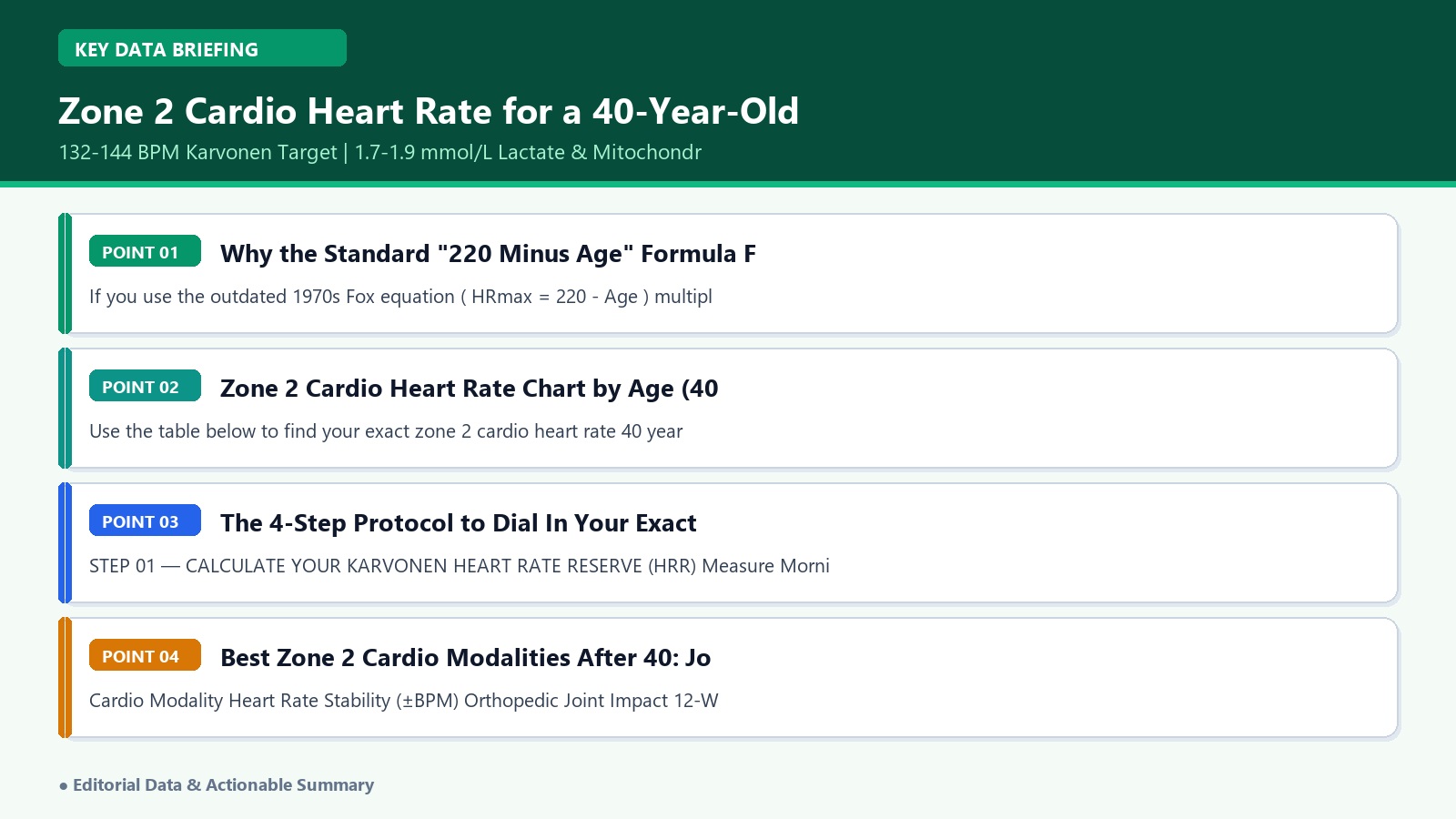
2. Zone 2 Cardio Heart Rate Chart by Age (40 to 65): 3 Clinical Formulas Compared
Use the table below to find your exact zone 2 cardio heart rate 40 year old (and 45–65+) target zone. In clinical metabolic testing (where Zone 2 corresponds to 1.7 to 1.9 mmol/L blood lactate or the first ventilatory threshold, VT1), the Karvonen 60%–70% HRR and Maffetone (180 – Age) bands align within 2 to 4 bpm of laboratory gas-exchange measurements:
| Age Bracket & Tanaka HRmax | Standard %HRmax (65%–75% of Max) | Karvonen HRR (60%–70% at RHR 60 bpm) | Maffetone MAF Ceiling (170–180 Minus Age) |
|---|---|---|---|
| Age 40 (HRmax: 180 bpm) | 117 – 135 bpm | 132 – 144 bpm (Gold Standard) | 130 – 140 bpm |
| Age 45 (HRmax: 176.5 bpm) | 115 – 132 bpm | 130 – 141 bpm | 125 – 135 bpm |
| Age 50 (HRmax: 173 bpm) | 112 – 130 bpm | 128 – 139 bpm | 120 – 130 bpm |
| Age 55 (HRmax: 169.5 bpm) | 110 – 127 bpm | 126 – 137 bpm | 115 – 125 bpm |
| Age 60 (HRmax: 166 bpm) | 108 – 125 bpm | 124 – 134 bpm | 110 – 120 bpm |
| Age 65 (HRmax: 162.5 bpm) | 106 – 122 bpm | 121 – 132 bpm | 105 – 115 bpm |
3. The 4-Step Protocol to Dial In Your Exact Zone 2 Ceiling Without a Lab
STEP 01 — CALCULATE YOUR KARVONEN HEART RATE RESERVE (HRR)
Measure Morning Resting Heart Rate for 3 Days & Apply 60%–70% HRR
Before getting out of bed for three consecutive mornings, record your resting pulse (for example, 58 bpm). Subtract your RHR from your Tanaka Max HR (for a 40-year-old:
180 - 58 = 122 bpm Heart Rate Reserve). Multiply that reserve by 0.60 and 0.70, then add your RHR back: (122 × 0.60) + 58 = 131 bpm (floor) to (122 × 0.70) + 58 = 143 bpm (ceiling).STEP 02 — VERIFY VT1 WITH THE 15-WORD CONVERSATIONAL TALK TEST
Confirm You Can Speak a Full 15-Word Sentence Without Gasping
At the exact boundary between Zone 2 and Zone 3 (2.0 mmol/L lactate), hydrogen ions buffered by sodium bicarbonate increase carbon dioxide (CO2) production, triggering an abrupt spike in respiratory rate known as the First Ventilatory Threshold (VT1). In true Zone 2 (132–143 bpm at age 40), you can recite a 12-to-15-word sentence smoothly or breathe exclusively through your nose; the person on the phone with you can hear that you are exercising, but you never have to pause mid-sentence for air.
STEP 03 — NEVER SPIKE ABOVE CEILING (AVOID THE 20-MINUTE LACTATE PENALTY)
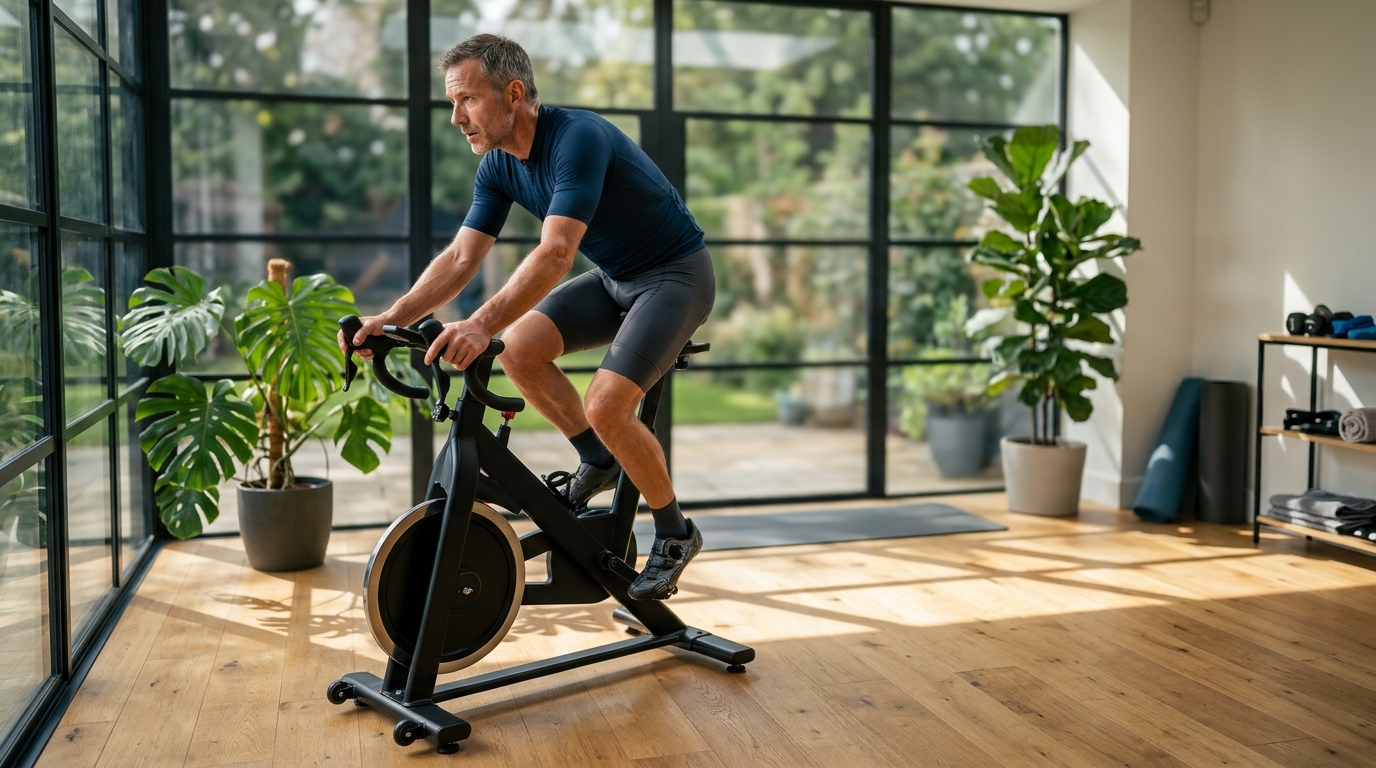
Use an Incline Treadmill, Stationary Bike, or Rower to Control Cardiac Drift
When you surge into Zone 3 or Zone 4 on a steep hill (spiking heart rate to 155+ bpm and blood lactate above 3.5 mmol/L), rising lactate inhibits lipolysis and downregulates carnitine palmitoyltransferase-1 (CPT-1), shutting off mitochondrial fat oxidation for 15 to 25 minutes even after you slow back down. Stationary cycling ergometers and 8%–12% incline treadmill walking allow precise wattage control within a ±3 bpm window.
STEP 04 — APPLY THE 80/20 POLARIZED LONGEVITY SPLIT
Combine 3–4 Zone 2 Sessions (45 Mins) With 1 Norwegian 4×4 VO2 Max Session
For maximum all-cause mortality reduction after 40, dedicate 80% of weekly cardio time (150–180 minutes across 3 to 4 sessions) to steady Zone 2, and 20% (one 30-minute session per week) to Zone 5 VO2 max intervals (4 rounds of 4 minutes at 90%–95% HRmax / 162–171 bpm with 3 minutes active recovery).
4. Best Zone 2 Cardio Modalities After 40: Joint Impact & Wattage Comparison
| Cardio Modality | Heart Rate Stability (±BPM) | Orthopedic Joint Impact | 12-Week Progress Benchmark |
|---|---|---|---|
| 1. Stationary Smart Bike / Ergometer | Excellent (±2 bpm in ERG mode) | Zero Impact (Knee/Hip Safe) | +20W to +35W power output at 138 bpm ( aim for 2.0–2.5 W/kg) |
| 2. Incline Treadmill Walk (8%–12% Grade) | Very High (±3 bpm at 3.0–3.5 mph) | Low Eccentric Knee Load | +0.3 mph speed or +2% incline at the same 135 bpm HR |
| 3. Concept2 Rowing Ergometer | High (±4 bpm at 18–20 strokes/min) | Zero Impact (Full-Body Recruitment) | 500m split time drops by 6–10 seconds at 138 bpm |
| 4. Outdoor Trail / Road Jogging | Moderate (Hills spike HR >150 bpm) | High Impact (2.5x bodyweight load) | Requires walk-jog intervals for beginners to stay <142 bpm |
CLINICAL MEDICATION CALLOUT: Beta-Blockers & Heart Rate Formulas After 40
If you take prescription beta-blockers (such as metoprolol, atenolol, carvedilol, or propranolol) for hypertension or arrhythmia, standard age-based formulas (including Karvonen and Maffetone) are invalid because beta-1 adrenergic blockade lowers both resting and maximal exercise heart rate by 15 to 30 bpm. If on beta-blockers, rely on the 15-word Conversational Talk Test and a Rate of Perceived Exertion (RPE) of 3 to 4 out of 10, or request a cardiopulmonary exercise test (CPET) from your cardiologist.
5. Frequently Asked Questions: Zone 2 Cardio Heart Rate After 40
Q1. Why does my heart rate jump above 145 bpm the moment I start jogging at age 40?
This is called “aerobic deficiency syndrome” and is extremely common in adults over 40 who have either been sedentary or only performed high-intensity interval classes. When slow-twitch mitochondrial density is low, your body recruits glycolytic Type IIa fibers immediately upon jogging, spiking lactate and sympathetic heart rate. Spend 6 to 8 weeks doing brisk 8%–10% incline walking or cycling at 132–140 bpm; within two months, your jogging pace at 138 bpm will increase by 60 to 90 seconds per mile.
Q2. What is cardiac drift after 30 minutes of Zone 2 cardio, and should I slow down?
After 30 to 40 minutes of continuous aerobic work, core body temperature rises and mild plasma volume loss reduces stroke volume, causing heart rate to drift upward by 5 to 8 bpm at the exact same wattage or pace. To keep metabolic output below the 2.0 mmol/L lactate threshold, slightly reduce your treadmill incline or bike wattage by 5% to 8% during the final 15 minutes so your heart rate never crosses your 144 bpm ceiling, and drink 400 mL of water with 300 mg sodium beforehand.
Q3. Is Apple Watch or Garmin optical wrist heart rate accurate enough for Zone 2 training?
Optical photoplethysmography (PPG) wrist sensors suffer from “cadence lock” during running and rowing (mistaking arm swing or wrist flexion for pulse), resulting in errors of ±8 to 15 bpm. Because the entire Zone 2 window is only 12 to 15 bpm wide (e.g., 130–144 bpm), an ECG chest strap (such as a Polar H10 or Garmin HRM-Pro) with 99.6% R-R interval accuracy is strongly recommended.
Q4. Should I do Zone 2 cardio before or after lifting weights after 40?
Perform Zone 2 cardio either on separate days from heavy strength training or after resistance training. Doing 45 minutes of Zone 2 immediately before lifting activates AMPK signaling and causes central nervous system fatigue that reduces peak force production by 10% to 15%. Conversely, a 30-to-40-minute Zone 2 session after lifting or on off-days accelerates lactate clearance and parasitic parasympathetic recovery.
RELATED CLINICAL LONGEVITY GUIDES
Medical & Clinical Disclaimer: This article is prepared by the WellnessHub Editorial & Clinical Research Team for informational purposes only and does not constitute medical advice or cardiac clearance. Adults over 40 with a family history of cardiovascular disease, hypertension, chest pain, or shortness of breath should consult a physician before initiating a new aerobic exercise program, in accordance with American Heart Association and ACSM guidelines.