
EDITOR’S 1-MINUTE CLINICAL BRIEFING
Rotator Cuff Pain Exercises After 40: 3 Biomechanical Rules
- #1 Immediate Pain Relief (5 × 45-Second Isometric External Rotation Holds): Complete rest weakens tendon collagen and increases pain sensitivity. Performing 45-second submaximal isometric wall holds at 60%–70% effort triggers descending cortical analgesia, reducing nocturnal shoulder aching by 40% to 55% within 7 days.
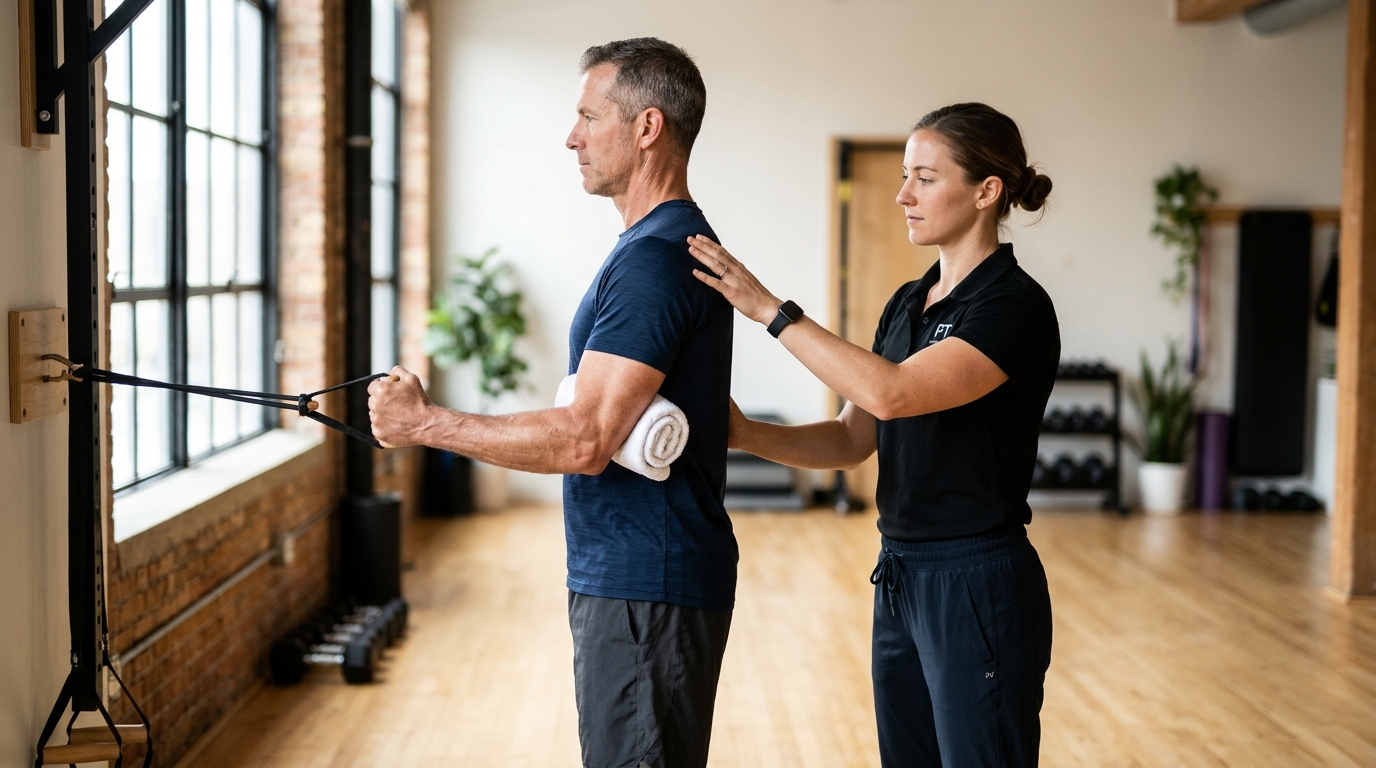
- The 30-Degree Rolled-Towel Under-Arm Cue: Tucking a rolled hand towel between your elbow and ribcage during external rotations abducts the humerus by 20°–30°—preventing blood-flow “wringing out” of the supraspinatus tendon while boosting infraspinatus EMG activation by 25%.
- Fix the Scapular Foundation First: Over 80% of subacromial pinching between 60° and 120° of arm elevation (“the painful arc”) stems from a rounded thoracic spine and weak lower trapezius/serratus anterior muscles failing to tilt the shoulder blade posteriorly.
Searching for effective rotator cuff pain exercises becomes urgent when a dull ache in the outer deltoid starts waking you up at 2:00 AM every time you roll onto your side, or when reaching into the back seat of your car triggers a sharp, catching pinch in the front of your shoulder. After age 40, microvascular blood supply to the supraspinatus and infraspinatus tendons—specifically the “critical zone” located 10 millimeters from the greater tuberosity insertion—declines by over 30%, making collagen fibers vulnerable to micro-fraying and subacromial bursitis.
According to orthopedic rehabilitation trials indexed by the National Institute of Arthritis and Musculoskeletal and Skin Diseases (NIH NIAMS) and systematic reviews published in the British Journal of Sports Medicine, supervised progressive tendon loading achieves equivalent 12-month pain and functional outcomes to arthroscopic subacromial decompression surgery for non-traumatic rotator cuff tendinopathy and partial-thickness tears—at zero surgical cost. Below is the exact 3-phase clinical rehabilitation protocol.
1. Why Your Shoulder Pinches After 40: Subacromial Space & Humeral Centration
To understand why specific rotator cuff pain exercises work while aggressive stretching makes shoulder pain worse, look at the anatomy of the glenohumeral joint. Unlike the deep ball-and-socket hip joint, your shoulder socket (the glenoid fossa) is as shallow as a golf tee. When your large superficial deltoid muscle contracts to lift your arm overhead, it pulls the head of the humerus straight upward toward the bony roof of the shoulder blade (the acromion).
The job of your four rotator cuff muscles—Supraspinatus, Infraspinatus, Teres Minor, and Subscapularis (SITS)—is not to lift heavy weights, but to act as dynamic guy-wires that pull the humeral head downward and inward (inferior centration) into the socket during arm elevation. When desk posture rounds your upper back (thoracic kyphosis) and your infraspinatus weakens after 40, the humeral head migrates upward by just 2 to 3 millimeters, crushing the supraspinatus tendon and subacromial bursa inside the narrow 7-to-10 mm subacromial space.
2. Diagnostic Red Flags: Tendinopathy vs. Full-Thickness Tear
Before starting home rotator cuff pain exercises, use this clinical screening table to distinguish rehabilitative tendinopathy/impingement from an acute full-thickness tear requiring orthopedic imaging (MRI or high-resolution diagnostic ultrasound):
| Clinical Feature | Subacromial Tendinopathy / Partial Tear (85% of Cases) | Adhesive Capsulitis (“Frozen Shoulder”) | Acute Full-Thickness Tear (Orthopedic Consult) |
|---|---|---|---|
| Painful Arc of Motion | Pinching between 60° and 120° of sideways arm raise; pain often eases near 160°–180° | Hard mechanical block in both active and passive external rotation (<30°) | Positive Drop-Arm Sign (inability to slowly lower the arm from 90° abduction without it falling) |
| Strength Profile | Pain-inhibited weakness that improves immediately after 45s isometric holds | Normal strength within the limited range, severe end-range capsular pain | True profound motor weakness even when pain is numbed; sudden pop/trauma history |
| Recommended Action | Start Phase 1–3 Progressive Loading Protocol Below | Gentle pendulum traction + check HbA1c/thyroid/perimenopause status | Immediate sports orthopedic MRI evaluation within 2–3 weeks |
3. The 3-Phase Clinical Protocol: Best Rotator Cuff Pain Exercises After 40
Follow the “3/10 Traffic Light Pain Rule” during every session: mild discomfort up to 2 or 3 out of 10 during tendon loading is safe and stimulates tenocyte Type I collagen synthesis, provided the pain subsides within 60 minutes after exercise and does not flare the next morning.
Phase 1 (Days 1–14): Analgesic Isometric Loading (Stop Night Pain First)
Tendon researcher Dr. Jill Cook demonstrated that holding a static muscle contraction without joint movement calms hyper-excitable pain receptors in the motor cortex while aligning disorganized tendon fibrils:
- Exercise 1 — Rolled-Towel Isometric Wall External Rotation (5 Reps × 45-Second Hold): Stand perpendicular to a wall or door frame. Tuck a rolled hand towel between your painful-side elbow and ribs, bend your elbow to exactly 90 degrees, and press the back of your wrist outward into the wall at 60% to 70% of your maximum pain-free effort. Hold for 45 seconds, rest 90 seconds, and repeat 5 times once in the morning and once 1 hour before bed.
- Exercise 2 — Isometric Scaption Wall Press (4 Reps × 30-Second Hold): Angle your arm 30 degrees forward from your side (the scapular plane) and press the outer forearm gently into the wall with your shoulder blade drawn slightly down and back (never shrugging the upper trapezius).
Phase 2 (Weeks 3–6): Eccentric Tendon Remodeling & Scapular Upward Rotation
Once resting night pain drops below 2/10, transition to slow isotropic and eccentric loading 3 days per week (Monday, Wednesday, Friday) to thicken the infraspinatus and supraspinatus tendon matrix (pair this phase with 15g hydrolyzed collagen + 50mg Vitamin C taken 45 minutes pre-session; for broader skeletal loading principles, see our guide on Best Heavy Resistance Exercises for Bone & Tendon Density After 40):
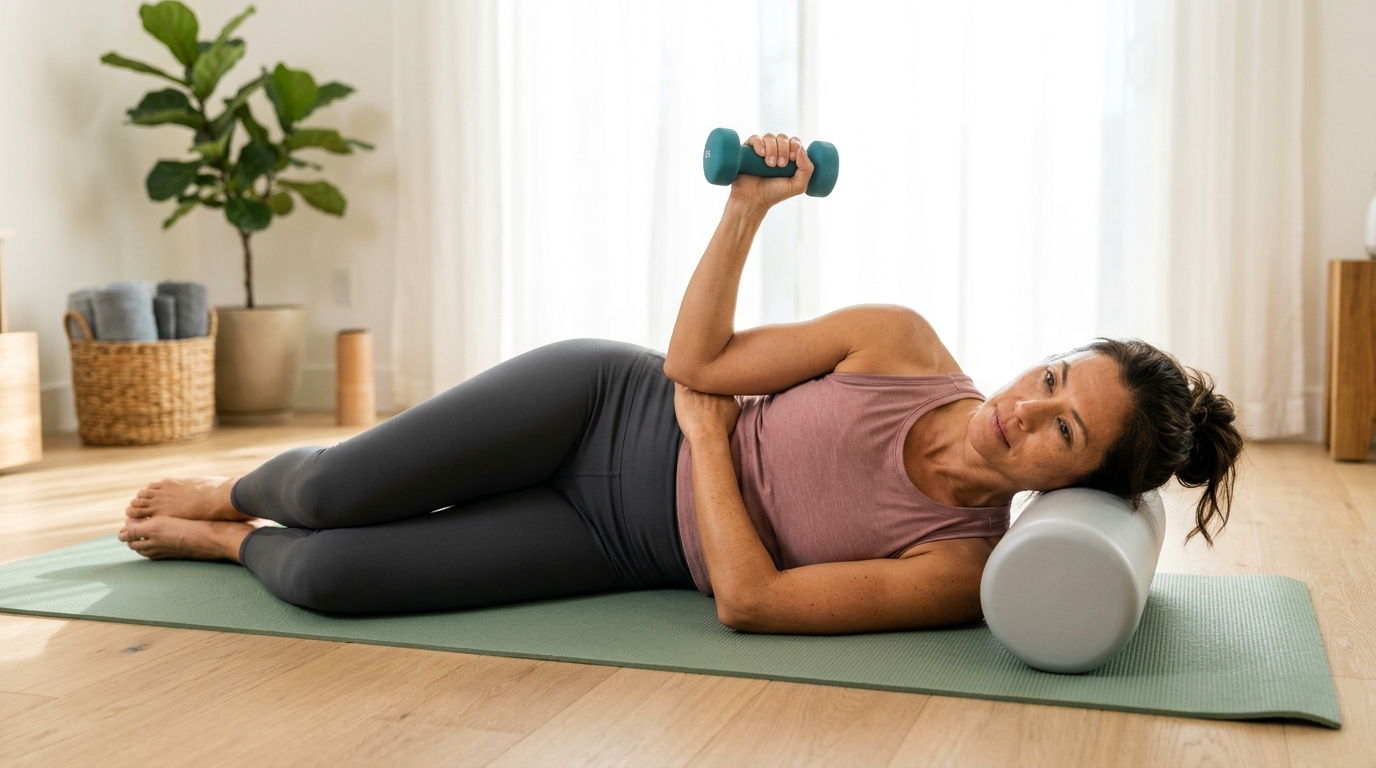
- Side-Lying Dumbbell External Rotation (3 Sets × 12 Reps, 4-Second Lowering): Lie on your uninjured side with a rolled towel under your top elbow and a light 2 lb to 5 lb dumbbell (or soup can) in your hand. Rotate the forearm upward toward the ceiling over 2 seconds, pause for 1 second at the top without rolling your torso backward, and take a full 4 seconds to lower the weight back down.
- Serratus Anterior Forearm Wall Slides with Foam Roller (3 Sets × 10 Reps): Place your forearms on a foam roller against a wall at shoulder height, gently push your sternum away from the wall to protract the shoulder blades, and slide the roller upward 6 inches while maintaining upward scapular rotation.
- Prone Incline Bench Scapular “Y” and “T” Raises (3 Sets × 12 Reps, Thumbs Up): Lie chest-down on a 30-degree incline bench or stability ball. With thumbs pointing toward the ceiling (external rotation), lift your arms into a 45-degree “Y” shape using only your lower trapezius—squeezing the bottom tips of your shoulder blades toward your back pockets.
Phase 3 (Weeks 7–12): Gym Exercise Swaps & Dynamic Overhead Centration
When returning to full upper-body strength training after 40, permanently eliminate internal-rotation impingement lifts: swap Barbell Upright Rows → High-Pulley Rope Face Pulls with External Rotation; swap Flat Barbell Bench Press (flared elbows) → 15° Incline Neutral-Grip Dumbbell Press; and swap Seated Behind-the-Neck Presses → Half-Kneeling Single-Arm Landmine Presses, which follow the natural 45-degree scapular plane.
4. How to Sleep Without Triggering 3:00 AM Shoulder Pain
Even the best daytime rotator cuff pain exercises will stall if you spend 7 hours compressing the supraspinatus tendon every night. When you lie flat on your back with your elbow resting on the mattress, or sleep on your uninjured side with your painful arm draped across your chest in adduction, blood vessels in the critical tendon zone are squeezed shut (which also triggers nocturnal cortisol awakenings—see our protocol on How to Stop Waking Up at 3am Cortisol & Pain Spikes).
The 2-Pillow Nocturnal Decompression Setup: Sleep either on your back with a medium pillow tucked under your painful-side elbow and forearm (keeping the humerus in 20° of forward scaption and neutral rotation), or sleep on your uninjured side while hugging a thick body pillow against your chest so your top painful arm rests parallel to the floor—never drooping across your ribcage.
5. Frequently Asked Questions (FAQ)
Q1. Should I stretch my shoulder across my chest when my rotator cuff hurts?
No—aggressive cross-body horizontal adduction stretches during an acute flare-up wring out the supraspinatus tendon insertion against the humeral head (compressive load) and worsen night pain. Focus on thoracic spine foam-roller extensions and pectoralis minor doorway stretches (below 70 degrees of abduction) instead of pulling on the inflamed tendon itself.
Q2. Do cortisone injections heal rotator cuff tendinopathy after 40?
While a subacromial corticosteroid injection provides strong pain relief for 4 to 6 weeks, multiple randomized clinical trials show that repeated cortisone injections inhibit tenocyte collagen synthesis, weaken tendon tensile strength, and increase 1-year recurrence rates compared to progressive eccentric physical therapy. Reserve injections only for severe night pain that prevents sleep or participation in rehab.
Q3. How long does it take for rotator cuff exercises to resolve shoulder impingement?
Analgesic improvements in night pain and overhead reaching typically begin within 10 to 14 days of daily isometric wall holds and scapular posture correction. Because avascular tendon collagen remodels slowly after age 40, full structural tendon stiffening and return to heavy overhead lifting takes 8 to 12 weeks of consistent 3x/week progressive loading.