
CLINICAL BRIEFING & SUMMARY
Key Takeaways: 3-Minute Morning Reset Summary
- The Biological Mechanism: Waking up with dread, heart palpitations, or stomach churning is caused by an exaggerated Cortisol Awakening Response (CAR) combined with nocturnal hypoglycemia and elevated sympathetic tone, not an unprovoked psychological flaw.
- Clinical Biomarker Targets: A healthy morning salivary cortisol level peaks between 10.0 and 20.0 nmol/L at 30 minutes post-wake; levels surging beyond 26.0 nmol/L indicate acute hypothalamic-pituitary-adrenal (HPA) axis hypersensitivity requiring intervention.
- The 4-Step Reset Protocol: Delay caffeine by 90 to 120 minutes, obtain 10 minutes of 10,000-lux natural light, consume 30 grams of protein with trace mineral electrolytes, and execute 5 minutes of cyclic physiological sighing.
If you regularly open your eyes at 6:00 AM only to be hit with an overwhelming wave of dread, racing thoughts, a pounding heartbeat, and nervous stomach tightness, you are experiencing an acute morning cortisol spike anxiety surge. Millions of adults over 40 mistake this daily alarm response for an unavoidable emotional defect or panic disorder.
In clinical practice, this phenomenon is driven by a dysregulated neuroendocrine mechanism known as the Cortisol Awakening Response (CAR). Implementing an evidence-based morning cortisol spike anxiety wake up protocol restores natural circadian balance, dampens sympathetic overdrive, and resets your adrenal rhythm within 14 to 21 days.
Under healthy physiological conditions, the human adrenal glands naturally produce a sharp rise in glucocorticoids shortly after morning light hits the retina. However, when chronic psychological load, nocturnal blood glucose drops, and circadian misalignment collide, this awakening surge transforms from an energizing wake-up signal into a debilitating flood of fight-or-flight hormones. Understanding the exact biological mechanics behind this morning cortisol spike is the decisive first step toward taking full control of your mornings.
1. Cortisol Awakening Response (CAR): Clinical Biomarkers and Normal vs Dysregulated Ranges
The Cortisol Awakening Response is an innate biological phenomenon characterized by a rapid 50% to 75% surge in circulating glucocorticoids within the first 30 to 45 minutes after waking. Regulated by the suprachiasmatic nucleus (SCN) in the anterior hypothalamus, the CAR acts as an internal biological spark plug designed to elevate blood pressure, stimulate hepatic gluconeogenesis, and prepare your musculoskeletal system for daytime physical exertion.
In clinical diagnostics, salivary cortisol testing measures free, bioactive cortisol rather than total protein-bound cortisol found in blood serum. When an individual suffers from severe morning dread, testing frequently reveals a steep, abnormal curve where cortisol climbs too high, too fast. Below is the clinical comparison framework established by the Endocrine Society and clinical guidelines indexed in the NIH National Library of Medicine:
| Clinical Profile | Peak Cortisol Timing | Salivary Cortisol (nmol/L) | Morning Physiological State | Primary Neuroendocrine Driver |
|---|---|---|---|---|
| Healthy Balanced CAR | 30 to 45 min post-wake | 10.2 – 18.5 nmol/L | Calm alertness, stable 60–75 bpm pulse, clear mental focus | Intact SCN circadian signaling and healthy negative feedback sensitivity |
| Hyperactive CAR (Morning Anxiety) | 15 to 30 min post-wake | 26.4 – 38.0 nmol/L | Chest tightness, palpitations (>85 bpm), gut churning, impending doom | Nocturnal hypoglycemia, elevated nocturnal ACTH, low vagal parasympathetic tone |
| Blunted CAR (Exhaustion / Burnout) | Absent peak (<15% rise) | 3.2 – 7.5 nmol/L | Severe sleep inertia, brain fog, fatigue persisting until 1:00 PM | Adrenocortical desensitization following years of prolonged chronic distress |

Natural dawn sunlight and a peaceful sleep sanctuary regulate the morning cortisol awakening response and lower sympathetic nervous system tone.
2. The 4 Hidden Triggers Driving Morning Cortisol Spike and Anxiety
Why does this surge turn toxic? In healthy individuals, the hypothalamic-pituitary-adrenal axis operates with a tightly controlled negative feedback loop: rising cortisol binds to glucocorticoid receptors in the hippocampus and pituitary, shutting down further Corticotropin-Releasing Hormone (CRH) secretion. When four specific metabolic and environmental stressors occur simultaneously, this regulatory brake fails completely:
Trigger 1: Nocturnal Reactive Hypoglycemia (3:00 AM – 5:00 AM Blood Sugar Dip)
During nocturnal fasting, if hepatic glycogen storage is depleted by late-night alcohol, refined carbohydrates, or elevated insulin resistance, blood glucose plunges below 70 mg/dL around 3:30 AM or 4:00 AM. In response to this metabolic crisis, the brain triggers an emergency catecholamine dump. The adrenal medulla releases epinephrine (adrenaline) and cortisol to mobilize emergency glucose via gluconeogenesis. You wake up with heart palpitations, damp palms, and intense dread not from an emotional trauma, but from an emergency glucose rescue reflex (for a targeted sleep reset, see our guide on stopping 3 AM cortisol spikes).
Trigger 2: Vagal Tone Withdrawal and Sympathetic Tone Dominance
The vagus nerve serves as the primary parasympathetic brake for the cardiovascular system. Heart rate variability (HRV) metrics during deep slow-wave sleep reflect this vagal buffer. In adults over 40 experiencing chronic life demands, nocturnal vagal tone drops substantially. When the morning CAR initiates, there is insufficient parasympathetic counter-regulation, allowing heart rate to accelerate by 20 to 35 beats per minute above resting baseline (practicing targeted vagus nerve stimulation exercises builds vital autonomic resilience).
Trigger 3: Pre-Waking Anticipatory Stress and Memory Consolidation
Clinical studies published by researchers at Harvard Medical School demonstrate that the magnitude of the CAR directly reflects an individual’s subjective appraisal of upcoming daily demands. If you go to bed carrying an unresolved to-do list or chronic interpersonal friction, the prefrontal cortex signals the amygdala in the final sleep cycle, priming the adrenal glands to fire at maximum capacity the instant consciousness returns.
Trigger 4: The 15-Minute Caffeine Compounding Catastrophe
Drinking a mug of strong coffee within 15 to 30 minutes of waking represents the single most common behavioral mistake. At this precise moment, circulating cortisol is already ascending toward its biological peak. Introducing 100 to 200 mg of caffeine blocks adenosine receptors and stimulates additional adrenocortical secretion, compounding your physiological stress response by an extra 35% to 50% and virtually guaranteeing a mid-morning anxiety crash.
3. The 4-Step Morning Cortisol Reset Protocol (Step-by-Step Action Guide)
Re-training an overactive HPA axis does not require pharmaceuticals or complex equipment. By timing light exposure, nutrient intake, autonomic breathing, and caffeine intake according to your body’s circadian clock, this evidence-based morning cortisol spike anxiety wake up protocol recalibrates your hormonal rhythm systematically:
STEP 01
The 90-Minute Caffeine Delay Window
Commit strictly to withholding coffee, espresso, or caffeinated energy drinks for 90 to 120 minutes following wake-up. This window permits your natural Cortisol Awakening Response to peak and begin its gentle downward slope without exogenous adrenal stimulation. During this waiting period, residual sleep-inducing adenosine is cleared naturally rather than being temporarily blocked, preventing the steep 2:00 PM energy crash and eliminating caffeine-induced morning palpitations.
STEP 02
10-Minute Morning Lux Light Exposure (SCN Anchoring)
Step outside within 30 minutes of waking and view natural outdoor light for 10 to 15 minutes (20 minutes on overcast mornings) without sunglasses. Outdoor morning sunlight delivers between 10,000 and 100,000 lux of photon energy compared to just 400 lux from indoor lighting. Photons strike intrinsically photosensitive retinal ganglion cells (ipRGCs), signaling melanopsin receptors to synchronize the SCN. This sets an exact 14-hour biological timer for evening melatonin synthesis while stabilizing morning CAR amplitude.
STEP 03
30g Bioavailable Protein + Trace Mineral Electrolyte Pre-Load
Upon waking, drink 16 ounces of warm filtered water mixed with 1/4 teaspoon (approx. 1.2 grams) of unrefined Celtic or Himalayan salt to restore nocturnal electrolyte depletion. Follow within 45 minutes with a breakfast containing at least 30 grams of high-quality protein (such as 3 whole eggs with Greek yogurt, wild salmon, or pasture-raised whey). The amino acids stimulate stable peptide YY and glucagon-like peptide release, halting reactive liver gluconeogenesis and terminating the adrenal emergency glucose signal.
STEP 04
5-Minute Cyclic Physiological Sighing (Immediate Vagal Brake)
Whenever morning dread begins to grip your chest, perform the Cyclic Physiological Sigh investigated extensively at Stanford Medicine. Inhale deeply through the nose until your lungs are 80% full, take a second sharp top-off sniff through the nose to fully inflate collapsed pulmonary alveoli, then release a slow, unforced exhale through open lips for 6 to 8 seconds. Repeating this pattern for 5 consecutive minutes activates baroreceptors, slows sinoatrial firing, and immediately engages the parasympathetic nervous system.
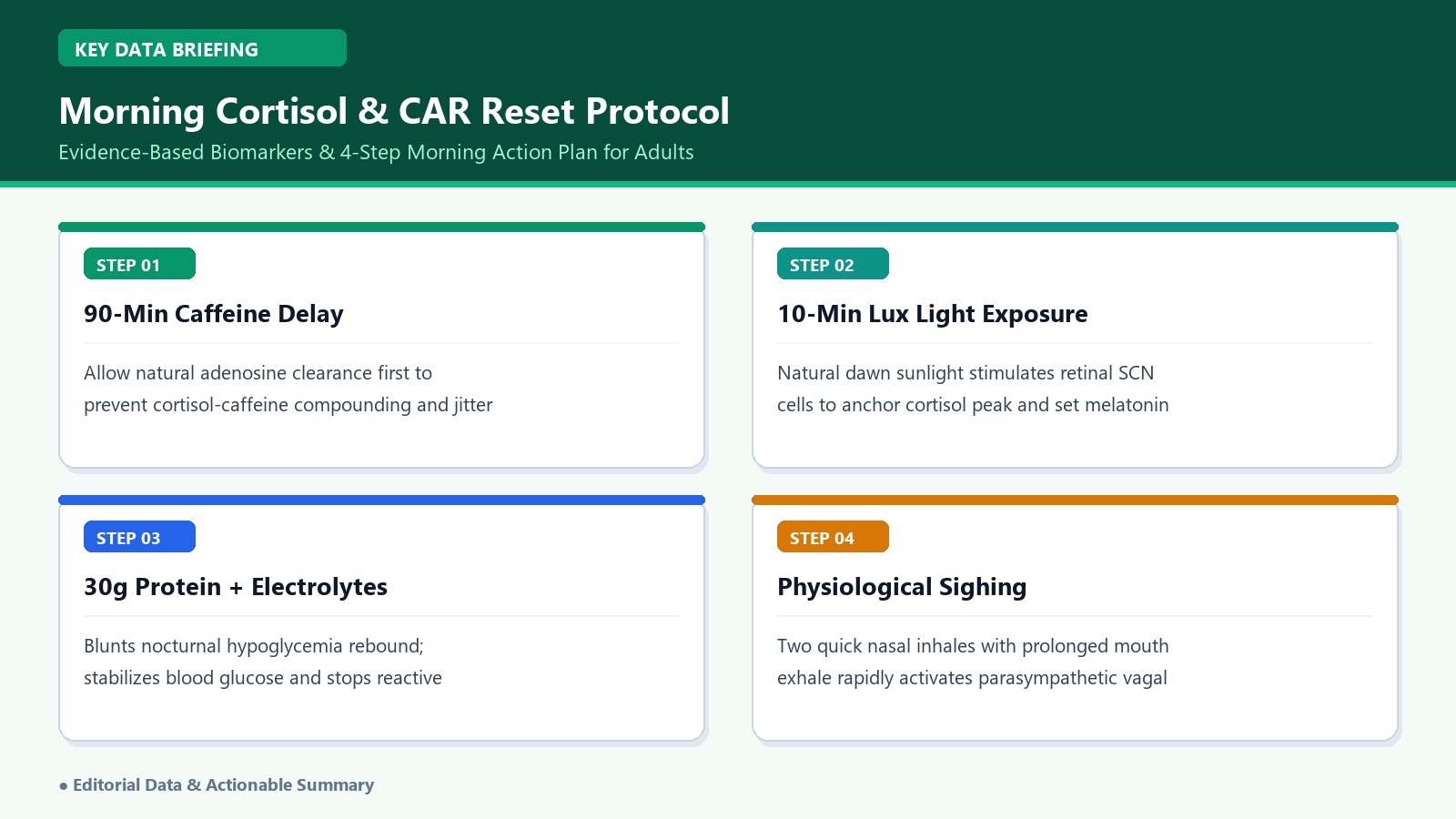
Data summary of the 4-step clinical protocol designed to modulate the Cortisol Awakening Response and prevent morning anxiety surges.
4. Evidence-Based Supplements to Modulate Morning Cortisol and Anxiety
While behavioral protocols form the bedrock of endocrine recovery, targeted micronutrient and botanical interventions can substantially accelerate HPA axis stabilization. The key is understanding exact pharmacological mechanisms and avoiding common dosing pitfalls:
| Compound & Active Form | Target Clinical Dose | Optimal Timing | Primary Mechanism of Action | Clinical Precautions |
|---|---|---|---|---|
| Phosphatidylserine (Sunflower PS) | 300 to 400 mg | Bedtime or wake-up | Blunts excessive ACTH release at the anterior pituitary; reduces acute peak cortisol by up to 30% in randomized trials | Avoid soy-derived variants if sensitive; take consistently for at least 3 weeks |
| L-Theanine (Suntheanine) | 200 to 400 mg | Upon waking with water | Antagonizes central glutamate receptors; induces relaxing cortical alpha-wave activity (8–12 Hz) within 35 minutes | Completely non-sedating; pairs exceptionally well with delayed morning matcha or green tea |
| Magnesium Glycinate / Bisglycinate | 200 to 350 mg elemental | 60 min before sleep | Inhibits excitatory NMDA receptor signaling; acts as cofactor for enzymes converting tryptophan into serotonin and melatonin | Select fully chelated TRAACS forms; if you experience paradox agitation, check our guide on magnesium glycinate paradox reactions |
| Ashwagandha (Sensoril vs KSM-66) | 125 mg (Sensoril) / 300 mg (KSM) | Evening with dinner | Withanolides mimic GABA receptor binding; clinical trials report a 27.9% reduction in chronic serum cortisol | Must be cycled (5 days on, 2 days off) to avoid anhedonia or emotional blunting; avoid in autoimmune thyroid disease |

Hydration pre-loading with trace minerals, adaptogenic botanicals, and warm herbal infusions gently calms the autonomic nervous system.
5. Clinical Red Flags: When Morning Anxiety Signals an Underlying Endocrine Disorder
While 85% of morning dread cases respond dramatically to circadian and nutritional alignment, it is clinically critical to differentiate functional HPA axis hyperactivity from organic endocrine or pulmonary pathology. According to clinical diagnostic guidance from the Mayo Clinic and endocrinology research from the National Institutes of Health (NIH), arrange comprehensive laboratory evaluation if you experience any of the following clinical warning signs:
Diagnostic Warning Checklist (Consult an Endocrinologist):
- Cushing’s Syndrome Signs: Rapid central adiposity, round “moon face”, purple abdominal striae wider than 1 cm, and persistent proximal muscle weakness.
- Addison’s Disease / Primary Adrenal Insufficiency: Severe postural dizziness upon standing, dark hyperpigmentation on gums or skin creases, and severe unremitting salt cravings with dangerously low blood pressure (<90/60 mmHg).
- Undiagnosed Obstructive Sleep Apnea (OSA): Chronic loud snoring, morning dry mouth, gasping for air at night, or waking with a dull front-of-head tension headache (hypoxic episodes trigger massive nocturnal adrenaline dumps).
- Recommended Testing Modality: Order a 4-Point Salivary Cortisol with DHEA-S curve (samples collected at wake-up, +30 min, 12:00 PM, 5:00 PM, and bedtime) or a comprehensive DUTCH dried urine test rather than a single morning serum draw, which cannot assess the dynamic slope of the awakening response.
6. Frequently Asked Questions (FAQ): Morning Cortisol Spike Anxiety Wake Up Protocol
Q1: Why does morning anxiety peak between 30 and 45 minutes after waking rather than immediately when I open my eyes?
This timing corresponds precisely to the physiological apex of the Cortisol Awakening Response (CAR). When your eyes detect morning ambient light, the anterior hypothalamus signals the pituitary to release adrenocorticotropic hormone (ACTH), which travels via the bloodstream to stimulate adrenocortical cortisol synthesis. It takes approximately 30 to 45 minutes for synthesized cortisol to reach peak concentrations in peripheral tissues and cross the blood-brain barrier into emotional processing centers like the amygdala.
Q2: Can drinking warm water with mineral salt immediately upon waking lower morning cortisol levels?
Yes, through two distinct physiological pathways. During 7 to 8 hours of nocturnal breathing, you lose between 500 mL and 1,000 mL of water through respiration and perspiration, creating mild relative hypovolemia. Decreased blood plasma volume forces the sympathetic nervous system to increase pulse and release aldosterone and cortisol to maintain blood pressure. Providing 16 oz of water with natural unrefined salt expands intravascular volume, terminating this hypovolemic stress reflex within 15 minutes.
Q3: Should I avoid high-intensity exercise (HIIT) if my morning cortisol and anxiety are already elevated?
Yes. High-intensity interval training or heavy resistance training temporarily spikes systemic cortisol by 40% to 80% to fuel muscular glycolysis. When your HPA axis is already hyper-reactive, an intense 6:30 AM workout compounds allostatic load, worsening afternoon fatigue and evening insomnia. Instead, shift morning exercise to Zone 2 cardiovascular walking outdoors (heart rate 60%–70% of max) or gentle mobility stretching, reserving high-intensity workouts for 12:00 PM to 4:00 PM when cortisol naturally drops.
Q4: How long does it take for the 4-step wake-up protocol to normalize the Cortisol Awakening Response?
Clinical observation indicates that acute subjective relief (reduced heart rate, calmer chest, diminished panic sensations) begins within 3 to 5 days as caffeine delay and physiological sighing immediately relieve sympathetic tone. However, full neuroendocrine recalibration—meaning downregulation of over-sensitized pituitary ACTH receptors and normalization of the salivary CAR curve—typically requires 14 to 21 consecutive days of consistent circadian light, protein breakfast timing, and mineral hydration.