

Clinical Biomarker Briefing
Evidence-Based Trichology Protocol
Evidence-Based Trichology Protocol
Ferritin Levels for Hair Growth in Women Over 40: Fast Clinical Facts
1. Standard Lab ‘Normal’ vs Follicular Optimal: Most commercial reference ranges classify serum ferritin down to 12-15 ng/mL as normal. However, trichology studies show active hair follicle cell division stalls below 50 ng/mL, causing chronic telogen shedding.
2. Dermal Papilla Iron Demand: Dermal papilla matrix cells divide every 23 to 72 hours—faster than nearly any other tissue in the body. They require abundant intracellular ferritin to synthesize ribonucleotide reductase, the rate-limiting enzyme in DNA synthesis.
3. The 4-Step Regrowth Rule: Target a serum ferritin floor of 70 to 100 ng/mL using chelated iron bisglycinate dosed on alternate mornings with 200mg of ascorbic acid, bypassing the body’s protective hepcidin blockade.
If you are a woman in your 40s or 50s experiencing sudden, diffuse hair thinning or widening along your central part, you have likely visited a physician, had standard blood work drawn, and heard the frustrating reassurance: “Your labs are completely normal.” Yet every morning, your shower drain and hairbrush tell a starkly different story. The disconnect between routine pathology reports and real-world follicular density stems from a critical clinical reality: standard laboratory reference ranges are designed to detect severe systemic anemia, not to sustain the metabolic machinery required for active hair regrowth.
Understanding your optimal ferritin levels for hair growth in women over 40 is one of the most powerful, evidence-backed interventions available in modern restorative trichology. Serum ferritin serves as your body’s primary intracellular iron storage protein. When ferritin drops below critical thresholds, your body triages available iron away from non-essential luxury organs like hair follicles toward vital survival functions, including cardiac oxygenation and cerebral ATP generation. Here is what peer-reviewed clinical science reveals about ferritin targets, transferrin saturation, and how to safely rebuild hair density.
1. The Latent Iron Deficiency Paradox: Why ‘Normal’ Ferritin Triggers Hair Shedding
In standard clinical laboratories across North America, the reference range for serum ferritin in adult women typically spans from 12 ng/mL to 150 ng/mL. This broad statistical bell curve was established based on large population cohorts where anyone without symptomatic hypochromic microcytic anemia was categorized as “healthy.” But a woman with a ferritin level of 18 ng/mL has depleted bone marrow iron stores. While she may produce enough hemoglobin (12.0 to 15.5 g/dL) to avoid hospitalization or acute fatigue, her hair follicle stem cells are starving.
Hair matrix cells reside at the base of each active hair follicle within the subcutaneous scalp tissue. These rapidly dividing cells must transition through the anagen (growth) phase, which typically lasts between 3 and 7 years. During anagen, hair matrix cells undergo rapid cellular mitosis, requiring continuous ATP generation and DNA replication driven by iron-dependent enzymes like ribonucleotide reductase and cytochrome c oxidase. When circulating ferritin drops below 30 ng/mL, the follicle prematurely truncates anagen and prematurely enters the telogen (resting/shedding) phase—a condition clinically termed Telogen Effluvium.
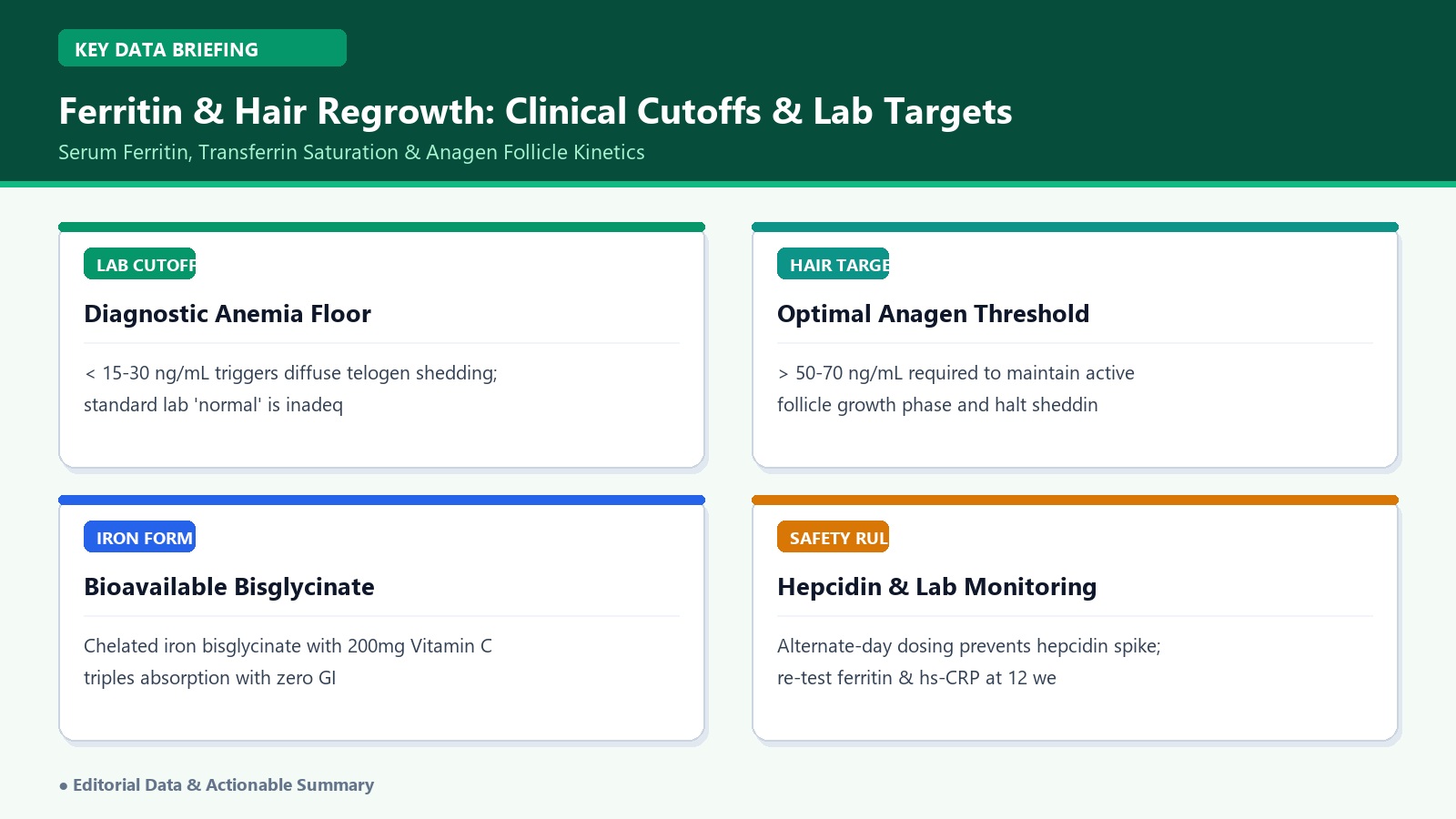
Clinical Serum Ferritin Targets for Telogen Effluvium Reversal vs Standard Pathological Ranges (2026 Evidence Standard)
2. Complete Iron Panel Interpretation: Ferritin, TIBC, and Transferrin Saturation
Ordering serum ferritin alone can be clinically deceptive. Ferritin is what functional biochemists call an “acute-phase reactant.” During episodes of chronic subclinical inflammation, autoimmune activation, fatty liver changes, or viral recovery, serum ferritin levels can artificially spike into the 70 to 120 ng/mL range even when functional intracellular iron stores are critically depleted.
To accurately evaluate your true iron bioavailability, comprehensive trichology guidelines mandate pairing serum ferritin with three companion biomarkers:
1. Transferrin Saturation (TSAT) — Optimal Range: 25% to 40%
TSAT measures the percentage of iron transport proteins currently saturated with iron. Even if ferritin appears moderately elevated (e.g., 65 ng/mL due to joint inflammation), a TSAT below 20% confirms functional cellular iron deficiency. Your hair follicles cannot pull iron out of inflamed storage; they need circulating transferrin to deliver it directly to the hair bulb.
2. Total Iron Binding Capacity (TIBC) — Optimal Range: 250 to 380 mcg/dL
TIBC reflects the liver’s production of transferrin. When your systemic reserves run low, the liver increases TIBC as a cry for more iron. An elevated TIBC (>400 mcg/dL) combined with ferritin under 40 ng/mL confirms an urgent requirement for clinical replenishment.
3. High-Sensitivity C-Reactive Protein (hs-CRP) — Optimal Target: < 0.8 mg/L
Testing hs-CRP alongside ferritin provides a reliable safety cross-check. If your hs-CRP is elevated (>2.0 mg/L), your ferritin reading is almost certainly artificially inflated. In such cases, TSAT and soluble transferrin receptor (sTfR) provide the true gauge of hair follicle nutrition.
In women over 40, perimenopausal hormonal fluctuations exacerbate this dynamic. Heavy, irregular menstrual cycles (menorrhagia) caused by anovulatory cycles can cause sudden, massive blood loss, purging 40 to 80 mg of elemental iron per cycle. Concurrently, natural age-related decreases in gastric parietal cell hydrochloric acid secretion impair the stomach’s ability to ionize non-heme dietary iron from plant and supplement sources.
3. The 4-Step Clinical Regrowth Protocol
Successfully raising serum ferritin to 70 ng/mL without triggering gastrointestinal misery, constipation, or dangerous oxidative overload requires a structured, pharmacologically sound approach. Follow this evidence-based 4-step repletion protocol:
STEP 01
Select Chelated Iron Bisglycinate (Avoid Ferrous Sulfate)
Traditional prescriptions often default to ferrous sulfate (325mg providing 65mg elemental iron). Unfortunately, up to 50% of elemental iron from sulfate salts precipitates as insoluble ferric hydroxide in the alkaline duodenum, causing severe constipation, abdominal cramps, and nausea. Instead, choose ferrous bisglycinate chelate (25 to 36 mg elemental iron). Bound to two glycine molecules, bisglycinate survives gastric acidity intact, absorbs via peptide transport pathways, and boasts a 3.4-fold higher bioavailability with near-zero GI irritation.
STEP 02
Bypass the Hepcidin Blockade with Alternate-Day Morning Dosing
Landmark clinical research published in Blood and The Lancet Haematology overturned the obsolete advice to take iron twice daily. When an oral dose of iron enters your system, the liver immediately secretes hepcidin—the master regulator hormone that locks ferroportin iron export channels. Circulating hepcidin stays elevated for 24 to 48 hours. Taking iron every single day means you swallow the second pill into a closed channel, increasing gut toxicity while absorbing less than 35% of the dose. Dosing every other morning yields 34% higher fractional iron absorption and virtually eliminates bowel distress.
STEP 03
Enforce the 2-Hour Polyphenol & Calcium Buffer with Vitamin C Co-Factor
Always co-administer your iron dose with 200mg of ascorbic acid (Vitamin C) or freshly squeezed lemon water. Ascorbic acid reduces insoluble ferric iron (Fe3+) into soluble, absorbable ferrous iron (Fe2+). Crucially, maintain a strict 2-hour exclusion zone before and after dosing: zero coffee, black/green tea, red wine, calcium carbonate supplements, or dairy. The chlorogenic acids in coffee and epigallocatechin gallate (EGCG) in green tea bind to iron, reducing absorption by up to 80%.
STEP 04
Schedule the 12-Week Biomarker Re-Test & Maintenance Taper
Hair follicles operate on biological delay. Even after serum ferritin climbs from 22 ng/mL to 75 ng/mL, telogen shedding requires roughly 12 to 16 weeks to fully subside because resting hairs take 90 days to naturally release from the follicle canal. Schedule repeat blood work at exactly 12 weeks. Once ferritin stabilizes between 70 and 90 ng/mL, taper your supplementation to a weekly maintenance dose (or dietary focus on organic pastured beef liver, shellfish, and pumpkin seeds) to avoid iron overload.

Evidence-Based Iron Bisglycinate Protocol Paired with Ascorbic Acid Co-Factors (2026 Regrowth Architecture)
4. Critical Drug Interactions & Co-Factor Cross-Screening
Before initiating any iron repletion regimen, women over 40 must account for three widespread medication interactions and systemic cross-factors:
The Levothyroxine 4-Hour Separation Rule: Hypothyroidism and subclinical Hashimoto’s thyroiditis are common culprits in adult hair loss. If you take levothyroxine (Synthroid), taking iron anywhere near your thyroid medication creates an insoluble chemical complex, rendering both drugs completely inert. You must separate oral iron and levothyroxine by a minimum of 4 full hours.
Proton Pump Inhibitors (PPIs) and Antacids: Medications like omeprazole, pantoprazole, or chronic calcium antacids suppress stomach acid (gastric pH > 5.0). Gastric acid is essential for cleaving dietary iron from food matrices. If you require acid suppression, liquid or chelated bisglycinate forms combined with 500mg of ascorbic acid are mandatory to achieve intestinal absorption.
The Essential Co-Factor Trio (Vitamin D, Zinc, Vitamin B12): Ferritin does not operate in isolation. Dermal papillae also require optimal circulating 25-hydroxy Vitamin D (target: 50 to 80 ng/mL), serum zinc (optimal: 90 to 120 mcg/dL), and active Vitamin B12 (target: >500 pg/mL). Deficiencies in any of these three co-factors can cause persistent telogen effluvium even after serum ferritin crosses 70 ng/mL.
5. Frequently Asked Questions (FAQ)
Q1: How long does it take for hair shedding to stop once ferritin reaches 50 ng/mL?
Expect a clinical lag of 8 to 16 weeks. The human hair cycle dictates that follicles that entered the telogen (resting) phase 3 months ago will inevitably shed, regardless of recent iron gains. Once serum ferritin sustains above 50 to 70 ng/mL for at least 60 days, active shed rates drop noticeably from 150+ hairs daily to the normal physiological baseline of 50 to 80 hairs daily.
Q2: Why did my primary physician say my ferritin of 22 ng/mL is normal when my hair is falling out?
Standard hospital pathology laboratories establish reference ranges to diagnose acute illness, primarily hemolytic or microcytic iron deficiency anemia. A level of 22 ng/mL means your red blood cells can carry enough oxygen to maintain life. However, trichology and dermatology research in the British Journal of Dermatology confirms that cosmetic and follicular anagen viability requires more than triple that baseline—specifically 70 ng/mL or higher.
Q3: Can taking iron supplements cause iron overload, and is it safe to take without testing?
Never initiate high-dose iron supplementation without baseline blood work. The human body lacks an active physiological excretion pathway for excess iron (it is only lost through bleeding or cellular sloughing). Individuals with hereditary hemochromatosis (HFE gene mutations) can accumulate toxic iron in the liver, pancreas, and heart. Always confirm baseline ferritin and transferrin saturation prior to supplementing, and re-test at 12 weeks.
Q4: Will biotin or collagen help if low ferritin is the true root cause of my hair thinning?
No. While biotin supports keratin infrastructure and collagen peptides provide amino acid building blocks, neither can replace the cofactor requirement of ribonucleotide reductase in dividing follicular stem cells. Taking biotin without addressing a ferritin deficiency under 30 ng/mL is like adding premium motor oil to an engine with no fuel. In fact, high-dose biotin can artificially distort thyroid and cardiac troponin blood tests, and should be discontinued 72 hours prior to lab draws.
Clinical Medical Disclaimer: This article is for informational and educational purposes only and does not constitute individual medical diagnosis or treatment advice. Always consult your board-certified physician, dermatologist, or functional endocrinologist before starting iron supplementation, especially if you have a history of liver disease, thyroid disorders, or genetic hemochromatosis.