

Editor’s 1-Minute Briefing
Endocrine Society & NIH Clinical Consensus (2026)
Endocrine Society & NIH Clinical Consensus (2026)
Vitamin D Blood Level 50 vs 80 ng/mL Safety: Why 40–55 ng/mL Wins for Most Adults Over 40
1. The Structural Difference: A serum 25-hydroxyvitamin D [25(OH)D] concentration of 50 ng/mL (125 nmol/L) sits cleanly inside the peak bone and immune physiology window, whereas 80 ng/mL (200 nmol/L) approaches the upper safety margin where urinary calcium excretion climbs.
2. Benefit-to-Risk Verdict: Randomized clinical trials and NIH Office of Dietary Supplements safety reviews show maximal parathyroid hormone (PTH) suppression and calcium absorption already plateau near 38–50 ng/mL. Pushing to 80 ng/mL adds zero extra fracture or mortality benefit for healthy adults.
3. 1-Second Selection Rule: Target 40–55 ng/mL using 2,000–4,000 IU of D3 paired with Vitamin K2 (MK-7) and magnesium. Reserve 60–75 ng/mL strictly for physician-monitored autoimmune or malabsorption cases, and avoid sustaining 80+ ng/mL unmonitored.
Chasing an aggressive supplement lab score can quietly backfire after age 40. Many health-conscious adults read longevity forums, swallow 10,000 IU of cholecalciferol daily without checking calcium, and wonder whether vitamin d blood level 50 vs 80 ng ml safety actually differs once your lab result clears the standard 30 ng/mL threshold.
The short answer from Endocrine Society clinical guidelines and PubMed randomized trials is unequivocal: more is not linearly better. Above 50–60 ng/mL, intestinal calcium uptake keeps climbing even after bone mineralization saturates, raising hypercalciuria and kidney stone risk if cofactors or baseline kidney reserve are overlooked.
1. Vitamin D Blood Level 50 vs 80 ng/mL Safety: 7-Factor Clinical Matrix
When clinicians evaluate vitamin d blood level 50 vs 80 ng ml safety, they examine seven physiological markers simultaneously rather than serum 25(OH)D in isolation. Review how 50 ng/mL compares directly against 80 ng/mL across endocrine suppression, kidney calcium load, and long-term safety trials.
2. How to Read Vitamin D Blood Test Results: 40–55 ng/mL vs. 60–80 ng/mL
Before adjusting your dosage, confirm the exact test name and unit on your laboratory portal. Physicians measure total 25-hydroxyvitamin D—also printed as 25(OH)D—rather than active 1,25-dihydroxyvitamin D, which can look falsely normal even during severe deficiency. Always multiply ng/mL by 2.5 if comparing US reports against European or Canadian nmol/L ranges.
TARGET 40–55 ng/mL WINNER
Best for Healthy Adults Over 40
Ideal if your priority is bone density preservation, winter respiratory resilience, muscle protein synthesis, and zero kidney stone provocation. Natural outdoor sun exposure in lifeguards rarely pushes serum 25(OH)D past 55–65 ng/mL because UV light self-regulates skin conversion.
MONITORED 60–75 ng/mL ZONE
Specific Physician-Guided Cases Only
Some specialists cautiously target 60–75 ng/mL for celiac disease, bariatric surgery malabsorption, severe osteomalacia recovery, or specific autoimmune protocols—always paired with periodic serum calcium, eGFR, and urinary calcium monitoring.
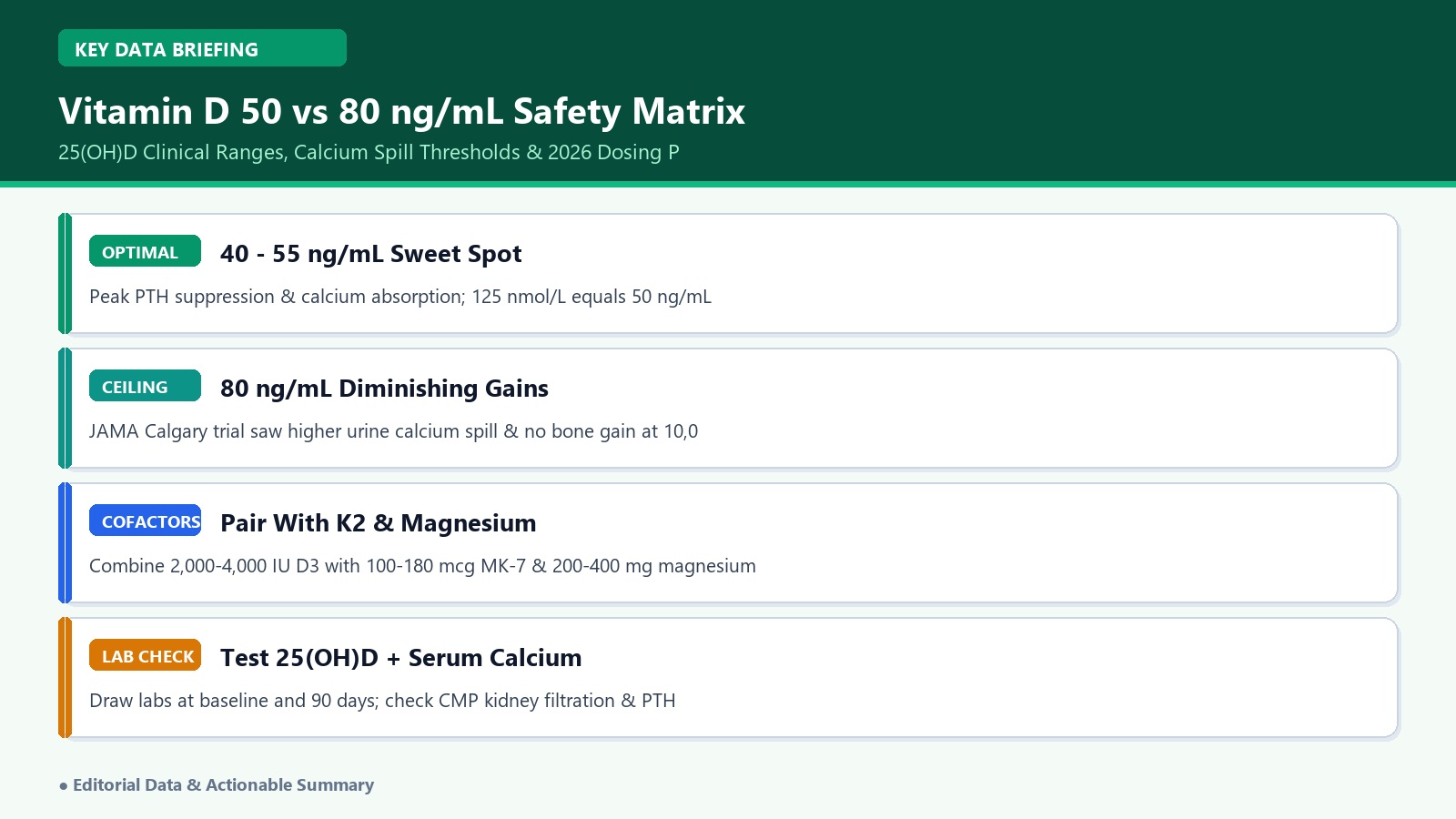
Figure 1: Vitamin D Blood Level 50 vs 80 ng/mL Safety Matrix — Lab Targets, Calgary Bone Trial Findings & Cofactor Synergy
3. Dosing Simulation: Why 80 ng/mL Triggers Diminishing Returns & Calcium Spill
A landmark three-year randomized trial from the University of Calgary published in JAMA compared 400 IU, 4,000 IU, and 10,000 IU daily in healthy adults aged 55 to 70. Participants taking 10,000 IU reached ~58–80 ng/mL, yet experienced statistically greater radial bone density loss and triple the hypercalciuria rate compared with the 400–4,000 IU arms.

Figure 2: Calcium-Vitamin D Equilibrium — Balancing Bone Mineralization Without Arterial or Renal Calcium Spill
4. 4-Step Protocol to Maintain Safe Vitamin D Blood Levels After 40
Because cholecalciferol is fat-soluble and stored inside adipose tissue, blood levels respond slowly over 8 to 12 weeks. Follow these four clinical steps to lock in the 40–55 ng/mL target without drifting toward unsafe territory.
STEP 01 — BASELINE LABS
Order 25(OH)D + Serum Calcium
Never megadose blindly. Request a 25-hydroxyvitamin D [25(OH)D] test alongside a Comprehensive Metabolic Panel (CMP) so you know both serum calcium and eGFR kidney filtration before supplementing.
STEP 02 — COFACTOR STACK
Pair With K2 (MK-7) & Magnesium
Every enzyme that converts Vitamin D into its active hormone requires magnesium (200–400 mg/day). Adding 100–180 mcg of Vitamin K2 (MK-7) activates osteocalcin and Matrix Gla Protein to steer calcium into bone rather than arteries.
STEP 03 — TIMING & FORM
Take D3 With Your Largest Meal
Taking Vitamin D3 alongside a meal containing 10–15 g of healthy fat boosts absorption by 32% to 50% compared with fasting water intake. Take it at breakfast or lunch so it never nudges evening melatonin suppression.
STEP 04 — 90-DAY RETEST
Verify Steady-State Ceiling
As a rough rule, every 1,000 IU of daily D3 raises serum 25(OH)D by 6 to 10 ng/mL after 12 weeks. If your retest reads 65–80 ng/mL, step down your daily dose by 50% and verify normal serum calcium.
5. Hidden Traps: Toxicity Thresholds, Kidney Stones & Drug Interactions
Clinical Caution: 3 Situations Where Even 50–80 ng/mL Requires Extra Oversight
1. Thiazide Diuretics & Calcium Pills: Blood pressure medications such as hydrochlorothiazide reduce urinary calcium excretion. Combining thiazides with high-dose Vitamin D and 1,000 mg calcium supplements can trigger silent hypercalcemia even below 80 ng/mL.
2. Granulomatous Conditions & Hyperparathyroidism: Sarcoidosis, tuberculosis, and primary hyperparathyroidism convert 25(OH)D into active 1,25(OH)2D outside normal kidney feedback, causing dangerous calcium spikes at modest doses.
3. Vitamin D Toxicity Reality (> 100–150 ng/mL): Acute clinical toxicity—manifesting as nausea, excessive thirst, polyuria, constipation, confusion, or vascular calcification—typically starts above 100–150 ng/mL, though subtle kidney stone risk begins rising much earlier above 60–80 ng/mL.
6. Frequently Asked Questions (FAQ): Vitamin D Blood Level 50 vs 80 ng/mL Safety
Q1: Is a vitamin D blood level of 80 ng/mL dangerous or toxic?
A single reading of 80 ng/mL (200 nmol/L) rarely causes acute vitamin D intoxication on its own—true hypercalcemic toxicity usually appears above 100–150 ng/mL. However, maintaining 80 ng/mL year-round sits above the 50–60 ng/mL threshold flagged by the NIH and increases urinary calcium loss and kidney stone formation without delivering extra clinical upside over 50 ng/mL.
Q2: What is the exact vitamin D blood test name I should ask my doctor for?
Ask specifically for 25-hydroxyvitamin D (often abbreviated as 25(OH)D or calcidiol). Do not order 1,25-dihydroxyvitamin D for routine screening, because parathyroid hormone artificially boosts 1,25(OH)2D levels when your true Vitamin D reserves are depleted.
Q3: How to read vitamin D blood test results when comparing ng/mL vs nmol/L?
Divide nmol/L by 2.5 to convert into US ng/mL units. For example, 125 nmol/L equals 50 ng/mL (ideal optimal ceiling), while 200 nmol/L equals 80 ng/mL. Deficiency is defined below 20 ng/mL (50 nmol/L), and sufficiency begins at 30 ng/mL (75 nmol/L).
Q4: Does Vitamin K2 eliminate all risk of high Vitamin D levels near 80 ng/mL?
No. Vitamin K2 (MK-7 at 100–180 mcg/day) helps carboxylate bone matrix proteins so absorbed calcium deposits cleanly into bone tissue rather than blood vessels, yet K2 cannot stop excessive intestinal calcium absorption or prevent kidney stones if Vitamin D exceeds physiological ranges.
Q5: How fast does a vitamin D level of 80 ng/mL drop down to 50 ng/mL if I pause?
Serum 25(OH)D has a biological half-life of roughly 15 to 25 days. Pausing supplementation completely for 4 to 6 weeks—while continuing normal magnesium-rich meals and hydration—typically brings an 80 ng/mL reading back into the safe 45–55 ng/mL range before resuming a lower 2,000 IU maintenance dose.
Related Clinical Protocols & Evidence Guides
Medical Disclaimer: This article is for educational purposes only and does not replace individualized medical advice. Vitamin D dosing and target serum 25(OH)D thresholds depend on baseline kidney function, parathyroid status, medications, and granulomatous conditions. Always review lab results with a licensed physician before changing supplement doses.