
EDITOR’S 1-MINUTE CLINICAL BRIEFING
Taking Supplements on an Empty Stomach vs. After Meals: 3 Golden Rules
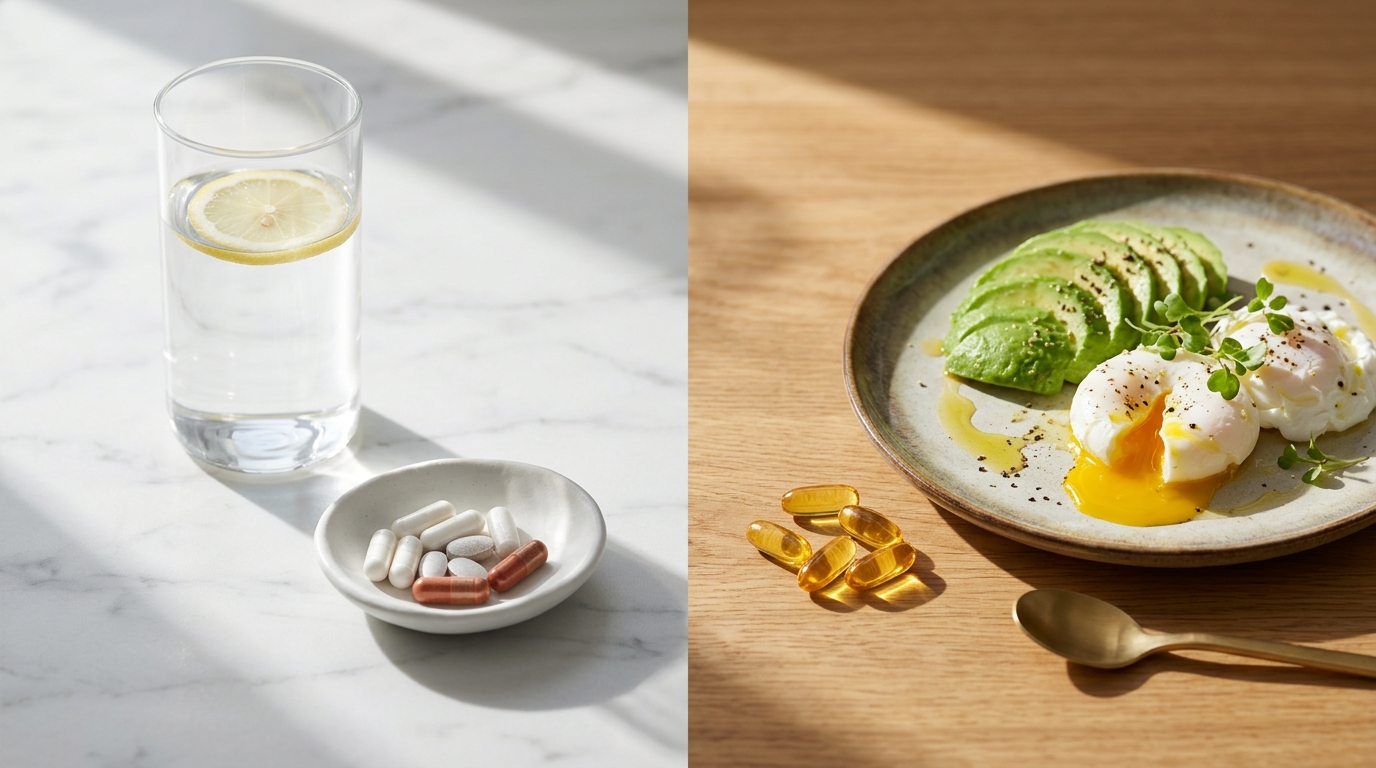
- #1 The 12-Gram Fat Rule for Fat-Soluble Nutrients (+32% to +300% Absorption): Swallowing Vitamin D3 + K2, CoQ10 Ubiquinol, Omega-3 Fish Oil, Curcumin, or Lutein on an empty stomach with black coffee wastes up to 70% of the dose. They require 10g–15g of dietary fat (eggs, avocado, olive oil, or Greek yogurt) to trigger gallbladder bile micelles.
- What Strictly Requires an Empty Stomach (30–60 Min Pre-Meal): Chelated Iron Bisglycinate, free-form amino acids (NAC, L-Tyrosine, L-Glutamine), and systemic proteolytic enzymes must be taken away from food so dietary phytates, calcium, and competing proteins do not block intestinal transporters.
- Circadian Clock Alignment: Take ATP/dopamine activators (B-Complex, Vitamin D3, CoQ10, Rhodiola, Maca) before 1:00 PM, and reserve NMDA/GABA relaxants (Magnesium Bisglycinate, Glycine, L-Theanine, Apigenin) for 60 minutes after dinner.
Knowing the exact pharmacokinetics of taking supplements on an empty stomach vs after meals is the easiest way to double the clinical efficacy of your daily longevity regimen without spending a single extra dollar. Most adults over 40 keep all their supplement bottles clustered next to the coffee maker, swallowing a handful of capsules at 7:00 AM on an empty stomach—and inadvertently flushing 50% to 80% of their expensive fat-soluble softgels straight through the digestive tract unabsorbed, while triggering preventable acid reflux or nausea.
According to clinical nutrition trials from the NIH Office of Dietary Supplements and human bioavailability studies conducted at Tufts University (published in the Journal of the Academy of Nutrition and Dietetics), intestinal absorption is governed by three biological gates: gallbladder bile-acid micelle formation, gastric pH ionization, and competitive amino-acid/mineral carrier proteins (DMT1 and LAT1). Below is the complete 24-hour clinical timing schedule.
1. Master Clinical Matrix: Taking Supplements on an Empty Stomach vs. After Meals
Use this quick-reference pharmacokinetic table to audit your current cabinet and assign every capsule or powder to its highest-absorption window:
| Timing Window | Specific Supplements Included | Biological Mechanism & Absorption Gain | What to Avoid Mixing |
|---|---|---|---|
| 1. Morning Empty Stomach (30–45 Min Pre-Breakfast) | • Iron Bisglycinate (+ 250mg Vitamin C) • NAC (N-Acetyl Cysteine) & L-Tyrosine • Sublingual Methyl-B12 • Collagen Peptides (Pre-exercise) |
Prevents dietary phytates, tannins, and protein amino acids from competing for DMT1 and L-type intestinal transporters (+40%–65% uptake) | Black coffee/tea within 60 min of Iron (polyphenols block iron by 60%) & Calcium |
| 2. With Breakfast or Lunch (Must Contain 12g+ Fat) | • Vitamin D3 + Vitamin K2 (MK-7) • CoQ10 Ubiquinol • Methylated B-Complex • Gelatinized Maca & Curcumin |
Dietary fat stimulates CCK hormone, releasing bile salts and pancreatic lipase to package lipophilic compounds into chylomicrons (+32%–50% higher serum D3) | Taking D3, B-Complex, or CoQ10 after 2:00 PM (can blunt nocturnal melatonin) |
| 3. With Dinner (Main Evening Meal) | • Omega-3 Fish Oil (EPA/DHA) • Lutein, Zeaxanthin & Astaxanthin • Zinc Picolinate / Bisglycinate (15mg) • Calcium Citrate (500mg max) |
Taking Omega-3 and Zinc in the middle of a solid meal eliminates “fishy burps” and completely prevents zinc-induced gastric nausea | Do not take Zinc >25mg at the exact same moment as high-dose Iron or Magnesium |
| 4. Pre-Bedtime Window (60 Min Before Sleep) | • Magnesium Bisglycinate or L-Threonate • Phosphatidylserine (200mg) • L-Theanine (200mg) & Glycine (3g) • Psyllium Husk Fiber (2h away from meds) |
Calms hypothalamic NMDA glutamate receptors, drops core body temperature by 0.5°F, and prevents 3:00 AM cortisol awakenings | Keep psyllium/soluble fiber at least 90–120 minutes apart from prescription drugs |
2. Why Fat-Soluble Supplements Fail on an Empty Stomach (The Bile Micelle Gate)
When evaluating taking supplements on an empty stomach vs after meals, the biggest financial waste occurs with lipophilic (fat-loving) molecules: Vitamins A, D3, E, and K2, plus CoQ10 Ubiquinol, Omega-3 EPA/DHA, Curcumin, and Carotenoids (Lutein/Astaxanthin). These compounds cannot dissolve in the watery environment of your small intestine on their own.
To cross the intestinal brush border into your lymphatic system, your duodenum must sense at least 10 to 15 grams of dietary fat (equivalent to two whole eggs, half an avocado, or a tablespoon of extra-virgin olive oil). That fat triggers enteroendocrine I-cells to secrete cholecystokinin (CCK), which contracts the gallbladder to release bile salts and signals the pancreas to release pancreatic lipase.
Bile salts wrap around the fat-soluble vitamin droplets to form microscopic spheres called mixed micelles. In a landmark clinical trial by Dawson-Hughes et al. at Tufts University, adults who took their Vitamin D3 supplement with a meal containing 11g of monounsaturated fat achieved a 32% to 50% greater peak rise in plasma 25(OH)D than those who took the exact same capsule on an empty stomach (for age-specific D3+K2 targets, see our Decade-by-Decade Supplement Recommendations After 40).
3. What Must Be Taken on an Empty Stomach (And How to Prevent Nausea)
Conversely, three categories of supplements lose potency if swallowed alongside a heavy meal:
1. Single Free-Form Amino Acids (NAC, L-Tyrosine, 5-HTP, L-Glutamine)
If you take 500 mg of L-Tyrosine (for morning dopamine focus) or 600 mg of N-Acetyl Cysteine (NAC) (for glutathione synthesis) right after eating a 35g protein omelette, your single amino acid capsule has to compete against 35,000 mg of food-derived amino acids for the exact same intestinal and blood-brain-barrier LAT1 transporter. Take single amino acids with 8 oz of water 30 to 45 minutes before breakfast.
2. Iron Bisglycinate (The 48-Hour Hepcidin & Coffee Rule)
Non-heme iron absorption drops by 50% to 70% if taken with calcium-rich dairy, whole-grain phytic acid, or polyphenol-rich coffee and black tea. As detailed in our Clinical Guide to Safe Iron Supplement Intake After 40, take 25–36 mg of chelated Iron Bisglycinate every other morning on an empty stomach with 250 mg of Vitamin C, and wait 60 minutes before drinking your morning coffee.
3. Water-Soluble B-Vitamins & Zinc: When “Empty Stomach” Backfires
Although B-Complex and Vitamin C are water-soluble and can absorb on an empty stomach, high-potency methylated B-vitamins and Zinc (even chelated zinc picolinate) frequently irritate gastric mucosal vagal nerves when taken into an empty stomach, causing a sudden wave of nausea 15 minutes later. Always take Zinc with lunch or dinner, and take your B-Complex mid-breakfast (for more solutions to capsule-induced reflux, read How to Manage & Prevent Supplement Side Effects).

4. Mineral Collisions & Prescription Medication Spacing Rules After 40
Beyond taking supplements on an empty stomach vs after meals, adults over 40 must prevent divalent cation competition—where two positively charged minerals fight for the same intestinal doorway—and protect prescription medication pharmacokinetics:
- Levothyroxine / Thyroid Hormone Rule (Strict 4-Hour Separation): Calcium, Iron, Magnesium, and Chromium bind directly to levothyroxine in the stomach, forming an insoluble chelate that causes hypothyroidism to return even while taking your medication. Take thyroid hormone at 6:30 AM with plain water, and do not take any mineral supplements until 10:30 AM or lunchtime.
- Calcium vs. Magnesium & Iron Spacing: The human intestine cannot absorb more than 500 mg of elemental calcium at one time, and high-dose calcium blocks both iron and magnesium transport. Take Calcium Citrate with lunch (see Effective Tips to Enhance Calcium Absorption) and save Magnesium Bisglycinate for 9:00 PM.
- Soluble Fiber (Psyllium / Glucomannan) Buffer: Viscous soluble fibers lower LDL/ApoB cholesterol and post-meal glucose, but their gel matrix can trap vitamin and medication molecules if swallowed together. Leave a 90-to-120-minute window between psyllium husk and your core supplement stack.
5. Frequently Asked Questions (FAQ)
Q1. Should I take probiotics on an empty stomach or with food?
In landmark gastrointestinal survival trials by Tompkins et al., non-enteric-coated Lactobacillus and Bifidobacterium probiotics had the highest survival rate when taken within 30 minutes before a meal or right at the start of a meal containing a small amount of fat and oatmeal/milk, which buffers harsh fasting stomach acid (pH 1.5 → pH 3.5). Spore-based probiotics (Bacillus coagulans/subtilis) and delayed-release capsules can be taken anytime.
Q2. Does black coffee or espresso count as “food” for fat-soluble vitamins, or does it block supplements?
Black coffee contains zero grams of fat—so it will not trigger the gallbladder bile release needed to absorb Vitamin D3, K2, CoQ10, or Omega-3s. Worse, the chlorogenic acid polyphenols in coffee reduce iron absorption by up to 60% and speed up urinary excretion of water-soluble B-vitamins and magnesium. Wait 45 to 60 minutes after coffee, or take your fat-soluble stack with solid food.
Q3. Does Creatine Monohydrate need to be taken on an empty stomach or pre-workout?
No. Creatine works via long-term intramuscular phosphocreatine saturation rather than acute stimulant spikes. In fact, taking 5 grams of micronized creatine monohydrate alongside a meal containing protein and carbohydrates slightly enhances muscle uptake via insulin-mediated sodium-creatine cotransporters while eliminating any chance of stomach cramping.