
EXECUTIVE CLINICAL BRIEFING | PREVENTIVE CARDIOLOGY
How to Lower ApoB Naturally: The 2026 Evidence-Based Lipidology Protocol
- The Definitive Atherogenic Metric: Apolipoprotein B (ApoB) measures the exact total count of atherogenic particles—including LDL, VLDL, and IDL—delivering far superior predictive accuracy for coronary heart disease than traditional LDL-C concentration.
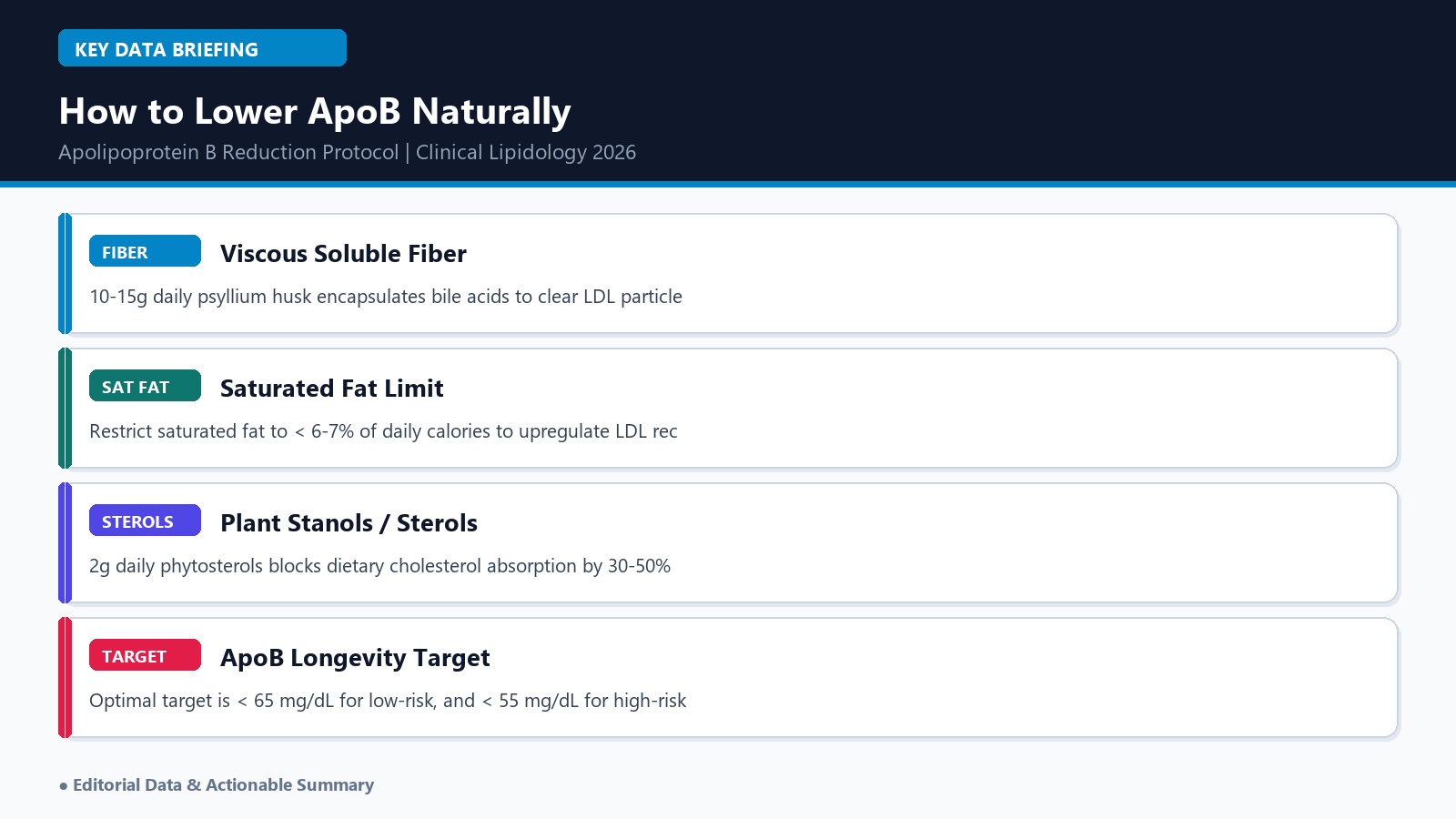
- Viscous Fiber Sequestration: Consuming 10 to 15 grams of soluble viscous fiber daily (psyllium husk and oat beta-glucan) traps intestinal bile acids, forcing the liver to clear circulating ApoB particles to synthesize new bile salts.
- Targeted Lipid Thresholds: Clinical consensus targets are below 80 mg/dL for primary cardiovascular prevention and below 55 mg/dL for high-risk patients. Strict dietary interventions lower baseline ApoB by 15% to 28% within 8 to 12 weeks.
Discovering how to lower apob naturally represents the frontline strategy in modern preventive lipidology and cardiovascular longevity. While routine blood tests measure total LDL cholesterol by weight (mg/dL), apolipoprotein B measures the absolute numerical concentration of atherogenic particles capable of infiltrating the arterial endothelium and initiating plaque formation.
In clinical research published in the Journal of the American College of Cardiology and documented by the National Institutes of Health (NIH), each ApoB particle contains exactly one molecule of apolipoprotein B-100. Lowering particle count directly reduces endothelial collisions, stabilizing vascular intima and halting arterial calcification across lifespan.
1. Clinical Benchmarks: How to Lower ApoB Naturally Target Levels
To evaluate treatment response when determining how to lower apob naturally, preventive cardiologists cross-reference fasting blood panels against four risk stratification tiers established by the European Society of Cardiology and the National Lipid Association:
| Cardiovascular Risk Tier | ApoB Target Range | Equivalent LDL-C | Clinical Recommendation |
|---|---|---|---|
| Optimal Longevity Target | < 65 mg/dL | < 80 mg/dL | Near-zero arterial wall penetration rate |
| Moderate Primary Prevention | 65 – 80 mg/dL | 80 – 100 mg/dL | Standard guideline target for healthy adults |
| Borderline Elevated | 81 – 99 mg/dL | 101 – 129 mg/dL | Requires strict dietary fiber and fat modifications |
| High Atherogenic Risk | ≥ 100 mg/dL | ≥ 130 mg/dL | High coronary calcium score risk; clinical intervention |
In clinical trials reviewing discordance between LDL-C and ApoB, patients with low LDL-C but high ApoB experience identical heart attack rates to patients with elevated LDL-C. This proves that particle number, rather than the amount of cholesterol carried inside each particle, drives cardiovascular plaque burden.
2. Viscous Fiber Protocols: How to Lower ApoB Naturally
Protocol 1: Psyllium Husk Sequestration (10g to 15g Daily)
Psyllium husk forms a dense viscous gel in the small intestine that encapsulates bile acids, preventing their reabsorption in the terminal ileum. Because bile acids are synthesized from hepatic cholesterol, the liver upregulates cell-surface LDL receptors to extract ApoB particles from circulation:
Target Dosing: 5g unflavored psyllium husk dissolved in 350mL water twice daily before meals
In randomized clinical trials published by the Mayo Clinic, consistent daily psyllium intake reduced ApoB concentrations by an average of 11.8 mg/dL (14.2%) within 8 weeks without altering protective HDL subfractions.
Protocol 2: Oat Beta-Glucan & Fermentable Pectin (3g to 5g Daily)
Beta-glucan fibers derived from steel-cut oats and barley stimulate colonic production of propionate, a short-chain fatty acid that inhibits hepatic HMG-CoA reductase, the rate-limiting enzyme in endogenous cholesterol synthesis. Consuming 3 grams of pure beta-glucan daily (equivalent to 1.5 cups of cooked steel-cut oats or 45 grams of oat bran) provides a synergistic 6% to 9% additional ApoB reduction.
3. Saturated Fat Reduction & Phytosterols: How to Lower ApoB Naturally
Saturated fatty acids—particularly palmitic (C16:0) and myristic acid (C14:0) found in butter, palm oil, and fatty cuts of red meat—downregulate hepatic LDL receptor activity by altering cell membrane fluidity. When evaluating how to lower apob naturally, limiting saturated fat intake to under 6% to 7% of total daily caloric intake (approximately 13 to 16 grams for a 2,000-calorie diet) is the single most potent lever for upregulating LDL clearance.
Plant Sterols and Stanols (2.0 Grams Daily)
Plant phytosterols possess a chemical structure nearly identical to human cholesterol, competing directly for incorporation into mixed micelles in the intestinal lumen. By displacing cholesterol from the Niemann-Pick C1-Like 1 (NPC1L1) enterocyte transporter, 2.0 grams of phytosterols daily decreases dietary cholesterol absorption by 30% to 50%, translating to an average 8% to 12% drop in circulating ApoB according to data from Harvard Medical School.

4. Exercise and Metabolic Protocols: How to Lower ApoB Naturally
While dietary fat and fiber directly control hepatic LDL receptor kinetics, metabolic exercise protocols target the production rate of very-low-density lipoproteins (VLDL). When applying methods on how to lower apob naturally, incorporate these two evidence-based physical conditioning strategies:
Zone 2 Aerobic Conditioning (150–180 Minutes Weekly)
Low-intensity Zone 2 training (exercising at a conversational pace corresponding to 65% to 75% of maximum heart rate) maximizes mitochondrial lipid oxidation. Prolonged Zone 2 bouts activate hepatic AMP-activated protein kinase (AMPK), suppressing liver fat accumulation and trimming large triglyceride-rich VLDL particles into harmless remnant fractions.
Visceral Adiposity Trimming & 14:10 Time-Restricted Feeding
Visceral fat surrounding abdominal organs pours free fatty acids directly into the portal vein, driving the overproduction of ApoB-100. A daily 14-hour overnight fast combined with whole-food Mediterranean nutrition reverses insulin resistance, dropping hepatic triglyceride synthesis by 22% to 35%.
5. Frequently Asked Questions: How to Lower ApoB Naturally
Q1: How quickly can I expect to see lower ApoB levels after starting natural interventions?
Hepatic LDL receptor kinetics respond rapidly to dietary shifts. Clinical trials demonstrate that rigorous adherence to viscous fiber supplementation and saturated fat restriction yields detectable ApoB reductions within 3 to 4 weeks, with maximal stabilization achieved at 8 to 12 weeks when follow-up blood draws should be scheduled.
Q2: Why is ApoB considered a superior marker compared to standard LDL-C?
LDL-C measures the total weight of cholesterol within low-density particles, but particles vary in size and density. Small, dense LDL particles contain less cholesterol per particle, meaning a patient can have a “normal” LDL-C reading while carrying a dangerous excess of atherogenic particles. ApoB counts the total particle number directly, providing zero false reassurance.
Q3: Can natural nutraceuticals like berberine or citrus bergamot lower ApoB?
Yes. Berberine (500mg two to three times daily) acts as a natural PCSK9 inhibitor, stabilizing LDL receptor mRNA and increasing hepatic clearance of ApoB by 10% to 15%. Citrus bergamot polyphenols (500mg to 1,000mg daily) provide complementary benefit by activating AMPK and reducing hepatic VLDL secretion.