
EDITOR’S 1-MINUTE CLINICAL BRIEFING
Vitamin C Benefits and Side Effects of Overdose: Pharmacokinetic Facts
- #1 The 250 mg–400 mg Intestinal Saturation Ceiling (SVCT1): NIH pharmacokinetic studies prove that a single 200 mg–250 mg dose achieves ~100% absorption and saturates white blood cells, whereas swallowing a single 1,000 mg–2,000 mg tablet drops absorption below 45%—dumping the rest into urine and the colon.
- #1 Overdose Danger After 40 (2x Calcium Oxalate Kidney Stone Risk): Excess unutilized ascorbic acid breaks down into urinary oxalate. Large prospective cohorts show men taking 1,000 mg+ Vitamin C pills daily double their risk of painful kidney stones; never exceed the 2,000 mg/day Upper Limit.
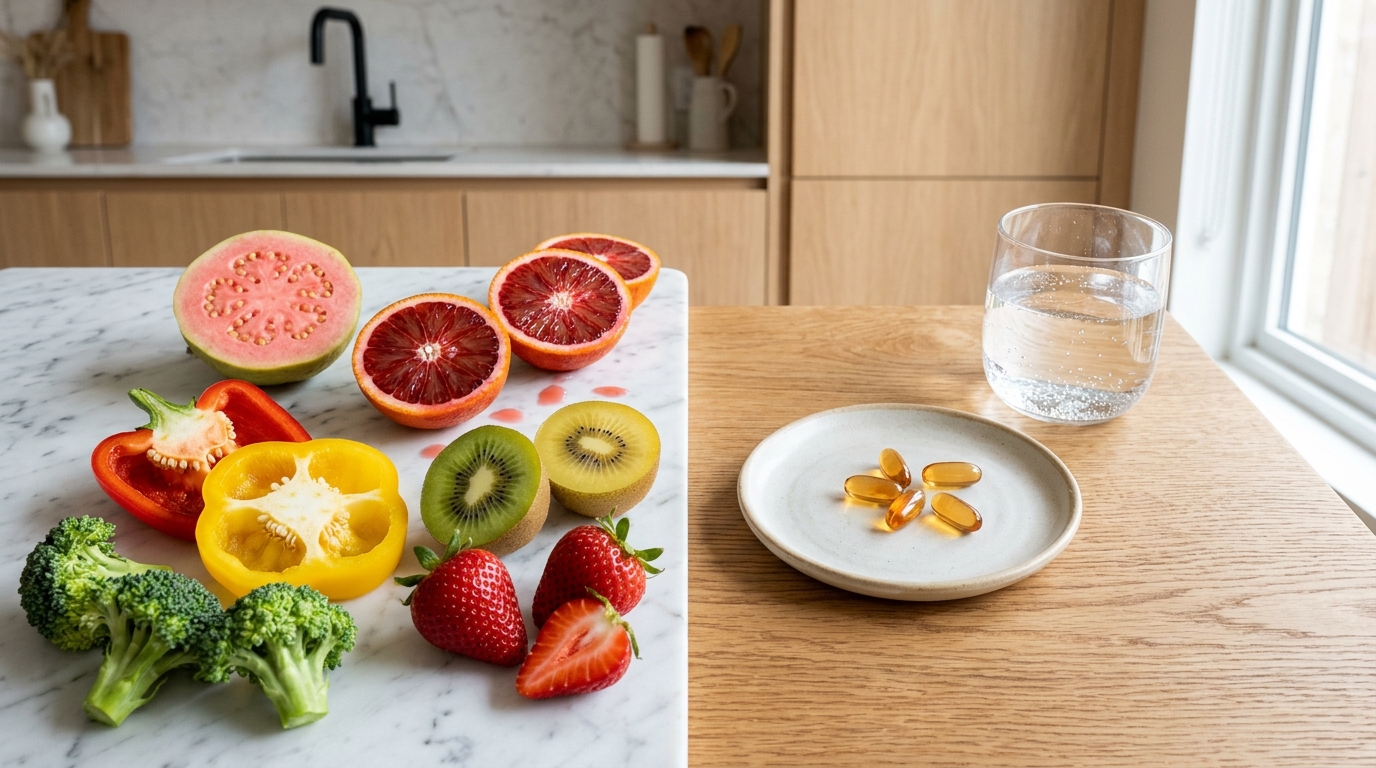
- Smart Longevity Protocol: Get 200–300 mg from bell peppers, kiwi, and berries, and if supplementing for arterial collagen or immune defense, split 250 mg twice daily (AM & PM) in buffered or liposomal form—never right after strength training.
Weighing vitamin c benefits and side effects of overdose requires unlearning decades of “mega-dose” supplement marketing. Ever since the 1970s, millions of health-conscious adults have reached for effervescent 1,000 mg to 3,000 mg ascorbic acid packets every winter morning, assuming that because Vitamin C is water-soluble, any excess simply washes harmlessly out in the urine.
Modern clinical pharmacokinetics from the National Institutes of Health (NIH NIDDK, Dr. Mark Levine et al.) and 11-year urological cohort studies published in JAMA Internal Medicine tell a very different story. While maintaining saturated intracellular Vitamin C (plasma levels of 70 to 85 umol/L) is indispensable for arterial collagen elasticity, adrenal catecholamine synthesis, and endothelial nitric oxide after age 40, chronic mega-dosing above 1,000–2,000 mg/day triggers four distinct clinical complications—from renal oxalate stones to blunted exercise adaptations.
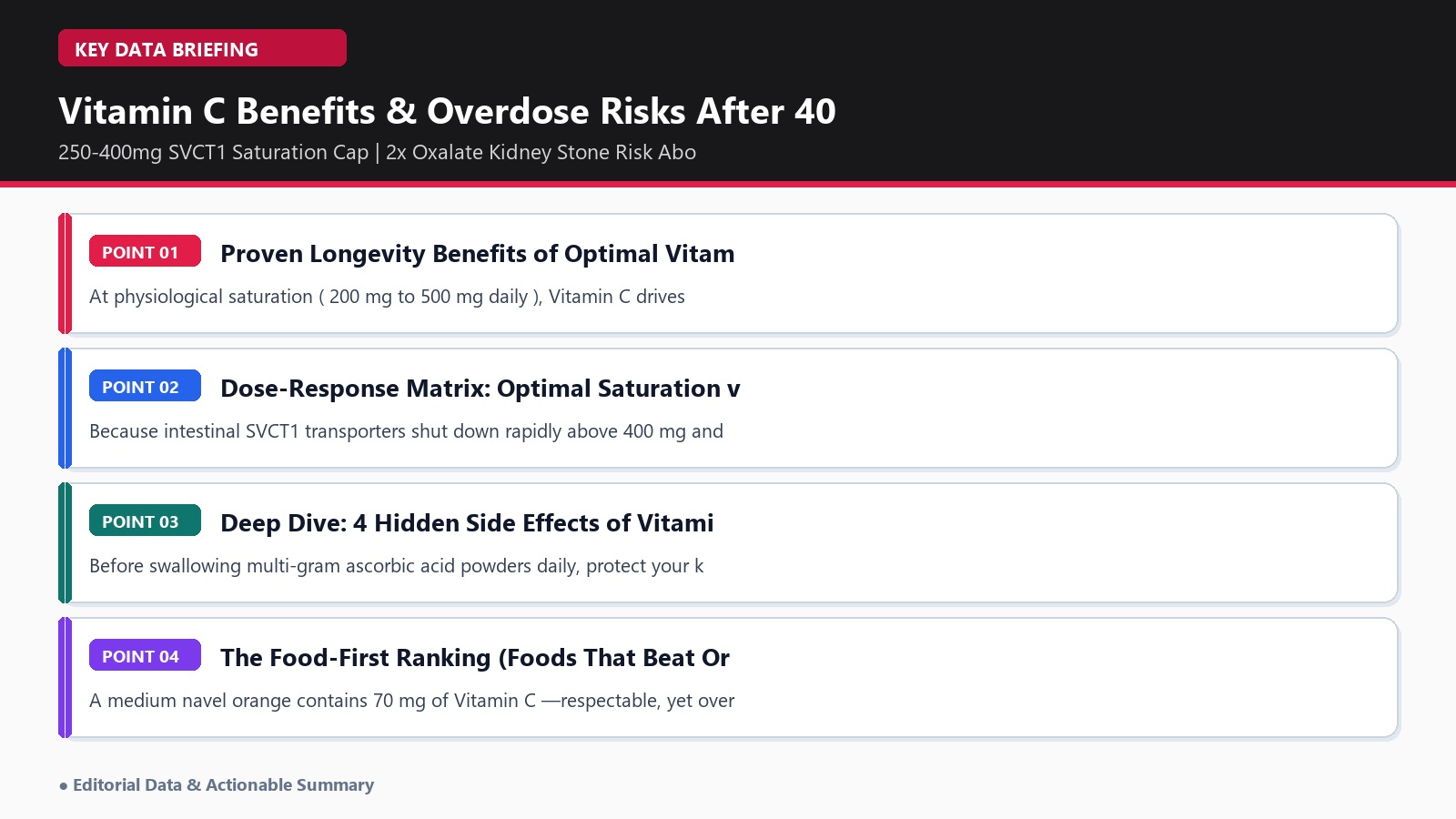
1. Proven Longevity Benefits of Optimal Vitamin C Saturation (200 mg – 500 mg/Day)
Unlike most mammals, humans carry a mutated GULO gene and cannot synthesize a single milligram of endogenous L-ascorbic acid from glucose. At physiological saturation (200 mg to 500 mg daily), Vitamin C drives four irreplaceable anti-aging pathways:
- 1. Arterial, Dermal & Tendon Collagen Cross-Linking: Vitamin C is the mandatory electron-donating cofactor for prolyl hydroxylase and lysyl hydroxylase—the enzymes that twist fragile procollagen strands into a strong triple helix inside your coronary arteries, skin dermis, rotator cuff tendons, and trabecular bone matrix (pair 50–100 mg Vitamin C with 15g collagen peptides 45 minutes before rehab—see Rotator Cuff Tendon Rehab After 40).
- 2. Endothelial Nitric Oxide (BH4) Protection & Blood Pressure: In Johns Hopkins meta-analyses of 29 randomized clinical trials, 500 mg/day of Vitamin C lowered systolic blood pressure by an average of 4.85 mmHg in hypertensive adults by preventing oxidative destruction of tetrahydrobiopterin (BH4), the cofactor required for vascular nitric oxide production (read more in Nitric Oxide Foods for Blood Pressure).
- 3. Adrenal Stress Recovery & Glutathione Recycling: Your adrenal glands and pituitary hold the highest tissue concentrations of Vitamin C in the entire body (up to 100x higher than blood plasma) to synthesize norepinephrine and regulate cortisol recovery, while regenerating oxidized Vitamin E and intracellular glutathione.
- 4. Non-Heme Iron Chelation & Uric Acid Clearance: Taking 200 mg of Vitamin C with plant-based or bisglycinate iron increases intestinal iron uptake by 300%, while 500 mg/day increases renal fractional excretion of uric acid, lowering gout flare risk in men over 45.
2. Dose-Response Matrix: Optimal Saturation vs. Overdose Side Effects
Because intestinal SVCT1 transporters shut down rapidly above 400 mg and kidney tubules actively dump plasma Vitamin C above the renal threshold (~70–80 umol/L), compare what happens inside your body at each daily intake tier when evaluating vitamin c benefits and side effects of overdose:
| Daily Oral Intake Tier | Intestinal Absorption % | Physiological Tissue Impact | Side Effects & Overdose Risk |
|---|---|---|---|
| 75–90 mg/day (Basic RDA) | ~95% – 100% | Prevents clinical scurvy, but leaves neutrophil white blood cells and plasma below peak antioxidant saturation | Zero risk |
| 250–500 mg/day (Longevity Sweet Spot — Food or Split 2x 250mg) | 80% – 92% | 100% leukocyte & tissue saturation; peak collagen synthesis, -4.8 mmHg systolic BP support & uric acid lowering | Virtually zero GI or renal oxalate risk |
| 1,000–1,500 mg/day (Chronic Single Mega-Dose Tablet) | <45% – 50% | More than half the pill passes unabsorbed into the colon or is excreted unchanged + metabolized into oxalate | 2x Kidney Stone risk in men; blunts VO2 max / strength gains if taken post-workout |
| >2,000 mg/day (Exceeds NIH Tolerable Upper Limit) | <20% – 30% | Severe colonic osmotic water pull; spikes urinary oxalate by 60%–100%; interferes with medical lab sensors | Osmotic diarrhea, cramps, GERD reflux, false-high CGM glucose & iron overload danger |
3. Deep Dive: 4 Hidden Side Effects of Vitamin C Overdose After 40
Before swallowing multi-gram ascorbic acid powders daily, protect your kidneys, teeth, and training adaptations from these four documented overdose complications:
1. Calcium Oxalate Kidney Stones (Especially in Men Over 40)
Roughly 80% of adult kidney stones are composed of calcium oxalate. When you consume 1,000 mg to 2,000 mg+ of supplemental Vitamin C, a portion of degraded dehydroascorbic acid converts directly into oxalate and is filtered through your kidneys. In the landmark 11-year Karolinska Institutet prospective study of 23,355 men, daily 1,000 mg Vitamin C supplement users suffered a 100% higher (2.0x) rate of incident kidney stones—whereas eating high-Vitamin-C whole fruits and vegetables caused zero stone risk because whole fruits supply stone-blocking potassium citrate and water.
2. Blunting Exercise Mitochondrial & Hypertrophy Signaling
When you perform Zone 2 cardio or lift heavy weights, contracting muscles intentionally generate brief bursts of reactive oxygen species (ROS). Those ROS pulses act as essential hormetic messengers that switch on PGC-1alpha (building new mitochondria) and increase insulin sensitivity. Multiple sports physiology trials (Ristow et al., PNAS; Paulsen et al., Journal of Physiology) proved that taking 1,000 mg of Vitamin C + Vitamin E around workouts blocked exercise-induced insulin-sensitivity gains and mitochondrial biogenesis! Never take high-dose antioxidants within 4 hours before or after exercise.
3. Chewable Enamel Erosion, Osmotic Diarrhea & CGM Lab Errors
- Dental Enamel Demineralization: Pure ascorbic acid has a harsh pH of 2.2 to 2.5 (nearly as acidic as stomach acid); chewing daily Vitamin C gummies or wafers softens tooth enamel (critical pH 5.5). Always swallow capsules whole (for more GI tips, see Managing Supplement Side Effects).
- Continuous Glucose Monitor (CGM) False Highs: Taking >500–1,000 mg of Vitamin C can oxidize at the interstitial sensor filament of popular CGMs (such as FreeStyle Libre), producing artificially elevated blood sugar alerts by 10 to 25 mg/dL, as well as false-negative stool occult blood tests.
- Iron Overload in Hemochromatosis: Roughly 1 in 200 adults of Northern European descent carries HFE hemochromatosis gene variants; mega-dose Vitamin C accelerates toxic cardiac and hepatic iron deposition (review safe ferritin rules in Safe Iron Intake After 40).
4. The Food-First Ranking (Foods That Beat Oranges 2x to 3x)
A medium navel orange contains 70 mg of Vitamin C—respectable, yet overshadowed by low-sugar longevity produce that saturates your plasma effortlessly in a single serving:
- Raw Red or Yellow Bell Pepper (1 cup chopped): 190 mg to 250 mg (nearly 3x an orange with only 5g sugar).
- SunGold or Green Kiwifruit (2 small kiwis): 135 mg to 260 mg (+ sleep-enhancing serotonin & actinidin digestive enzyme).
- Fresh Guava (1 cup) or Strawberries (1 cup halved): 90 mg to 370 mg (+ ellagic acid polyphenols).
- Lightly Steamed Broccoli or Brussels Sprouts (1 cup): 95 mg to 105 mg (avoid boiling in water, which leaches 50% of Vitamin C down the drain).
5. Frequently Asked Questions (FAQ)
Q1. Is Liposomal Vitamin C worth the extra price over standard ascorbic acid?
At normal daily longevity doses of 200 mg to 400 mg, plain ascorbic acid or buffered Sodium/Magnesium Ascorbate already absorbs at 85%–95%, so expensive liposomal Vitamin C is unnecessary. Liposomal sunflower-phospholipid encapsulation only offers a meaningful advantage (+35%–50% higher plasma AUC with zero bowel looseness) when taking acute short-term 1,000 mg doses during an active viral illness.
Q2. Does taking Vitamin C prevent catching the common cold?
Cochrane systematic reviews covering over 11,000 participants confirm that daily Vitamin C supplementation does not reduce cold incidence in the general population (except by 50% in marathon runners or cold-weather endurance athletes), but consistent saturation shortens cold symptom duration by 8% to 14% and reduces histamine-driven bronchial severity.
Q3. Should I take Vitamin C on an empty stomach or with meals?
Because Vitamin C has a short plasma half-life of roughly 2 to 3 hours above saturation, splitting 250 mg with breakfast and 250 mg with dinner maintains steady 24-hour plasma levels while buffering stomach acidity and enhancing non-heme mineral absorption from food (for full meal-timing rules, see our 24-Hour Supplement Timing Chart).