
EDITOR’S 1-MINUTE CLINICAL BRIEFING
Nitric Oxide Foods for Blood Pressure: Key Clinical Takeaways After 40
- Clinical Nitrate Target (300mg to 450mg/day): Consuming 300 mg to 450 mg of inorganic dietary nitrates daily from nitric oxide foods for blood pressure reduces resting systolic blood pressure by 4.4 to 7.7 mmHg and diastolic pressure by 2.5 to 4.2 mmHg within 3 to 6 hours according to American Heart Association (AHA) and NIH clinical trials.
- Why Endothelial eNOS Drops 50% After Age 40: Endogenous L-arginine-to-nitric-oxide synthesis declines by roughly 10% to 12% per decade after 30, making the secondary enterosalivary nitrate-nitrite-NO pathway from leafy greens and beetroot essential for arterial compliance in adults over 40.
- Stop Antibacterial Mouthwash Within 3 Hours: Chlorhexidine and cetylpyridinium mouthwashes wipe out oral Veillonella and Actinomyces bacteria, blunting the blood-pressure-lowering effect of dietary nitrates by up to 85% and raising systolic readings by 2 to 3.5 mmHg.
Searching for nitric oxide foods for blood pressure is one of the highest-impact cardiovascular steps adults over 40 can take before—or alongside—pharmacological therapy. By age 45, vascular endothelial cells experience oxidative uncoupling of the endothelial nitric oxide synthase (eNOS) enzyme, reducing natural nitric oxide bioavailability by nearly 40% to 50% compared to age 25. As endothelial nitric oxide falls, vascular smooth muscle remains constricted, peripheral vascular resistance rises, and resting brachial systolic blood pressure creeps from an optimal 115/75 mmHg into Stage 1 hypertension (130–139 / 80–89 mmHg).
Fortunately, human physiology possesses a powerful backup generator for vascular relaxation: the exogenous nitrate-nitrite-nitric oxide (NO3⁻ → NO2⁻ → NO) pathway. Clinical randomized controlled trials indexed on PubMed and reviewed by the American Heart Association (AHA) demonstrate that targeted daily intake of 400 mg (approximately 6.4 mmol) of dietary inorganic nitrate—paired with polyphenol antioxidants that protect nitric oxide from free-radical destruction—restores flow-mediated dilation (FMD) by 1.5% to 2.8% and lowers 24-hour ambulatory systolic blood pressure by 5.2 mmHg on average.
1. How Nitric Oxide Foods for Blood Pressure Bypass Aging Endothelial eNOS After 40
To understand why specific nitric oxide foods for blood pressure work when L-arginine capsules often fail after age 40, you must distinguish between the body’s two nitric oxide synthesis pathways.
In your 20s, vascular endothelial cells efficiently convert the amino acid L-arginine into nitric oxide gas via the oxygen-dependent eNOS enzyme, requiring tetrahydrobiopterin (BH4) as a cofactor. After age 40, rising asymmetric dimethylarginine (ADMA—an endogenous eNOS inhibitor) and BH4 oxidation cause “eNOS uncoupling,” meaning high-dose oral L-arginine (3,000 mg to 6,000 mg) is largely broken down by hepatic arginase or generates superoxide radicals instead of vasodilatory nitric oxide.
In contrast, the dietary enterosalivary pathway bypasses damaged eNOS entirely. When you chew nitrate-rich vegetables such as wild arugula, red spinach, or cooked beets, inorganic nitrate (NO3⁻) is absorbed almost 100% in the upper small intestine.
Roughly 25% of circulating plasma nitrate is actively concentrated by your salivary glands at levels 10-fold higher than blood plasma and secreted into saliva. Facultative anaerobic bacteria living in the deep crypts of the posterior tongue reduce salivary nitrate into bioactive nitrite (NO2⁻). Once swallowed into the acidic environment of the stomach (pH 1.5 to 3.0) and absorbed into deoxygenated arterioles, nitrite is directly converted into vasodilatory nitric oxide (NO), activating cyclic GMP (cGMP) to relax arterial walls within 150 to 180 minutes.
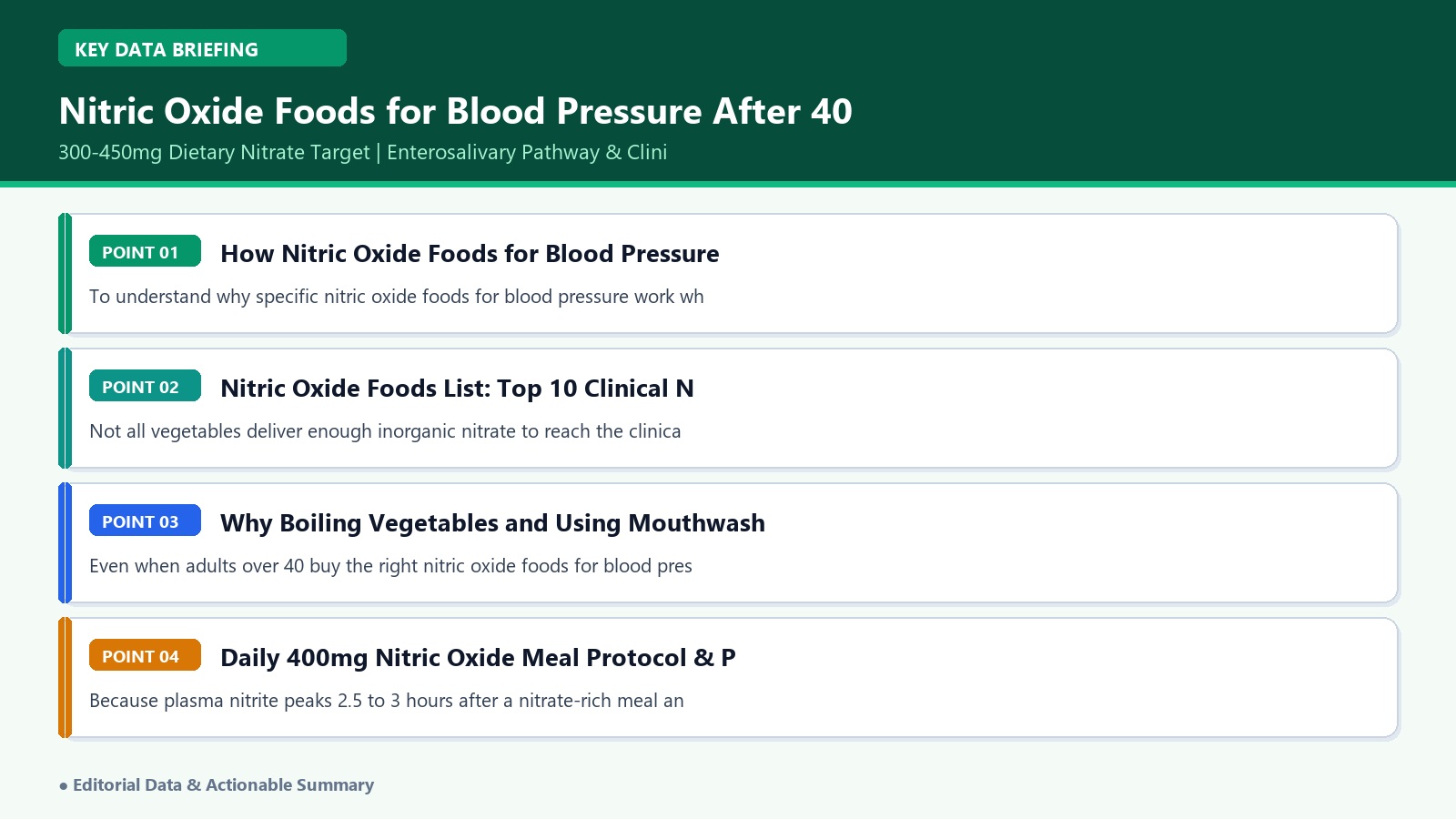
2. Nitric Oxide Foods List: Top 10 Clinical Nitrate & L-Citrulline Sources Compared
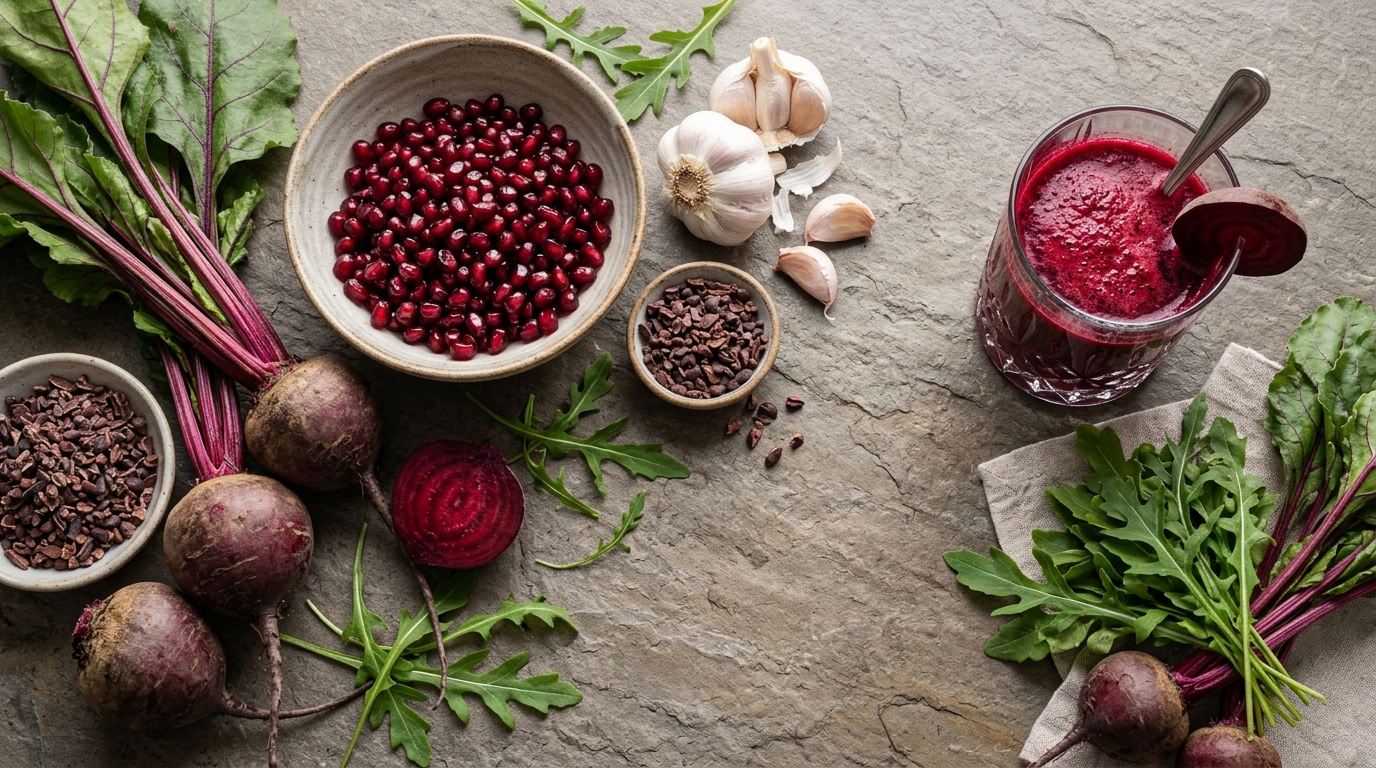
Not all vegetables deliver enough inorganic nitrate to reach the clinical vasodilation threshold of 300 mg to 450 mg per day. In fact, nitrate concentration varies by more than 50-fold between high-accumulating brassicas/chenopods (like arugula, rhubarb, and red beet) and low-nitrate fruiting vegetables (like tomatoes or bell peppers). Furthermore, combining direct dietary nitrate sources with L-citrulline foods (which bypass liver arginase to raise plasma arginine by 165%) and flavanol-rich foods (which stimulate eNOS phosphorylation) provides a 12-hour sustained blood pressure reduction rather than a brief 4-hour peak.
| Food Source (100g / Standard Serving) | Primary Active Compound & Yield | Mechanism of Action | Clinical Serving to Hit Target |
|---|---|---|---|
| 1. Wild Arugula / Rocket (100g) | 350 mg – 480 mg Dietary Nitrate | Direct enterosalivary NO3⁻ → NO2⁻ → NO reduction | 1.5 cups raw salad (85g–100g) daily |
| 2. Concentrated Beetroot Juice (250 mL) | 380 mg – 450 mg Dietary Nitrate + Betanin | Peak plasma nitrite in 2.5 hrs; lowers SBP 5–8 mmHg | 250 mL fresh juice or 70 mL clinical shot |
| 3. Fresh Spinach & Swiss Chard (100g) | 210 mg – 310 mg Nitrate + 79 mg Magnesium | Dual nitrate + magnesium calcium-channel relaxation | 150g lightly steamed (never boiled in water) |
| 4. Red Watermelon Flesh + Rind (300g) | 650 mg – 1,100 mg L-Citrulline + Lycopene | Renal conversion of L-citrulline into plasma L-arginine | 2 wedges (300g) including white inner rind |
| 5. Pomegranate Juice / Arils (150 mL) | Punicalagins & Ellagitannins (300 mg polyphenols) | Shields nitric oxide from superoxide destruction (+45% half-life) | 120 mL–150 mL pure unsweetened juice |
| 6. 85% Dark Cacao / Raw Cocoa (30g) | 450 mg – 600 mg Cocoa Flavanols (-)-Epicatechin | Activates endothelial eNOS phosphorylation & inhibits arginase | 25g–30g non-alkalized (non-Dutch) dark chocolate |
| 7. Crushed Raw or Aged Garlic (2 cloves / 6g) | 2.4 mg S-Allyl Cysteine + Allicin (H2S donor) | Hydrogen sulfide + NO cross-talk lowers SBP by 6–8 mmHg | 2 cloves crushed & rested 10 mins before cooking |
3. Why Boiling Vegetables and Using Mouthwash Destroy Nitric Oxide Yield by 50% to 85%
Even when adults over 40 buy the right nitric oxide foods for blood pressure, three common household habits neutralize their antihypertensive benefit before a single molecule of nitric oxide reaches the aorta:
MISTAKE 01: Boiling Spinach, Beets, or Bok Choy in Water (-45% to -60% Nitrate Loss)
Inorganic nitrate (NO3⁻) is highly water-soluble. Food chemistry analyses published by the National Institutes of Health (NIH) show that boiling spinach or cubed beets in a pot of water leaches 47% to 62% of the nitrate into the discarded cooking water within 10 minutes. Always consume arugula raw, roast whole beets in their skin at 375°F (190°C), or lightly steam greens for under 4 minutes.
MISTAKE 02: Using Antiseptic Mouthwash or Heavy Tongue Scraping (-85% Nitrite Conversion)
Human cells lack the nitrate reductase enzyme required to convert salivary NO3⁻ into NO2⁻; we rely 100% on commensal oral bacteria. In landmark clinical studies, rinsing twice daily with 0.2% chlorhexidine or alcohol-based antibacterial mouthwash reduced salivary nitrite production by 85%, plasma nitrite by 25%, and caused an immediate 2.0 to 3.5 mmHg increase in resting systolic blood pressure within 7 days.
MISTAKE 03: Taking High-Dose Proton Pump Inhibitors (PPIs) With Nitrate Meals
The final non-enzymatic conversion of swallowed salivary nitrite into nitric oxide gas requires gastric hydrochloric acid (stomach pH < 3.5) and dietary vitamin C (ascorbic acid). Chronic use of proton pump inhibitors (such as omeprazole 20–40 mg) raises gastric pH above 4.5, blunting the hypotensive response to beetroot juice by more than 60%. Squeeze 15 mL of fresh lemon juice (providing 7 mg vitamin C and citric acid) over nitrate-rich greens to accelerate gastric nitric oxide reduction.

4. Daily 400mg Nitric Oxide Meal Protocol & Pharmacokinetic Timing Table
Because plasma nitrite peaks 2.5 to 3 hours after a nitrate-rich meal and stays elevated for roughly 6 to 9 hours, splitting your intake of nitric oxide foods for blood pressure across lunch and dinner prevents both the afternoon sympathetic blood pressure surge and the dangerous early-morning blood pressure spike between 6:00 AM and 9:00 AM.
| Protocol Window | Exact Food Combination & Portion | Active Yield (Nitrate / Citrulline / Flavanols) | Expected Vascular Window |
|---|---|---|---|
| Morning (7:30 AM) | 150 mL Beetroot + Pomegranate Blend + 15g Walnuts | 240 mg Nitrate + 220 mg Ellagitannins + 1.3g ALA | Peak SBP drop (-5.5 mmHg) from 10:00 AM to 3:30 PM |
| Afternoon (2:30 PM) | 25g 85% Non-Alkalized Dark Cacao + 200g Watermelon | 450 mg Cocoa Flavanols + 500 mg L-Citrulline | Sustains endothelial eNOS activity through 7:00 PM |
| Dinner (6:30 PM) | 80g Wild Arugula Salad + Lemon Olive Oil + 2 Cloves Garlic | 280 mg Nitrate + 15 mg Vitamin C + Allicin H2S | Supports nocturnal dipping (-10% to -15% nighttime BP) |
CLINICAL SAFETY CALLOUT: Kidney Stone (Oxalate) & PDE5 Medication Precautions
1. Calcium Oxalate Kidney Stones: Beetroot and raw spinach are high in soluble oxalates (100 mg to 600 mg per 100g). If you have a history of calcium oxalate nephrolithiasis, swap spinach and beets for low-oxalate, high-nitrate wild arugula (rocket), bok choy, and Chinese cabbage (napa), which deliver 200 mg to 450 mg of nitrate per 100g with less than 5 mg of oxalate.
2.
2.
Antihypertensives & PDE5 Inhibitors: Combining concentrated dietary nitrate shots (>500 mg) with prescription alpha-blockers, nitrates, or PDE5 inhibitors (sildenafil/tadalafil) can cause additive orthostatic hypotension (dizziness upon standing). Monitor home blood pressure with an upper-arm cuff for 14 days when starting this protocol.
5. Frequently Asked Questions: Nitric Oxide Foods for Blood Pressure
Q1. Are nitrates in nitric oxide foods for blood pressure the same as harmful nitrates in bacon and cured meats?
Chemically, the inorganic nitrate ion (NO3⁻) is identical, but its metabolic fate is completely different because of food matrix cofactors. Over 80% to 85% of human dietary nitrate comes from vegetables, which are packed with vitamin C, polyphenols, and betalains that direct nitrite conversion toward beneficial nitric oxide gas (NO) and inhibit nitrosamine formation by over 90%. Processed meats lack antioxidants and contain heme iron and secondary amines heated at high temperatures, which react with added sodium nitrite to form carcinogenic N-nitrosamines.
Q2. What are the best nitric oxide foods for men over 40 experiencing both high blood pressure and endothelial dysfunction?
For men over 40, microvascular penile and coronary arteries (1 to 2 mm diameter) show endothelial nitric oxide decline years before larger arteries. The strongest clinical combination pairs 80g wild arugula or 250 mL beetroot juice (providing 350 mg to 400 mg inorganic nitrate for immediate cGMP vasodilation) with 300g watermelon (providing 800 mg L-citrulline) and 150 mL pure pomegranate juice to prevent oxidative destruction of nitric oxide.
Q3. How quickly do nitric oxide foods lower blood pressure after eating?
Salivary nitrite rises within 45 to 60 minutes of chewing nitrate-rich greens or drinking beetroot juice, and peak brachial blood pressure reduction (an average drop of 4.4 to 7.7 mmHg systolic) occurs at 2.5 to 3.5 hours post-ingestion. With consistent daily consumption over 4 weeks, arterial stiffness (measured by pulse wave velocity) decreases by 0.5 to 0.8 m/s.
Q4. Why does beetroot turn urine or stool pink (beeturia), and is it dangerous?
Beeturia occurs in roughly 10% to 14% of adults when betalain pigments (specifically betanin) in red beets are not fully decolorized by stomach acid or ferric ions. It is completely benign, though it is more common in individuals with low gastric acid (hypochlorhydria) or low iron stores (serum ferritin below 30 ng/mL).
RELATED CLINICAL LONGEVITY GUIDES
Medical & Clinical Disclaimer: This article is written by the WellnessHub Editorial & Clinical Research Team for educational informational purposes only and does not substitute for personalized medical advice, diagnosis, or prescription antihypertensive therapy. Always consult your cardiologist or primary care physician before modifying blood pressure medications or starting concentrated nitrate supplementation, referencing guidelines from the American Heart Association and Mayo Clinic.