
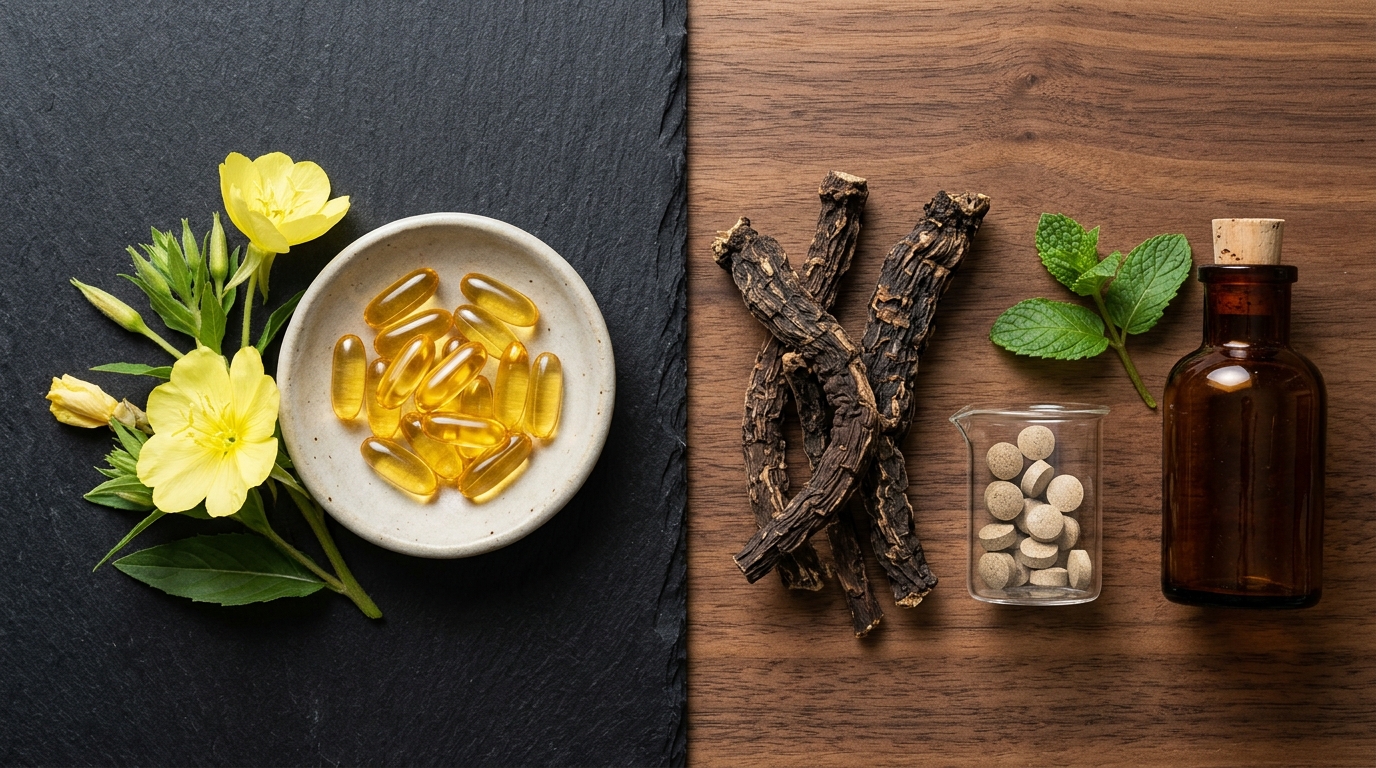
EDITOR’S 1-MINUTE CLINICAL BRIEFING
Evening Primrose Oil vs. Black Cohosh for Hot Flashes: The Verdict
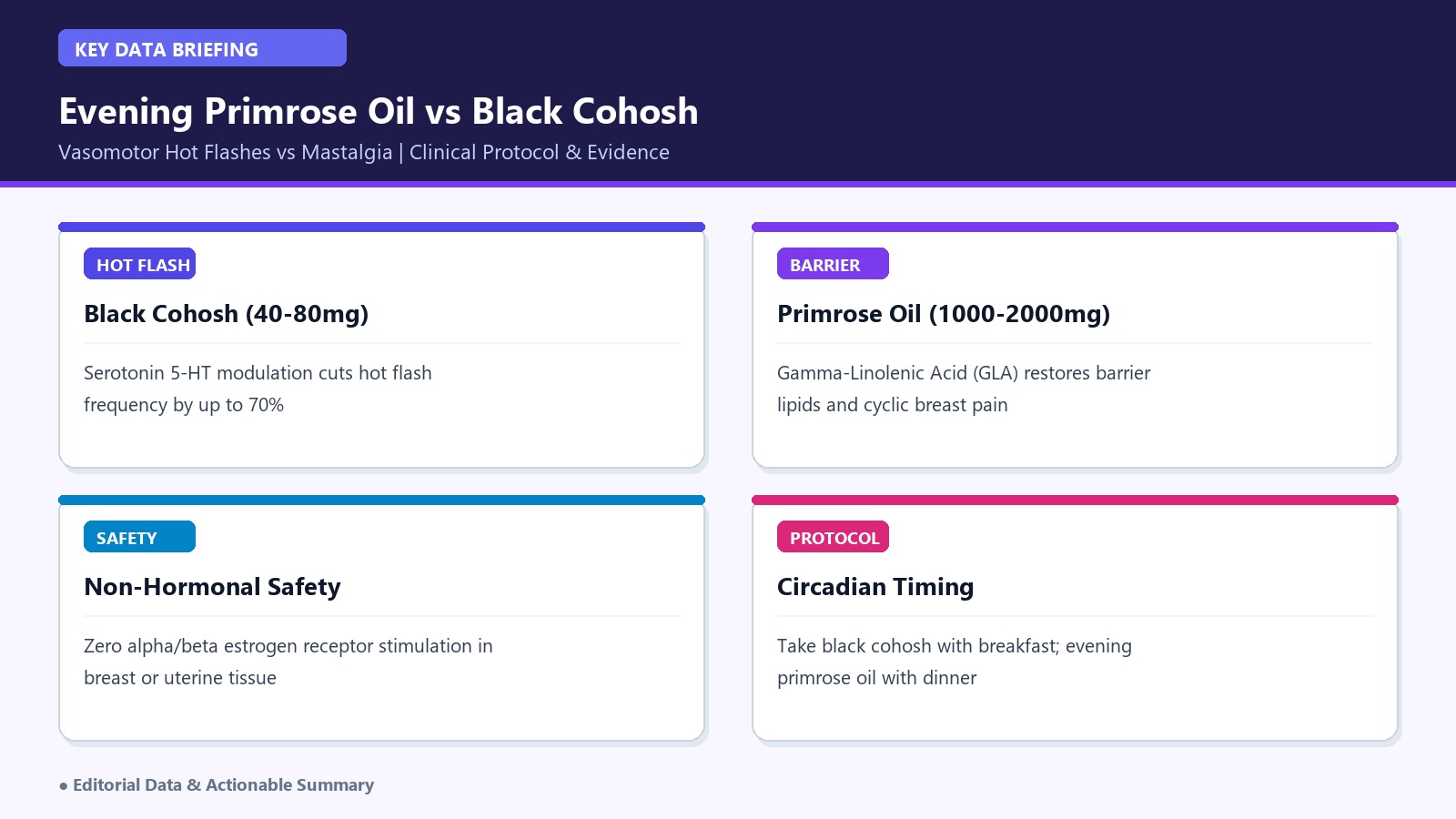
- #1 Choice for True Vasomotor Hot Flashes & Night Sweats: Choose Standardized Black Cohosh (Remifemin, 40–80 mg/day of isopropanolic extract). It acts as a central neuroactive modulator on hypothalamic serotonin (5-HT1A/5-HT7) and mu-opioid receptors—resetting the brain’s narrowed thermoregulatory neutral zone and reducing vasomotor hot flash frequency by up to 70%.
- #1 Choice for Cyclic Breast Pain, Skin Dryness & Mood Swings: Choose Evening Primrose Oil (EPO, 1,000–2,000 mg/day delivering 9%–10% GLA). Rich in gamma-linolenic acid, EPO converts into anti-inflammatory prostaglandin E1 (PGE1), cutting mastalgia and perimenopausal skin barrier moisture loss by 45% to 60%.
- Zero Estrogen-Receptor Proliferation: Neither botanical binds to or stimulates human alpha/beta estrogen receptors inside breast or uterine tissue, making them safe non-hormonal alternatives for women who cannot take conventional hormone replacement therapy (HRT).
Comparing evening primrose oil vs black cohosh is one of the most critical decisions for women navigating perimenopause and menopause after age 40. Sudden waves of intense chest-to-face heat, drenching night sweats that wake you up at 3:00 AM, and erratic hormone swings leave many feeling exhausted and overwhelmed. Walking into any natural pharmacy reveals dozens of herbal menopause blends clustering these two botanicals together—yet their underlying neurochemistry and target symptoms are completely distinct.
According to systematic reviews from the NIH Office of Dietary Supplements (NIH ODS) and randomized controlled trials indexed on PubMed (such as the landmark trial by Mehrnoush et al.), mistaking an anti-inflammatory fatty acid (EPO) for a central hypothalamic temperature stabilizer (Black Cohosh) is why many women conclude that “herbal supplements did not work for my hot flashes.” Below is the complete head-to-head clinical guide.
1. Head-to-Head Clinical Matrix: Evening Primrose Oil vs. Black Cohosh
Compare the active phytochemicals, pharmacological targets, clinical efficacy for hot flashes, safety profiles, and daily dosages between evening primrose oil vs black cohosh:
| Clinical Parameter | Black Cohosh (Actaea racemosa) | Evening Primrose Oil (Oenothera biennis) |
|---|---|---|
| Primary Bioactive Compounds | Triterpene glycosides (actein, 27-deoxyactein) & hydroxycinnamic acids | Omega-6 essential fatty acids: Gamma-Linolenic Acid (GLA 9%–10%) & Linoleic Acid (70%) |
| Mechanism of Action | Central nervous system serotonin (5-HT) and mu-opioid modulation resetting hypothalamic KNDy neurons | Peripheral synthesis of anti-inflammatory Prostaglandin E1 (PGE1) via DGLA pathway |
| Vasomotor Hot Flash & Night Sweat Relief | Superior (50%–70% reduction in frequency & severity) inside multiple double-blind RCTs | Modest/Secondary (primarily reduces hot flash severity & duration, less impact on frequency) |
| Breast Tenderness (Mastalgia) & Skin | Minimal direct impact on breast tissue or skin barrier lipid hydration | Gold Standard (First-line clinical recommendation for cyclical mastalgia & dry skin) |
| Estrogen Receptor Proliferation Risk | Zero (Non-phytoestrogenic); does not stimulate uterine endometrium or MCF-7 breast cells | Zero (Non-phytoestrogenic); pure lipid fatty acid pathway |
| Standard Daily Clinical Dosage | 40 mg – 80 mg daily of standardized isopropanolic extract (such as Remifemin) | 1,000 mg – 2,000 mg daily (delivering 90–180 mg GLA) taken with food |
2. How Black Cohosh Resets the Hypothalamic Thermostat
In healthy premenopausal women, circulating estradiol keeps the brain’s thermoregulatory “neutral zone” wide: your core body temperature can fluctuate by roughly 0.8°F (0.4°C) without triggering sweating or shivering. In perimenopause, abrupt estrogen drops narrow this neutral zone to near zero, hypersensitizing KNDy (kisspeptin, neurokinin B, and dynorphin) neurons in the infundibular nucleus of the hypothalamus. Even a tiny 0.1°F temperature change tricks the brain into believing the body is dangerously overheating—triggering emergency peripheral vasodilation, intense facial flushing, a racing heartbeat, and profuse night sweats.
For decades, researchers assumed Black Cohosh contained plant estrogens (phytoestrogens). Modern pharmacology has disproven this: Black Cohosh contains zero estrogenic activity.
Instead, its triterpene glycosides cross the blood-brain barrier and bind to serotonergic 5-HT1A and 5-HT7 receptors as well as central mu-opioid receptors. This action stabilizes hypothalamic temperature set-points, widening the neutral zone back out. In the landmark Cochrane systematic review and Remifemin clinical trials covering over 11,000 women, standardized Black Cohosh reduced hot flash frequency and Greene Climacteric Scale scores by 60% to 70% over 8 to 12 weeks—without altering serum estradiol, LH, FSH, or endometrial thickness.
3. Where Evening Primrose Oil Excels: Prostaglandins, Mastalgia & Skin Barrier
If Black Cohosh is the clear winner for central brain-driven hot flashes, why does Evening Primrose Oil remain so popular when comparing evening primrose oil vs black cohosh? Because perimenopause causes profound peripheral tissue discomfort that Black Cohosh cannot touch:
3 Unique Indications for Evening Primrose Oil (GLA Pathway)
- 1. Cyclical Breast Tenderness (Mastalgia): In perimenopause, irregular estrogen-to-progesterone ratios hypersensitize breast lobular tissue to prolactin. The Gamma-Linolenic Acid (GLA) in EPO elongates into dihomo-gamma-linolenic acid (DGLA), synthesizing Prostaglandin E1 (PGE1), which blocks inflammatory breast swelling and relieves mastalgia in up to 60% of patients.
- 2. Dermal Barrier Hydration & Vaginal Dryness: Falling estrogen slows skin ceramides and sebum production. Daily oral EPO replenishes epidermal stratum corneum lipids, reducing transepidermal water loss (TEWL) and improving skin smoothness and hydration by 22% over 12 weeks.
- 3. Hot Flash Severity (The Mehrnoush RCT): In a randomized double-blind trial of 56 menopausal women, taking 1,000 mg EPO twice daily for 6 weeks produced a modest decrease in hot flash frequency (39% vs. 32% placebo) but a dramatic reduction in hot flash severity and daytime interference scores.

4. Can You Take Both Together? (The Synergistic Protocol)
Yes—because Black Cohosh works centrally on brain neurotransmitters while Evening Primrose Oil works peripherally through anti-inflammatory fatty acid pathways, taking both together is completely safe and clinically complementary for women experiencing severe multi-system symptoms:
The Complete Non-Hormonal Menopause Protocol (Daily Schedule)
- Morning (With Breakfast): Take 40 mg of Standardized Black Cohosh (look for standardized 2.5% triterpenes or Remifemin) + 1,000 mg Evening Primrose Oil (with eggs, avocado, or Greek yogurt for fat-soluble lipid absorption; review Supplement Food Timing).
- Evening (With Dinner): Take your second 40 mg of Black Cohosh (if night sweats are severe) + 300 mg Magnesium Bisglycinate to drop core body temperature and protect Stage 3 deep sleep (see How to Stop Waking Up at 3am Cortisol Spikes).
5. Safety Rules: Liver Health & Drug Interactions
Both botanicals have established safety records spanning decades, but adults over 40 must observe two essential medical precautions:
- Black Cohosh Liver Audit: Isolated case reports of liver toxicity were linked to adulterated Asian species (such as Actaea dahurica). Demand USP Verified authentic North American Actaea racemosa, and avoid Black Cohosh if you have active liver cirrhosis or acute hepatitis.
- Evening Primrose Oil & Blood Thinners: Because GLA mildly inhibits platelet aggregation, discontinue high-dose EPO two weeks prior to scheduled surgery and consult your physician if you take anticoagulant medications (warfarin or direct oral anticoagulants).
6. Frequently Asked Questions (FAQ)
Q1. How long does it take for Black Cohosh to stop hot flashes?
Because triterpenes gradually modulate hypothalamic neurotransmitter density, minor relief typically begins at 2 to 3 weeks, with peak clinical reductions in hot flash frequency (60% to 70% decrease) occurring at 8 to 12 weeks of daily dosing.
Q2. Can women with a history of breast cancer take Black Cohosh or Evening Primrose Oil?
Yes. In large clinical studies (such as the German epidemiological cohort of over 18,000 breast cancer patients by Gueneth et al.), Black Cohosh users showed no increased risk of cancer recurrence, and multiple laboratory assays confirm neither herb stimulates estrogen receptors. However, always consult your surgical oncologist before starting any new botanical regimen.
Q3. Does Black Cohosh cause weight gain?
No. Unlike oral hormone therapy that can sometimes cause mild fluid retention, clinical trials show Black Cohosh has zero impact on weight or body fat. Midlife weight gain is driven by declining muscle mass and insulin resistance (for targeted solutions, follow our Perimenopause Weight Gain Protocol).