

EDITOR’S 1-MINUTE CLINICAL BRIEFING
Magnesium L-Threonate vs. Glycinate: The 30-Second Verdict
- Choose Magnesium L-Threonate (Magtein, 1,500–2,000 mg = 144 mg Elemental Mg) if your #1 goal is word-recall memory, perimenopause brain fog, ADHD executive focus, or silencing racing REM dreams. It is the only form proven to cross the blood-brain barrier and raise cerebrospinal fluid (CSF) magnesium by 7% to 15%.
- Choose Magnesium Bisglycinate (300–400 mg Elemental Mg) if your #1 goal is falling and staying asleep, stopping nocturnal calf cramps, lowering blood pressure, or correcting a true RBC magnesium deficiency at 1/3 the monthly cost.
- Yes, You Can Stack Both Safely: Taking 1,000 mg L-Threonate (72 mg elemental Mg) in the morning + 250 mg elemental Bisglycinate at 9:00 PM delivers 322 mg total elemental magnesium—unlocking daytime synaptic plasticity and nighttime Stage 3 slow-wave sleep without GI upset.
Deciding between magnesium l threonate vs glycinate has become one of the most fiercely debated questions in longevity medicine after age 40. Walk down any pharmacy aisle and you will see cheap magnesium oxide or citrate tablets that pull water into the colon and act primarily as laxatives. Magnesium L-threonate and magnesium bisglycinate sit at the pinnacle of bioavailable chelates—yet they target completely different tissues inside your body.
According to neuropharmacology research originally developed at MIT and published in Neuron alongside clinical micronutrient guidelines from the NIH Office of Dietary Supplements, nearly 52% of North American adults over 45 fail to meet basic cellular magnesium requirements due to soil depletion, filtered water, and stress-induced urinary magnesium excretion. Below is the head-to-head pharmacokinetic comparison so you buy the exact chelate your nervous system needs.
1. Head-to-Head Clinical Comparison: Magnesium L-Threonate vs. Glycinate
Compare the molecular carrier, elemental magnesium yield, tissue destination, clinical sleep outcomes, and daily cost of magnesium l threonate vs glycinate below:
| Clinical Parameter | Magnesium L-Threonate (Magtein) | Magnesium Bisglycinate (TRAACS Chelate) |
|---|---|---|
| Chelating Ligand | L-Threonic Acid (natural endogenous metabolite of Vitamin C) | Two Glycine Molecules (inhibitory calming neurotransmitter amino acid) |
| Elemental Magnesium % | ~7.2% Elemental (2,000 mg Magtein = 144 mg elemental Mg across 3 capsules) | ~14.1% Elemental (2,100 mg chelate = 300 mg elemental Mg + 1.8g glycine) |
| Primary Tissue Target | Brain, Hippocampus & Prefrontal Cortex (Crosses blood-brain barrier via GLUT transporters) | Skeletal Muscle, Heart, Vascular Endothelium & Whole-Body RBC Stores |
| Sleep Architecture Impact | Boosts REM & deep sleep scores (2024 Sleep Medicine: X RCT) and improves next-day mental alertness | Drops core body temperature by 0.5°F–1.0°F via glycine vasodilation; stops physical restlessness & 3 AM cortisol jolts |
| GI Tolerance / Laxative Risk | Excellent (virtually zero loose stools; mild vivid dreams in 5% of users if taken all at night) | Gold-standard GI comfort (absorbed intact via PEPT1 dipeptide channels; zero laxative pull) |
| Average Cost per Month | $34 – $48 / month (Patented Magtein raw material) | $12 – $19 / month (Highest clinical value per elemental mg) |
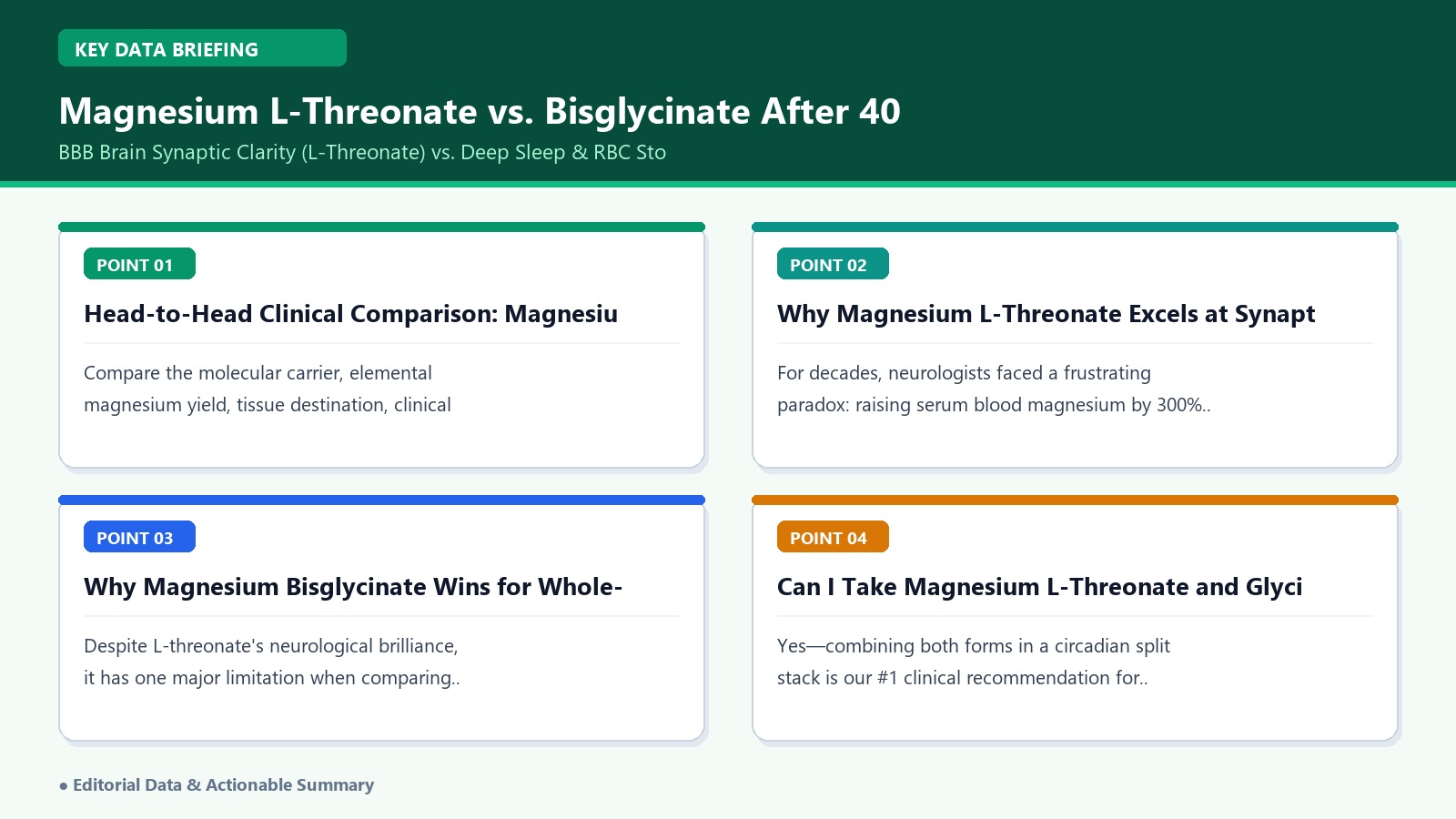
2. Why Magnesium L-Threonate Excels at Synaptic Density & Brain Fog
For decades, neurologists faced a frustrating paradox: raising serum blood magnesium by 300% via intravenous magnesium sulfate barely budged magnesium levels inside human cerebrospinal fluid (CSF), because the blood-brain barrier (BBB) strictly blocks ionized minerals. When MIT neuroscientist Dr. Guosong Liu screened dozens of organic carriers, L-threonic acid emerged as the sole ligand capable of shuttling magnesium directly across endothelial brain capillaries into neurons.
Once inside the hippocampus and prefrontal cortex, Magnesium L-Threonate sits inside the channel pore of NMDA (N-methyl-D-aspartate) glutamate receptors at resting membrane potentials—preventing background excitotoxic “noise” while upregulating NR2B subunit expression so synapses fire more cleanly during learning.
In a landmark 12-week double-blind placebo-controlled trial of adults aged 50 to 70 with subjective memory complaints (Liu et al., Journal of Alzheimer’s Disease), 1,500–2,000 mg/day of Magnesium L-Threonate reversed composite executive-function deficits equivalent to 9.0 years of cognitive brain aging. Even more recently, a 2024 randomized controlled trial using Oura Ring sleep-tracking metrics confirmed that L-threonate significantly increased deep sleep and REM sleep scores while improving daytime mental energy and mood.
3. Why Magnesium Bisglycinate Wins for Whole-Body Deficiency, Muscle & Metabolic Health
Despite L-threonate’s neurological brilliance, it has one major limitation when comparing magnesium l threonate vs glycinate: three large capsules of Magtein yield only 144 mg of elemental magnesium (roughly 34% of a 40+ man’s 420 mg daily requirement). If your red blood cells (RBC magnesium <5.0 mg/dL), heart myocardium, skeletal muscles, or osteoblastic bone matrix are depleted, L-threonate alone will not refill your systemic tank efficiently.
3 Reasons Magnesium Bisglycinate Remains the Systemic Gold Standard
- 1. Dual Glycine Thermoregulation for Deep Sleep: A 300 mg elemental dose of pure magnesium bisglycinate simultaneously delivers roughly 1,800 mg of glycine. Glycine acts on hypothalamic NMDA receptors in the suprachiasmatic nucleus to dilate blood vessels in your hands and feet, shedding core body heat by 0.5°F to 1.0°F—the exact physiological trigger needed to enter Stage 3 slow-wave sleep and prevent 3:00 AM awakenings (see our full 3:00 AM Cortisol Spike Protocol).
- 2. Insulin Sensitivity & Blood Pressure Control: Intracellular magnesium is required for insulin receptor tyrosine kinase phosphorylation and endothelial nitric oxide synthase (eNOS). Supplementing 300–400 mg/day of bisglycinate lowers systolic blood pressure by 3 to 5 mmHg and improves HOMA-IR insulin sensitivity (pair with our 7-Day Insulin Resistance Diet Plan After 40).
- 3. Label Trap Warning (“Buffered” Bisglycinate): Always read the Supplement Facts fine print. Dishonest brands sell “Magnesium Glycinate Buffered,” which secretly blends cheap, poorly absorbed magnesium oxide into the capsule to inflate milligram numbers. Demand “100% Non-Buffered Chelated Magnesium Bisglycinate (TRAACS)”.

4. Can I Take Magnesium L-Threonate and Glycinate Together? (The Hybrid Protocol)
Yes—combining both forms in a circadian split stack is our #1 clinical recommendation for high-performing adults over 40 who want sharp morning cognition and restorative night sleep without exceeding safe elemental magnesium thresholds:
The 24-Hour AM/PM Dual Magnesium Protocol (318 mg Total Elemental Mg)
- Morning (8:30 AM With Breakfast): Take 1 to 2 capsules of Magnesium L-Threonate (~1,000–1,300 mg Magtein = 72–96 mg elemental Mg) alongside your Vitamin D3+K2 (note: magnesium is the mandatory enzymatic cofactor required by your liver and kidneys to convert inert Vitamin D3 into active calcitriol—see our 24-Hour Supplement Timing Chart).
- Evening (9:00 PM, 60 Min Before Bed): Take 200 mg to 240 mg elemental Magnesium Bisglycinate. This brings your 24-hour supplemental elemental total to ~315 mg—comfortably respecting kidney filtration while saturating both brain CSF and peripheral RBC muscle stores.
5. Frequently Asked Questions (FAQ)
Q1. Why did Magnesium Glycinate make me feel wired or anxious at night?
In roughly 5% to 8% of adults—particularly those with elevated brain glutamate, chronic histamine/MCAS sensitivity, or low Vitamin B6 (P5P)—glycine can act as a co-agonist at excitatory NMDA receptors rather than an inhibitory signal. If bisglycinate makes you feel alert at bedtime, switch your evening dose to Magnesium L-Threonate or Magnesium Taurate, or add 20 mg of active P5P Vitamin B6 in the morning to convert excess glutamate into calming GABA.
Q2. Does Magnesium L-Threonate cause withdrawal headaches if you stop taking it?
Magnesium is an essential physiological mineral, not a sedative drug, so it does not cause chemical addiction. However, if you abruptly stop L-threonate after months of elevated hippocampal NMDA regulation, some sensitive users notice mild tension headaches or vivid dreams for 3 to 4 days; simply taper down by 1 capsule per week if discontinuing.
Q3. Which blood test proves if my magnesium supplement is actually working?
Never rely on a standard Serum Magnesium panel—99% of your body’s magnesium lives inside bone and intracellular tissue, and your body will strip magnesium out of your bones to keep serum levels looking “normal” (1.8–2.2 mg/dL). Request a Red Blood Cell (RBC) Magnesium test and aim for an optimal longevity range of 5.5 to 6.5 mg/dL.