

Neurochemical Troubleshooting & Sleep Pharmacology
Why Magnesium Glycinate Causes Anxiety and Insomnia: The 2026 Paradoxical Reaction Guide
Investigating why magnesium glycinate causes anxiety and insomnia in 10% to 15% of users reveals a neurochemical paradox. While elemental magnesium promotes relaxation via GABA-A agonism, its carrier—glycine—acts as an obligatory co-agonist at excitatory NMDA receptors. In individuals with elevated baseline glutamate, impaired GlyT1 reuptake, or CBS gene variants, supplemental glycine triggers central nervous hyper-excitation, racing thoughts, and nocturnal wakefulness.
Paradox Prevalence: 10% to 15% of sensitive adults
Primary Target: NMDA GluN1 glycine co-agonist site
Tonight Action: Hydration + 500mg taurine rescue
Optimal Alternative: Magnesium L-Threonate or Malate
Magnesium glycinate (also known as magnesium bisglycinate) is widely championed across clinical wellness circles as the gold standard of mineral supplementation. Chelation to two glycine molecules protects the elemental magnesium cation from binding dietary phytates in the duodenum, delivering superior intestinal bioavailability exceeding 80% without the laxative threshold characteristic of inorganic magnesium oxide or citrate. For the majority of individuals, this combination delivers profound somatic muscle relaxation and deeper delta slow-wave sleep.
Yet every week, thousands of exasperated individuals take a standard 200mg to 400mg dose of magnesium bisglycinate thirty minutes before bed, only to find themselves lying wide awake at 2:00 AM with a pounding heart, restless legs, sensory hyper-awareness, and an unfamiliar surge of acute panic. For patients caught in this distressing cycle, determining why magnesium glycinate causes anxiety and insomnia is vital to restoring neurochemical balance without abandoning necessary magnesium repletion.
Emergency Action Card: What to Do If You Are Awake and Panicking Tonight
If you consumed magnesium glycinate tonight and are currently experiencing racing thoughts or acute anxiety, execute this immediate stabilization sequence:
• 1. Flush Systemic Glycine: Drink 400ml to 500ml of room-temperature filtered water with a pinch of sea salt to accelerate renal excretion of free amino acids.
• 2. Counteract Glycine Excitation: Take 500mg to 1,000mg of pure taurine or sip concentrated chamomile tea. Taurine acts as an inhibitory neurotransmitter that directly dampens NMDA receptor excitation and restores hippocampal GABAergic tone within 30 to 45 minutes.
• 3. Stop Re-dosing: Do not take additional magnesium glycinate thinking you simply “need a higher dose to relax”—this will compound synaptic NMDA saturation.
• 4. Implement Physiological Sighs: Perform 5 minutes of cyclical double-inhale, prolonged-exhale breathing to engage the vagus nerve and downregulate systemic sympathetic arousal.
The NMDA Paradox: How Glycine Shifts from Calming to Neuro-Excitatory
To understand why magnesium glycinate causes anxiety and insomnia, one must examine the dual personality of the glycine molecule within the mammalian central nervous system. In the spinal cord and lower brainstem, glycine acts almost exclusively through strychnine-sensitive inhibitory glycine receptors (GlyR), promoting muscle relaxation and spinal reflex inhibition. This is why glycine was historically labeled an “inhibitory neurotransmitter.”
However, in the cerebral cortex, hippocampus, and amygdala—the brain structures governing conscious thought, fear processing, and emotional regulation—glycine plays an entirely different physiological role. In these higher forebrain regions, glycine does not inhibit neural firing. Instead, it serves as an obligatory co-agonist at the GluN1 subunit of the N-methyl-D-aspartate (NMDA) receptor complex.
The NMDA receptor is the master excitatory gatekeeper of the central nervous system. For an NMDA receptor channel to open and allow an influx of calcium ions—generating an excitatory action potential—two distinct molecules must bind simultaneously:
1. Glutamate: The primary activating neurotransmitter, which binds to the GluN2 subunit.
2. Glycine (or D-serine): The essential co-agonist, which binds to the GluN1 subunit.
2. Glycine (or D-serine): The essential co-agonist, which binds to the GluN1 subunit.
Under basal physiological conditions, the NMDA glycine site is roughly 60% to 80% saturated. In a neurotypical individual, the 2 to 3 grams of glycine delivered by a clinical dose of magnesium bisglycinate is smoothly cleared by astrocytic transporters. But in an individual whose synaptic cleft already harbors elevated extracellular glutamate (due to chronic stress, systemic inflammation, or caffeine), the sudden influx of supplemental glycine saturates 100% of available GluN1 binding sites. This unleashes uncontrolled calcium influx, depolarizing cortical neurons and triggering acute psychological agitation.
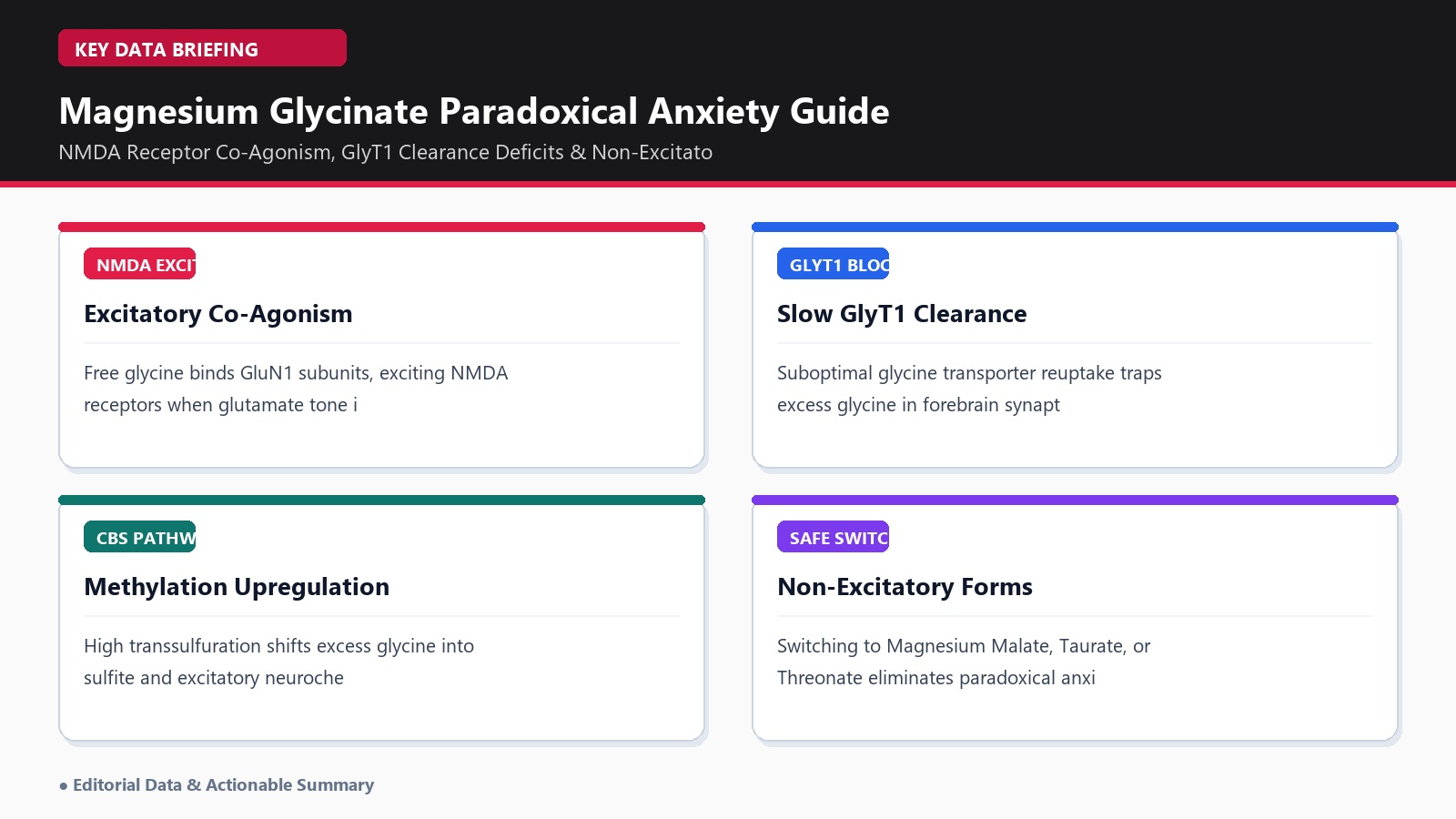
Figure 1: Cellular mechanism of the magnesium glycinate paradoxical reaction: GluN1 co-agonist NMDA receptor saturation, GlyT1 clearance failure, and transsulfuration shifts.
The 4 Underlying Biological Triggers of Magnesium Glycinate Intolerance
Why does this paradoxical reaction affect only 10% to 15% of the population while the remaining 85% sleep peacefully? Clinical research and functional metabolomics have identified 4 distinct neurochemical and genetic triggers that predispose individuals to magnesium glycinate-induced insomnia:
Trigger 1: Glycine Transporter 1 (GlyT1) Suboptimal Clearance
Astrocytes surrounding forebrain synapses utilize sodium- and chloride-dependent glycine transporter 1 (GlyT1) proteins to pump excess glycine out of the synaptic cleft, preventing continuous NMDA activation. In individuals with single nucleotide polymorphisms (SNPs) in the SLC6A9 gene, or those suffering from neuroinflammation driven by intestinal permeability or chronic viral reactivation, GlyT1 transport velocity is substantially suppressed. Free glycine remains stranded in the synaptic junction for hours, turning what should be a transient spike into sustained nocturnal excitation.
Trigger 2: Elevated Baseline Glutamate-to-GABA Neurochemical Ratio
The central nervous system operates on a delicate equilibrium between excitatory glutamate and inhibitory gamma-aminobutyric acid (GABA). Individuals with chronic psychological burnout, heavy workload, late-night blue-light exposure, or low vitamin B6 (pyridoxal-5-phosphate) have impaired glutamic acid decarboxylase (GAD) enzyme function, leaving excess glutamate trapped in synapses. When glycine is introduced into a glutamate-heavy brain, it immediately ignites dormant NMDA receptors, transforming mild fatigue into restless, racing thoughts.
Trigger 3: Cystathionine Beta-Synthase (CBS) and Methylation Polymorphisms
Glycine is an intimate participant in one-carbon methylation and transsulfuration biochemistry. Individuals with upregulated cystathionine beta-synthase (CBS A360A or C699T) variants rapidly funnel homocysteine and glycine into the transsulfuration pathway, creating excessive sulfites, ammonia, and hydrogen sulfide. If molybdenum levels are insufficient to fuel the sulfite oxidase (SUOX) enzyme, accumulated sulfites act as powerful neurotoxins that stimulate autonomic sympathetic outflow, causing nocturnal heart palpitations and sudden panic attacks.
Trigger 4: Gastric Hypochlorhydria and Chelate Cleavage Kinetics
In a healthy gastrointestinal tract, magnesium bisglycinate remains partially chelated until brush-border absorption. However, in individuals with low stomach acid (hypochlorhydria) or those using proton pump inhibitors (PPIs), the chelation bonds fracture prematurely in alkaline duodenal environments. This releases massive boluses of unbuffered free glycine directly into portal circulation, provoking a sharp systemic amino acid peak that crosses the blood-brain barrier via LAT1 transporters, shocking cerebral equilibrium.

Figure 2: Shifting from excitatory glycine chelates to calming magnesium taurate, threonate, and botanical nervines restores peaceful nocturnal sleep architecture.
Diagnostic Matrix: Comparing Magnesium Forms for Sleep, Bioavailability & Anxiety Risk
Experiencing adverse symptoms from magnesium bisglycinate does not mean you must forfeit the profound benefits of magnesium supplementation. The key lies in selecting a chelate whose carrier molecule matches your unique neurochemical profile. The clinical matrix below compares the 6 primary supplemental magnesium forms across elemental yield, blood-brain barrier penetration, and paradoxical anxiety probability:
| Magnesium Chelate Form | Carrier Molecule | Blood-Brain Penetration | Paradoxical Anxiety Risk | Optimal Timing & Clinical Use |
|---|---|---|---|---|
| Magnesium Bisglycinate | 2x Glycine Amino Acid | Moderate | Moderate-High (10-15%) | 30 min before bed (for non-reactors only) |
| Magnesium L-Threonate (Magtein) | L-Threonic Acid (Vitamin C metabolite) | Superior (Active CSF transport) | Extremely Low (<1%) | Evening / Synaptic plasticity & cognitive calm |
| Magnesium Taurate | Taurine (Inhibitory Amino Acid) | High | Near Zero (<0.5%) | Evening / Cardiac palpitations & vagal calm |
| Magnesium Malate | Malic Acid (Krebs Cycle Intermediate) | Moderate | Very Low (<2%) | Morning / Muscle soreness & ATP cellular energy |
| Magnesium Citrate | Citric Acid | Low-Moderate | Low (<3%) | Dinner / Mild constipation & GI motility |
| Magnesium Oxide | Inorganic Oxide Ion | Negligible (4% absorption) | Zero (Causes diarrhea) | Clinical colon cleanses & acute antacid relief |
The 4-Step Action Runbook: How to Safely Resume Magnesium Without Anxiety
If you have experienced paradoxical insomnia from magnesium glycinate, follow this systematic clinical runbook to restore your intracellular magnesium levels while completely bypassing glycine-mediated NMDA overstimulation:
Step 1: Initiate a 72-Hour Washout Period
Discontinue all magnesium bisglycinate supplements for a minimum of 3 consecutive days. This allows extracellular glycine levels to normalize, gives GlyT1 transporters time to clear synaptic pools, and resets cortical NMDA receptor subunit sensitivity. During this washout window, support hydration with 2 to 3 liters of water daily containing essential trace electrolytes (potassium and sodium).
Clinical Action: Check all current multivitamin labels, protein powders, and collagen peptides—collagen is roughly 33% glycine by weight and may be silently contributing to systemic glycine accumulation.
Step 2: Transition to Magnesium L-Threonate or Magnesium Taurate
Replace bisglycinate with a non-excitatory carrier. Magnesium L-Threonate (Magtein) is the only chelate demonstrated in clinical trials to cross the blood-brain barrier intact and directly increase cerebrospinal fluid (CSF) magnesium concentrations by 15%, density of pre-synaptic release sites, and slow-wave sleep depth without activating GluN1 glycine sites. Alternatively, Magnesium Taurate delivers taurine, which actively stimulates inhibitory glycine receptors (GlyR) and GABA-A receptors, providing cardiovascular rhythm stability and anti-anxiety calm.
Clinical Action: Begin with 1,000mg to 1,500mg of Magnesium L-Threonate (providing 72mg to 108mg of elemental magnesium) taken 45 minutes before bedtime, or 150mg of elemental Magnesium Taurate with your evening meal.
Step 3: Shift Magnesium Dosing to the Morning or Afternoon
While the common dogma dictates taking magnesium right before turning off the lights, intracellular magnesium homeostasis operates on an 8 to 12-week timeline rather than an acute 30-minute sedative trigger. Taking your supplement with breakfast or lunch allows the body to utilize magnesium for ATP synthesis and cellular enzymatic reactions throughout active waking hours, completely eliminating nocturnal vulnerability to paradoxical neurotransmitter spikes.
Clinical Action: If utilizing Magnesium Malate (ideal for daytime energy and fibromyalgia relief), take 200mg of elemental magnesium at 8:00 AM alongside a whole-food breakfast.
Step 4: Objective Biomarker Verification (RBC Magnesium Testing)
Never rely on standard serum magnesium blood tests, which represent less than 1% of total body magnesium stores and remain tightly defended by renal resorption even in severe clinical deficiency. Request a Red Blood Cell (RBC) Magnesium test. An optimal RBC magnesium target for neurological health and sleep regulation is 6.0 to 6.8 mg/dL (2.47 to 2.80 mmol/L). Testing RBC magnesium provides clarity on whether your paradoxical reaction is masking profound cellular depletion that demands careful, micro-dosed replenishment.
Clinical Action: Schedule a baseline RBC Magnesium panel alongside serum Vitamin B6 (P5P) and plasma amino acids after 8 to 12 weeks of non-glycine magnesium supplementation.
Frequently Asked Questions (FAQ)
Q1: How long does the anxiety and insomnia from magnesium glycinate typically last?
The half-life of oral glycine ranges from approximately 0.5 to 1.5 hours in healthy human plasma. However, the downstream NMDA receptor cascade and associated sympathetic arousal can persist for 4 to 8 hours. Most individuals notice the acute racing thoughts and palpitations begin to subside within 3 to 5 hours, with full baseline autonomic tranquility restored by late morning, provided adequate hydration and avoidance of further doses.
Q2: Does this mean I am allergic or permanently intolerant to all magnesium supplements?
No, absolutely not. True biochemical allergy to elemental magnesium is biologically impossible, as it is an essential intracellular cofactor required for more than 300 enzymatic reactions. Your reaction is almost certainly an amino acid intolerance to the glycine carrier molecule rather than the magnesium mineral itself. Over 98% of people who experience paradoxical insomnia from magnesium bisglycinate tolerate Magnesium Taurate, Magnesium L-Threonate, or topical transdermal magnesium chloride flakes with outstanding clinical success.
Q3: Can taking vitamin B6 or P5P stop magnesium glycinate from causing insomnia?
In many individuals, yes. Pyridoxal-5-phosphate (P5P)—the active coenzymatic form of vitamin B6—is the obligatory rate-limiting cofactor for the GAD enzyme, which converts excitatory glutamate into calming GABA. If you are functional B6 deficient, glutamate builds up in brain synapses, leaving your NMDA receptors primed to explode upon the arrival of supplemental glycine. Replenishing active P5P (25mg to 50mg daily) can rebalance the glutamate/GABA ratio, though switching to magnesium threonate or taurate remains a faster and more direct solution.
Q4: What is the single best magnesium form if I have severe panic attacks or cardiac palpitations?
For individuals prone to acute anxiety, panic attacks, or nocturnal cardiac palpitations, Magnesium Taurate is the undisputed clinical front-runner. Taurine possesses intrinsic anti-arrhythmic and neuro-inhibitory properties, acting as an agonist at cardiac potassium channels and cerebral GABA-A receptors. Clinical trials show that Magnesium Taurate smooths heart rate variability (HRV) and dampens sympathetic fight-or-flight outflow without any risk of NMDA co-agonist excitation.
Clinical References & Primary Sources:
1. Johnson, J. W., & Ascher, P. (1987). Glycine potentiates the NMDA response in cultured mouse brain neurons. Nature, 325(6104), 529-531.
2. Danysz, W., & Parsons, C. G. (1998). Glycine and N-methyl-D-aspartate receptors: physiological significance and therapeutic applications. Pharmacological Reviews, 50(4), 597-664.
3. Slutsky, I., et al. (2010). Enhancement of learning and memory by elevating brain magnesium. Neuron, 65(2), 165-177.
4. McCarty, M. F. (1996). Complementary vascular-protective actions of magnesium and taurine: rationale for magnesium taurate. Medical Hypotheses, 46(2), 89-100.
5. National Institutes of Health (NIH) Office of Dietary Supplements. (2024). Magnesium: Fact Sheet for Health Professionals. NIH ODS Clinical Reference Portal.
Medical Disclaimer: This diagnostic article is for clinical educational purposes only and does not constitute formal medical diagnosis or personal pharmacotherapy advice. Always consult a board-certified physician or qualified healthcare practitioner before altering magnesium supplementation protocols or discontinuing prescribed medications.