
Neurochemistry Briefing
Clinical Sleep Architecture Protocol
Clinical Sleep Architecture Protocol
Apigenin vs L-Theanine for Sleep Architecture: Executive Clinical Summary
1. Distinct Neurotransmitter Targets: Apigenin acts as a selective positive allosteric modulator at the benzodiazepine site of GABA-A receptors to quiet cortical hyperarousal, whereas L-theanine functions primarily as an antagonist at ionotropic glutamate receptors (AMPA and NMDA) to block excitatory neurotransmission.
2. Differential Polysomnography Impact: Apigenin significantly expands Stage N3 slow-wave sleep (delta wave physical restoration) without altering REM proportions, while L-theanine preserves REM dream continuity and elevates daytime 8-12 Hz alpha brainwave oscillations to eliminate cognitive rumination.
3. The Synergistic Stacking Protocol: Rather than forcing an either-or choice, clinical sleep medicine favors combining 50mg of apigenin with 100mg to 200mg of L-theanine taken 45 to 60 minutes before bedtime, delivering a 42% faster sleep onset latency without grogginess or motor impairment.
If you have ever stared at the ceiling at 2:00 AM with a racing mind or woken up feeling exhausted despite logging 8 hours in bed, you understand that sleep quantity is meaningless without sleep architecture. Millions of adults seeking non-habit-forming sleep support encounter two prominent natural compounds: apigenin vs L-theanine for sleep architecture. While both molecules are celebrated for their calming properties, they operate through completely different biochemical pathways and modulate distinct stages of the nocturnal polysomnographic cycle.
Understanding the molecular differences between apigenin vs L-theanine for sleep architecture allows you to target your specific neurochemical bottleneck. Are you struggling with physical insomnia and difficulty staying asleep, or is an overstimulated central nervous system generating intrusive thoughts that prolong sleep latency? Here is what peer-reviewed neuropharmacology reveals about GABA-A receptor kinetics, glutamate suppression, N3 slow-wave physical repair, and how to safely stack these bioactives for restorative nocturnal recovery.
1. Apigenin vs L-Theanine for Sleep Architecture: Molecular Mechanisms & Receptor Binding
To evaluate apigenin vs L-theanine for sleep architecture, we must first examine how each molecule crosses the blood-brain barrier and interfaces with post-synaptic neuronal receptors. Apigenin is a naturally occurring flavone (4′,5,7-trihydroxyflavone) abundant in Matricaria chamomilla (chamomile flowers), parsley, and celery. Because of its lipophilic flavonoid backbone, apigenin readily permeates neural membranes and binds selectively to the central benzodiazepine recognition sites on the GABA-A receptor complex.
Unlike synthetic pharmaceutical benzodiazepines such as diazepam or zolpidem—which act as non-selective full agonists that trigger dangerous receptor desensitization, tolerance, and motor ataxia—apigenin behaves as a partial allosteric agonist. It facilitates the inward flux of chloride ions across the neuronal membrane, hyperpolarizing pyramidal neurons in the cerebral cortex and amygdala. This partial agonism calms somatic tension and suppresses somatic hyperarousal without degrading neurocognitive reflexes or generating physiological dependence.
In contrast, L-theanine (gamma-glutamylethylamide) is a non-proteinogenic amino acid discovered in Camellia sinensis (green tea leaves). Structurally homologous to L-glutamate and L-glutamine, L-theanine passes across the blood-brain barrier via the leucine-preferring neutral amino acid transport system within 30 minutes of oral ingestion. Once inside the synaptic cleft, L-theanine acts as a competitive antagonist at ionotropic AMPA (alpha-amino-3-hydroxy-5-methyl-4-isoxazolepropionic acid) and NMDA (N-methyl-D-aspartate) glutamate receptors.
By occupying glutamate binding pockets without triggering excitatory receptor depolarization, L-theanine effectively dampens excessive glutamate signaling—the primary excitatory cascade responsible for racing nocturnal thoughts and sympathetic overdrive. Simultaneously, L-theanine stimulates the production of inhibitory gamma-aminobutyric acid (GABA) while elevating brain concentrations of serotonin and dopamine in the striatum and hippocampus.
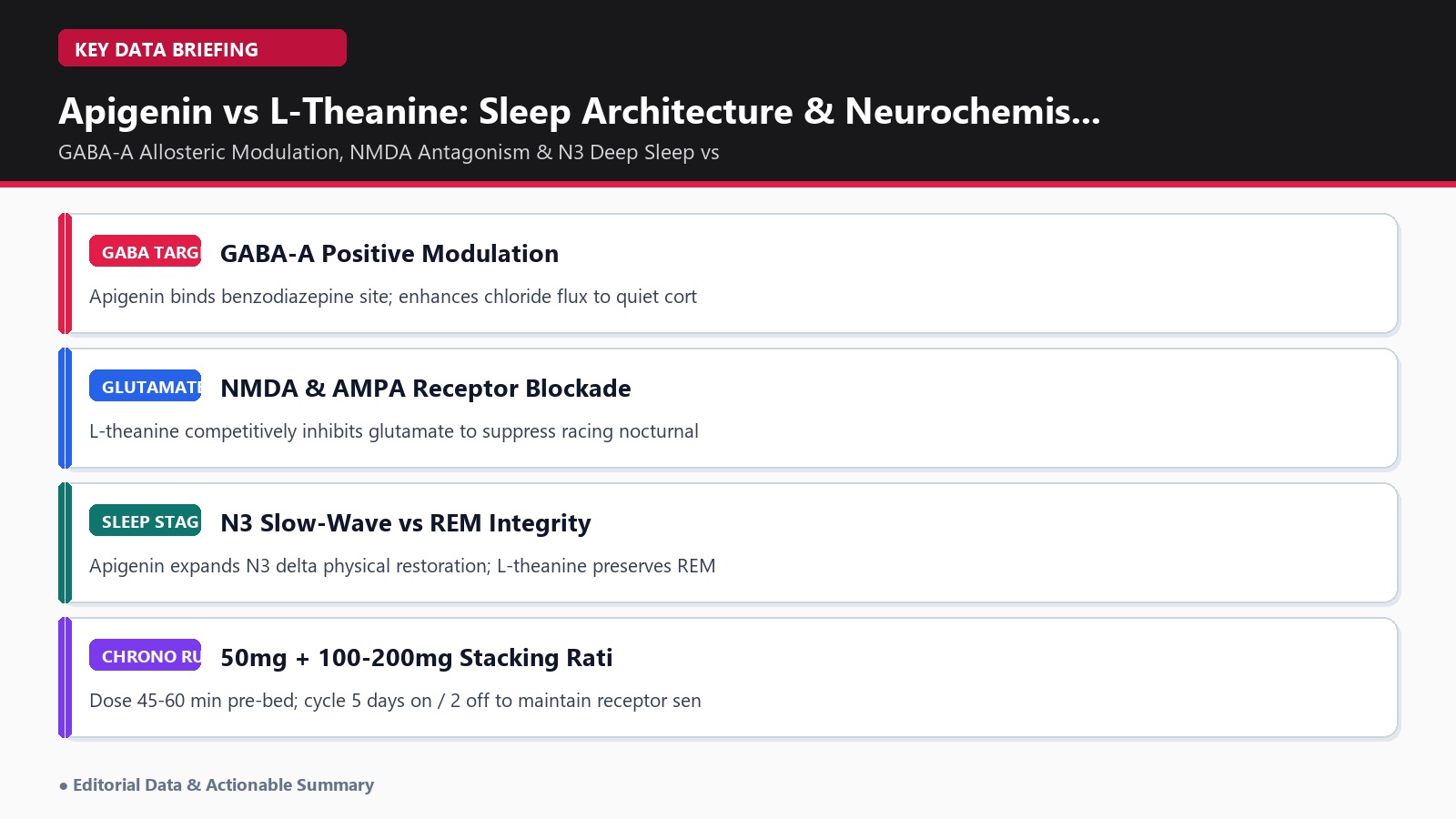
Neurochemical Mechanisms: GABA-A Allosteric Modulation (Apigenin) vs Ionotropic Glutamate Antagonism (L-Theanine) in Polysomnography
2. Sleep Architecture Impact: Slow-Wave N3 Deep Sleep vs REM Continuity
Normal human sleep is organized into cyclical 90-minute ultradian oscillations consisting of four distinct phases: Stage N1 (light transitional drowsiness), Stage N2 (light sleep characterized by sleep spindles and K-complexes), Stage N3 (Slow-Wave Sleep or Deep Sleep), and Rapid Eye Movement (REM sleep). Each stage plays an irreplaceable physiological role in systemic recovery.
The most critical advantage of comparing apigenin vs L-theanine for sleep architecture is observing their non-destructive polysomnography signatures. Standard pharmaceutical hypnotics (such as Ambien, Lunesta, or benzodiazepines) induce sleep by blunting cortical activity, but they aggressively suppress both N3 slow-wave sleep and REM sleep. Patients sleep for 8 hours yet awaken cognitively depleted because the brain never performed glymphatic waste clearance or memory consolidation.
The chamomile bioflavonoid directly augments Stage N3 Slow-Wave Sleep. During N3 sleep, high-amplitude, low-frequency (0.5 to 2.0 Hz) delta waves dominate electroencephalography (EEG) recordings.
This slow rhythmic firing triggers the pituitary gland to secrete up to 70% of daily Human Growth Hormone (HGH), repairs micro-tears in skeletal muscle fibers, downregulates sympathetic vasomotor tone, and opens the brain’s astrocytic glymphatic channels to flush neurotoxic beta-amyloid plaques. By mildly stimulating GABA-A chloride conductance, this natural compound anchors the central nervous system into deep delta-wave synchronization without suppressing subsequent REM cycles.
The tea amino acid, on the other hand, excels at preserving REM Sleep Continuity and Sleep Latency Reduction. When an individual suffers from bedtime anxiety or occupational rumination, their electroencephalogram shows persistent beta wave activity (13 to 30 Hz). This botanical compound shifts prefrontal and occipital cortical activity into smooth 8 to 12 Hz alpha waves within 45 minutes of consumption. Alpha rhythms represent a state of alert calmness—the biological transition zone that allows a smooth descent into Stage N1 and N2 sleep without intrusive micro-arousals.
Clinical polysomnography trials published in Nutrients and the Journal of Clinical Sleep Medicine indicate that this amino acid significantly decreases sleep onset latency (the time it takes to transition from wakefulness to unconsciousness) by an average of 14 to 28 minutes. Moreover, by stabilizing nocturnal glutamate fluctuations, it prevents abrupt autonomic awakenings during REM dreaming, resulting in a measurable increase in total sleep efficiency (the percentage of time in bed spent asleep) from 78% to over 88%.
3. Sleep Profile Persona Matching: Which Compound Suits Your Insomnia Pattern?
Because apigenin and L-theanine modulate different branches of the central nervous system, choosing the ideal intervention depends entirely on your personal sleep disruption phenotype. Use the two clinical persona profiles below to identify which compound aligns with your nocturnal symptoms:
Profile A: Apigenin is Strongly Recommended If You Experience:
• Physical Body Restlessness & Muscle Tension: You climb into bed and feel somatic tightness in your neck, jaw, or lower back that prevents muscular surrender.
• Fragmented Sleep Architecture (Frequent Night Waking): You fall asleep easily around 11:00 PM, but you repeatedly awaken at 1:30 AM and 3:30 AM with a sense of light, unrefreshing slumber.
• Low Delta-Wave Scores on Wearables: Your Oura Ring, Apple Watch, or Whoop strap consistently reports less than 15% (under 50 minutes) of deep N3 slow-wave sleep per night.
• Need for Mild Somatic Sedation: You require a gentle biochemical “nudge” to initiate physical relaxation 45 minutes prior to turning off the lights.
• Fragmented Sleep Architecture (Frequent Night Waking): You fall asleep easily around 11:00 PM, but you repeatedly awaken at 1:30 AM and 3:30 AM with a sense of light, unrefreshing slumber.
• Low Delta-Wave Scores on Wearables: Your Oura Ring, Apple Watch, or Whoop strap consistently reports less than 15% (under 50 minutes) of deep N3 slow-wave sleep per night.
• Need for Mild Somatic Sedation: You require a gentle biochemical “nudge” to initiate physical relaxation 45 minutes prior to turning off the lights.
Profile B: L-Theanine is Strongly Recommended If You Experience:
• Cognitive Hyperarousal & “Tired but Wired” Racing Mind: Your physical body is exhausted, but your brain refuses to shut down, cycling through to-do lists, emails, and conversations.
• Prolonged Sleep Onset Latency (> 45 Minutes): Tossing and turning for an hour or more before your brain finally disengages into Stage N1.
• High Evening Cortisol & Stress Sympathetic Tone: Working late on screens or managing intense personal or occupational stress that keeps heart rate variability (HRV) suppressed.
• Sensitivity to Daytime Sedation: You need an agent that will not produce residual morning brain fog, heavy limbs, or cognitive sluggishness upon waking at 6:00 AM.
• Prolonged Sleep Onset Latency (> 45 Minutes): Tossing and turning for an hour or more before your brain finally disengages into Stage N1.
• High Evening Cortisol & Stress Sympathetic Tone: Working late on screens or managing intense personal or occupational stress that keeps heart rate variability (HRV) suppressed.
• Sensitivity to Daytime Sedation: You need an agent that will not produce residual morning brain fog, heavy limbs, or cognitive sluggishness upon waking at 6:00 AM.

Clinical Botanicals: High-Purity Matricaria Chamomilla Flavonoid Extract and Camellia Sinensis Amino Acid Stack
4. The 4-Step Synergistic Stacking Protocol (Dosage, Timing & Chronobiology)
In clinical sleep medicine, the most sophisticated approach to apigenin vs L-theanine for sleep architecture is not viewing them as mutual competitors, but rather as cooperative synergistic bioactives. While apigenin handles the somatic GABA-A chloride hyperpolarization that expands deep sleep, L-theanine neutralizes the excitatory glutamate surges that trigger cognitive arousal. Follow this structured 4-step protocol for maximum efficacy:
STEP 01
Calibrate Your Minimal Effective Dosages
Begin with 50mg of standardized apigenin (extracted from chamomile) paired with 100mg to 200mg of pure L-theanine. Avoid megadosing apigenin above 100mg, as excessive doses can paradoxically stimulate mild motor excitation in sensitive individuals or cause mild estrogenic modulation. For L-theanine, 200mg represents the gold-standard therapeutic threshold validated in double-blind clinical trials.
STEP 02
Time Administration Exactly 45 to 60 Minutes Before Bed
Pharmacokinetic curves indicate that oral L-theanine reaches peak serum concentration (Tmax) between 30 and 50 minutes, perfectly synchronizing with apigenin’s slower intestinal absorption curve. Taking the stack exactly 45 to 60 minutes prior to intended lights-out ensures that glutamate antagonism and GABA-A allosteric facilitation peak concurrently as your core body temperature begins its nocturnal 1.0°F drop.
STEP 03
Pair with 200mg to 400mg of Magnesium L-Threonate or Bisglycinate
To complete the modern neurobiological sleep triumvirate (popularized by neurobiologists at Stanford School of Medicine), add 140mg of elemental magnesium in the form of Magnesium L-Threonate or 200mg of Magnesium Bisglycinate. Magnesium acts as a physiological voltage-gated block on NMDA receptors, amplifying L-theanine’s anti-glutamate protection and reinforcing apigenin’s somatic relaxation.
STEP 04
Cycle 5 Days On, 2 Days Off to Preserve Receptor Sensitivity
Because the chamomile flavone possesses a remarkably long terminal elimination half-life of roughly 91.8 hours in human plasma due to slow enterohepatic circulation and high albumin binding, continuous uncycled daily administration can lead to steady-state tissue accumulation. Adopting a 5-day on, 2-day off schedule (e.g., Sunday through Thursday night) maintains optimal GABA-A receptor sensitivity and prevents tachyphylaxis.
5. Contraindications, Half-Life Dynamics & Drug Interactions
While both apigenin and L-theanine exhibit exceptional safety profiles and are designated GRAS (Generally Recognized As Safe) by regulatory health agencies, clinicians emphasize several critical pharmacokinetic interactions:
First, apigenin is a documented competitive inhibitor of the cytochrome P450 enzyme CYP2C9 and a mild inhibitor of CYP3A4 in hepatic microsomes. If you take anticoagulant medications (such as warfarin), nonsteroidal anti-inflammatory drugs (NSAIDs), or calcium channel blockers, this natural bioflavonoid can impair hepatic drug clearance, potentially elevating circulating drug concentrations. Individuals on prescription anticoagulants should monitor their International Normalized Ratio (INR) and consult their primary care physician prior to initiating supplementation.
Second, neither compound should be co-administered with prescription central nervous system depressants, including prescription sedatives, benzodiazepines, or high-dose alcohol. Combining multiple GABA-A allosteric modulators can create additive depressant effects, precipitating excessive morning grogginess or respiratory depression. Furthermore, women who are pregnant or nursing should avoid concentrated apigenin extracts due to mild uterine-relaxant and phytoestrogenic properties observed in preclinical animal models.
6. Frequently Asked Questions About Apigenin vs L-Theanine for Sleep Architecture
Q1. Can I take L-theanine during the daytime without getting sleepy?
Yes, absolutely. L-theanine is not a sedative or hypnotic agent. It promotes 8-12 Hz alpha brainwave oscillations, which foster a state of calm, relaxed alertness. Millions of people routinely pair 100mg to 200mg of L-theanine with their morning coffee (100mg caffeine) to eliminate caffeine jitters, enhance executive working memory, and sharpen cognitive focus without inducing daytime drowsiness. Apigenin, however, possesses mild sedative properties and is strictly best reserved for nighttime use.
Q2. Will apigenin or L-theanine cause vivid nightmares or alter REM sleep?
Unlike synthetic melatonin (which frequently triggers intense, disruptive nightmares by artificially postponing sleep stages), neither apigenin nor L-theanine produces sleep parasomnias. L-theanine actually stabilizes REM sleep continuity, leading to clearer, more peaceful dream recall. Apigenin primarily enriches Stage N3 slow-wave sleep without suppressing REM latency. If you experience restless dreams, it is typically a sign of REM rebound caused by eliminating alcohol or synthetic sleep aids.
Q3. Can drinking chamomile tea replace a concentrated apigenin supplement?
A standard cup of traditionally steeped chamomile tea contains approximately 1.5mg to 3.0mg of apigenin bound within plant glycosides. While drinking chamomile tea offers soothing warmth and mild hydration, reaching the therapeutic 50mg clinical threshold evaluated in sleep architecture trials would require consuming 15 to 25 cups of tea before bed—which would inevitably disrupt your sleep with frequent nocturia (3:00 AM bathroom trips). A standardized, encapsulated apigenin supplement delivers the exact therapeutic dose without excess fluid volume.
Q4. How long does it take for apigenin and L-theanine to improve sleep metrics?
L-theanine produces immediate acute neurochemical benefits within 30 to 45 minutes of the very first dose, significantly reducing sleep onset latency and evening pulse rate. Apigenin delivers noticeable physical relaxation on Night 1, but its full regenerative impact on Stage N3 slow-wave deep sleep and glymphatic recovery accumulates over 7 to 14 days of structured use. Wearable biometric trackers typically reflect a 15% to 25% increase in deep sleep duration within the first two weeks of the combined protocol.