

Editor’s 1-Minute Briefing
2026 Lipidomics & Supplement Bioavailability Audit
Fish Oil rTG vs. Ethyl Ester Bioavailability: Clinical Verdict
1. The 70% Absorption Gap: In landmark 6-month randomized trials, re-esterified triglyceride (rTG) fish oil raised the blood Omega-3 Index up to 70% faster than synthetic ethyl ester (EE) concentrates at identical EPA+DHA doses.
2. The Fat-Meal Trap: Synthetic ethyl esters require pancreatic carboxyl ester lipase triggered by 10 to 15 g of dietary fat; swallowing an EE capsule with black coffee cuts real absorption below 25%.
3. Buyer Rule & Benchmarks: Pick IFOS-certified rTG fish oil with TOTOX under 26 meq/kg, verify EPA+DHA totals against NIH Office of Dietary Supplements targets, and ignore viral Styrofoam cup myths.
Millions of adults over 40 grab a bargain 400-count warehouse jug labeled “1,200 mg Fish Oil,” swallow one softgel with morning black coffee, and assume their heart and brain are protected. Six months later, their blood work barely budges because synthetic ethyl ester oil passes largely unabsorbed without heavy dietary fat—making fish oil rtg vs ethyl ester bioavailability the single biggest hidden variable in omega-3 supplementation.
Clinical pharmacokinetic studies indexed on PubMed and Nature European Journal of Clinical Nutrition confirm that molecular ester structure determines how much EPA and DHA actually enters red blood cell membranes. Below, we compare rTG, ethyl ester, and natural triglyceride formats so you never overpay for poorly absorbed oil.
1. Fish Oil rTG vs. Ethyl Ester vs. Natural TG: 7-Point Molecular Comparison
Wild fish store omega-3 fatty acids on a three-fatty-acid glycerol backbone called a triglyceride (TG), typically capped at 30% EPA+DHA concentration. To concentrate EPA and DHA above 60%, manufacturers cleave the glycerol backbone with ethanol—producing synthetic ethyl esters (EE)—and premium brands then enzymatically rebuild that purified oil back into a high-potency re-esterified triglyceride (rTG).
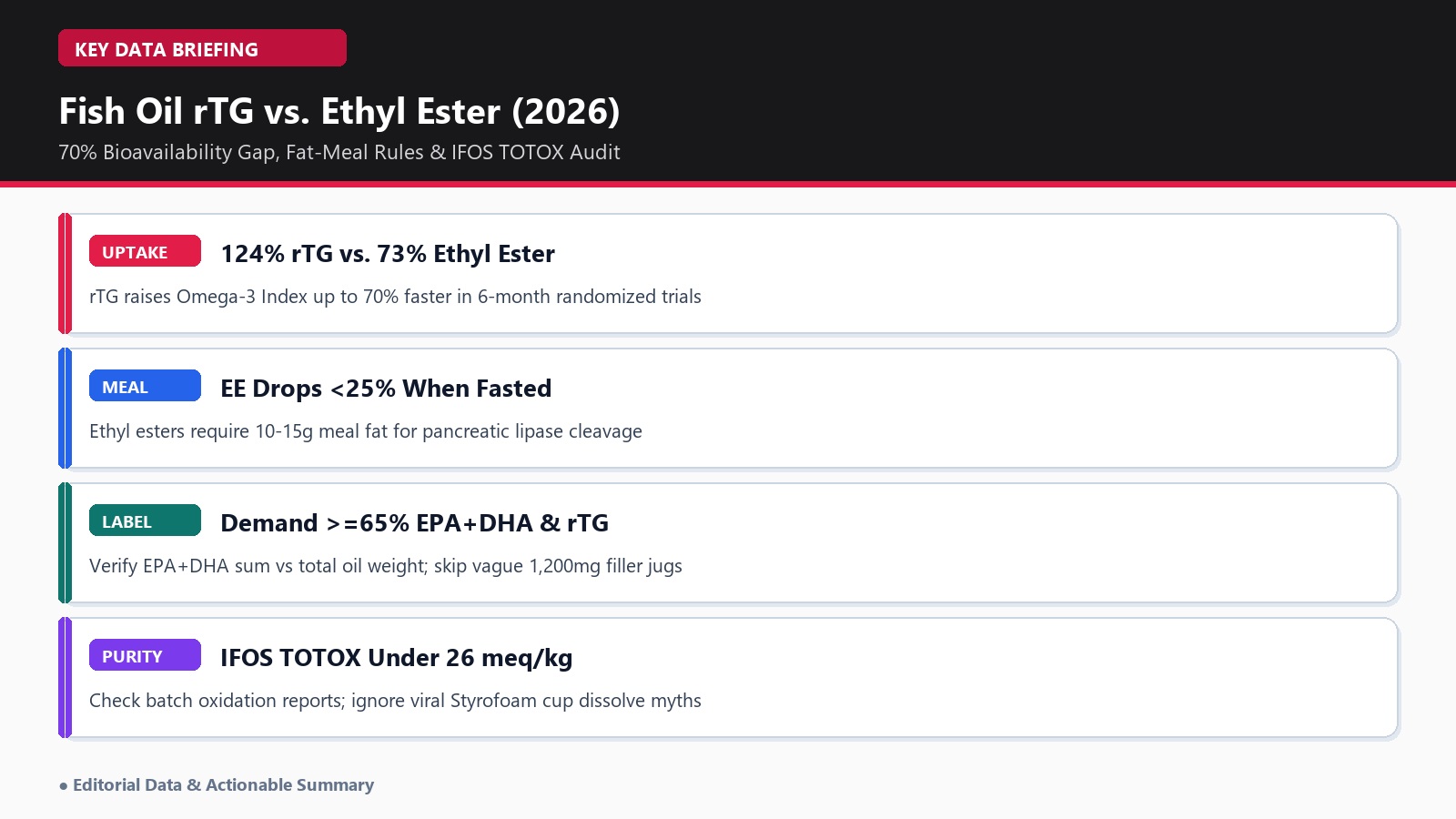
Figure 1: Fish Oil rTG vs. Ethyl Ester Bioavailability — Clinical Absorption Gap, Fat-Meal Threshold & TOTOX Verification
2. Who Needs rTG Fish Oil vs. Ethyl Ester? 40+ Buyer Persona Matrix
Choosing between rTG fish oil and an ethyl ester softgel is not about marketing hype—it comes down to your digestion, meal timing, and whether you are targeting an Omega-3 Index above 8%. Match your profile against the two-column verdict below.
Choose rTG Fish Oil If You Fit These Criteria
1. Light Breakfast or Intermittent Fasting: If you take supplements with coffee, yogurt, or a light lunch under 10 g of fat, rTG absorbs reliably without sitting in your stomach.
2. Targeting Omega-3 Index 8%+: Adults over 45 aiming for cardiovascular and cognitive resilience hit target blood levels weeks faster on rTG.
3. Dry Eyes, Reflux, or Pill Fatigue: Re-esterified oils deliver 1,000+ mg EPA/DHA in 1–2 small capsules with minimal fishy aftertaste.
When Ethyl Ester (EE) Still Makes Sense
1. Prescription Triglyceride Therapy: FDA-approved drugs like icosapent ethyl (Vascepa, 4,000 mg/day) use pharmaceutical-grade EE with strict oxidation controls for triglycerides ≥150 mg/dL.
2. Strict High-Fat Dinner Anchor: If you always swallow softgels mid-dinner alongside salmon, olive oil, or eggs (≥15 g fat), EE absorption catches up substantially.
3. Tight Monthly Budget: Taking two high-dose EE capsules with your heaviest fatty meal remains cost-effective when stored in a dark fridge.
3. Real-World Absorption & Cost Simulation: 1,000 mg EPA/DHA Math
A $12 bottle is no bargain if 75% of its oil never crosses your intestinal wall. In the landmark 6-month trial by Dyerberg et al. and follow-up lipidomics cohorts cited by American Heart Association researchers, subjects taking rTG achieved a 124% relative bioavailability versus natural fish oil, while EE lagged at 73% even with food and collapsed to 20%–25% in low-fat conditions.

Figure 2: Pairing Concentrated Omega-3 Softgels With Whole-Food Healthy Fats Maximizes Micelle Formation and Absorption
4. How to Know If Fish Oil Is rTG: 4-Step Label & Purity Audit
Supplement brands are not legally required by the FDA to print “Ethyl Ester” in bold letters on the front label. Run these four quick checks on any bottle before buying.
STEP 01 — Decode the Supplement Facts Panel & Molecular Claim
Look specifically for the explicit phrase “rTG,” “Re-esterified Triglyceride,” or “Triglyceride Form (TG)” combined with high concentration (>60% EPA+DHA). If the label boasts “1,000 mg Ultra-Concentrated EPA/DHA” with zero mention of triglyceride or rTG form, it is almost always a cheaper ethyl ester oil.
STEP 02 — Calculate True EPA + DHA Percentage (The 60% Benchmark)
Ignore the front “2,000 mg Fish Oil” banner and flip to the Supplement Facts box. Add EPA mg + DHA mg, then divide by the total fish oil weight per serving. Quality rTG concentrates hit 65% to 85% combined EPA+DHA; generic 30% bottles carry mostly filler saturated and monounsaturated fats.
STEP 03 — Verify IFOS 5-Star Batch TOTOX (<26 meq/kg)
Independent testing by IFOS (International Fish Oil Standards) sets a strict ceiling of Peroxide Value ≤5 meq/kg, Anisidine ≤20, and total oxidation TOTOX ≤26 meq/kg (premium rTG batches often test under 10). Never buy opaque bottles without lot-level third-party oxidation certificates.
STEP 04 — Skip the Viral “Styrofoam Cup Test” & Anchor With Dinner
Social media clips claiming ethyl ester fish oil is “toxic” because it melts polystyrene foam confuse polarity with toxicity: ethyl esters are nonpolar organic solvents just like orange peel oil (limonene), whereas human digestion uses bile salts and pancreatic lipase. Take your rTG capsules with a meal containing 10 g+ healthy fat and store the bottle away from kitchen heat.
Clinical Safety Limits & Medication Warnings (40+ Guardrails)
1. High-Dose Atrial Fibrillation Signal: Large cardiovascular outcome trials cited by Cleveland Clinic observed a slight rise in atrial fibrillation at prescription-level intakes of 3,000 to 4,000 mg/day; stick to 1,000–2,000 mg/day combined EPA+DHA unless physician-directed.
2. Anticoagulant & Antiplatelet Check: Above 2,000 mg/day, omega-3s mildly reduce platelet aggregation. Consult your prescribing doctor before combining high-dose rTG fish oil with warfarin, apixaban (Eliquis), rivaroxaban, or clopidogrel.
3. Rancidity Bite Test: Open one softgel every 60 days and taste the oil—fresh rTG tastes faintly of mild ocean water, whereas sharp painty or sour bitterness indicates oxidation; discard immediately.
5. Frequently Asked Questions: Fish Oil rTG Form & Bioavailability
Q1. What is rTG fish oil, and how does rTG vs TG differ?
Both TG and rTG share the natural three-fatty-acid glycerol backbone that human digestive enzymes absorb effortlessly. Natural TG fish oil is unrefined and limited to roughly 30% EPA+DHA, whereas rTG (re-esterified triglyceride) is purified to strip mercury and PCBs, concentrated to 65%–85% EPA+DHA, and enzymatically restored to the triglyceride structure.
Q2. How do I know if fish oil is rTG or ethyl ester if the bottle does not say?
When a high-potency fish oil contains more than 50% combined EPA and DHA without explicitly printing “rTG” or “Triglyceride Form” on the label or brand COA, it is almost certainly an ethyl ester concentrate—because re-esterification adds roughly 25%–35% to manufacturing cost and brands always advertise rTG when they pay for it.
Q3. Does rTG omega-3 still require food for maximum bioavailability?
Yes, though far less than ethyl esters. Taking rTG fish oil with a modest meal containing 8 to 12 g of fat (such as eggs, avocado, or dinner protein) stimulates gallbladder bile release and boosts bioavailability another 15%–20% compared to fasting, while preventing mild nausea.
Q4. How long does it take rTG fish oil to raise my Omega-3 Index?
Red blood cells turn over roughly every 120 days. Consistent daily dosing of 1,500 to 2,000 mg EPA+DHA in rTG form typically elevates a baseline 4.5% Omega-3 Index into the cardioprotective 8%+ optimal zone within 12 to 16 weeks.
Related Clinical Protocols & Evidence Guides