
Editor’s 1-Minute Briefing
Adaptogen Phytochemistry & Mitochondrial Fatigue Verdict (2026)
Adaptogen Phytochemistry & Mitochondrial Fatigue Verdict (2026)
Rhodiola Crenulata vs. Rosea for Chronic Fatigue: Clear Clinical Verdict
1. The Core Phytochemical Split: Human trials archived on PubMed clinical trial registries overwhelmingly test Rhodiola rosea standardized to 3% rosavins and 1% salidroside, whereas Rhodiola crenulata naturally lacks rosavins and supplies almost exclusively salidroside (0.5%–1.5%).
2. Why Cheap Bottles Disappoint Burned-Out Adults: Independent botanical testing shows roughly 20% to 30% of bargain “Rhodiola” capsules substitute cheaper Tibetan R. crenulata without disclosing the species switch, stripping away the rosavin-driven cortisol-buffering profile needed for chronic fatigue.
3. Fast 1-Second Buyer Rule: Choose Siberian/Arctic Rhodiola rosea (200–400 mg/day, SHR-5 or 3:1 ratio) before noon for stress-linked exhaustion; reserve pure Rhodiola crenulata only for acute hypoxic or altitude-endurance protocols under practitioner guidance.
Imagine spending $28 per bottle for four straight months hoping to lift afternoon brain fog and post-work exhaustion, only to feel jittery at 10 AM and wiped out by 3 PM. Across the 2026 adaptogen market, that exact frustration often traces back to a single label trap: buying Rhodiola crenulata disguised inside a generic “Rhodiola” blend instead of clinically studied Rhodiola rosea.
Understanding rhodiola crenulata vs rosea for chronic fatigue requires looking beyond marketing claims of “500 mg adaptogen extract.” Monograph reviews from the NIH National Center for Complementary and Integrative Health (NCCIH) and peer-reviewed trials in the British Journal of Nutrition confirm that species chemistry dictates whether a root calms hypothalamic-pituitary-adrenal (HPA) burnout or simply acts like a mild metabolic stimulant.
1. Rhodiola Crenulata vs Rosea for Chronic Fatigue: 7-Point Master Comparison
Both species belong to the Crassulaceae botanical family and survive freezing high-altitude environments, yet their secondary metabolites diverge sharply. Over-harvesting of wild Arctic Rhodiola rosea triggered CITES trade protections in 2023–2026, pushing low-cost manufacturers toward farmed Tibetan Rhodiola crenulata—even though human fatigue RCTs do not support treating the two roots as interchangeable.
Why do rosavins matter so much when comparing rhodiola crenulata vs rosea for chronic fatigue? While salidroside drives AMPK phosphorylation and protects neurons against oxidative stress, rosavins uniquely inhibit monoamine oxidase (MAO) degradation subtly and dampen stress-activated protein kinases (JNK/SAPK) inside fatigued muscle and brain tissue. Without rosavins, R. crenulata delivers only half of the clinical fatigue-recovery equation.
2. Which Species Fits Your Fatigue Pattern? Adult 40+ Decision Cards
Not all fatigue over 40 comes from the same bottleneck. Before ordering either extract, match your dominant symptom cluster—stress-induced HPA exhaustion versus physical oxygen-delivery fatigue—to the specific root below.
Winner for Chronic Fatigue: Rhodiola Rosea (3% Rosavins)
Choose this if: You wake unrefreshed, hit a 2 PM cognitive wall, or experience burnout paired with irritability and poor focus after age 40.
Clinical benchmark: In a 12-week multi-center trial using 400 mg/day standardized R. rosea extract, burnout exhaustion scores dropped 31% within 4 weeks and continued improving through week 12 without stimulant crashes.
Niche Winner Only: Rhodiola Crenulata (Salidroside-Rich)
Choose this if: You specifically want high-salidroside support for high-altitude travel, VO2-max hypoxia conditioning, or targeted athletic endurance blocks.
Reality check: Even when high-salidroside R. crenulata boosts physical stamina in controlled sports labs, it lacks validated human chronic fatigue syndrome or burnout recovery trials compared with R. rosea.
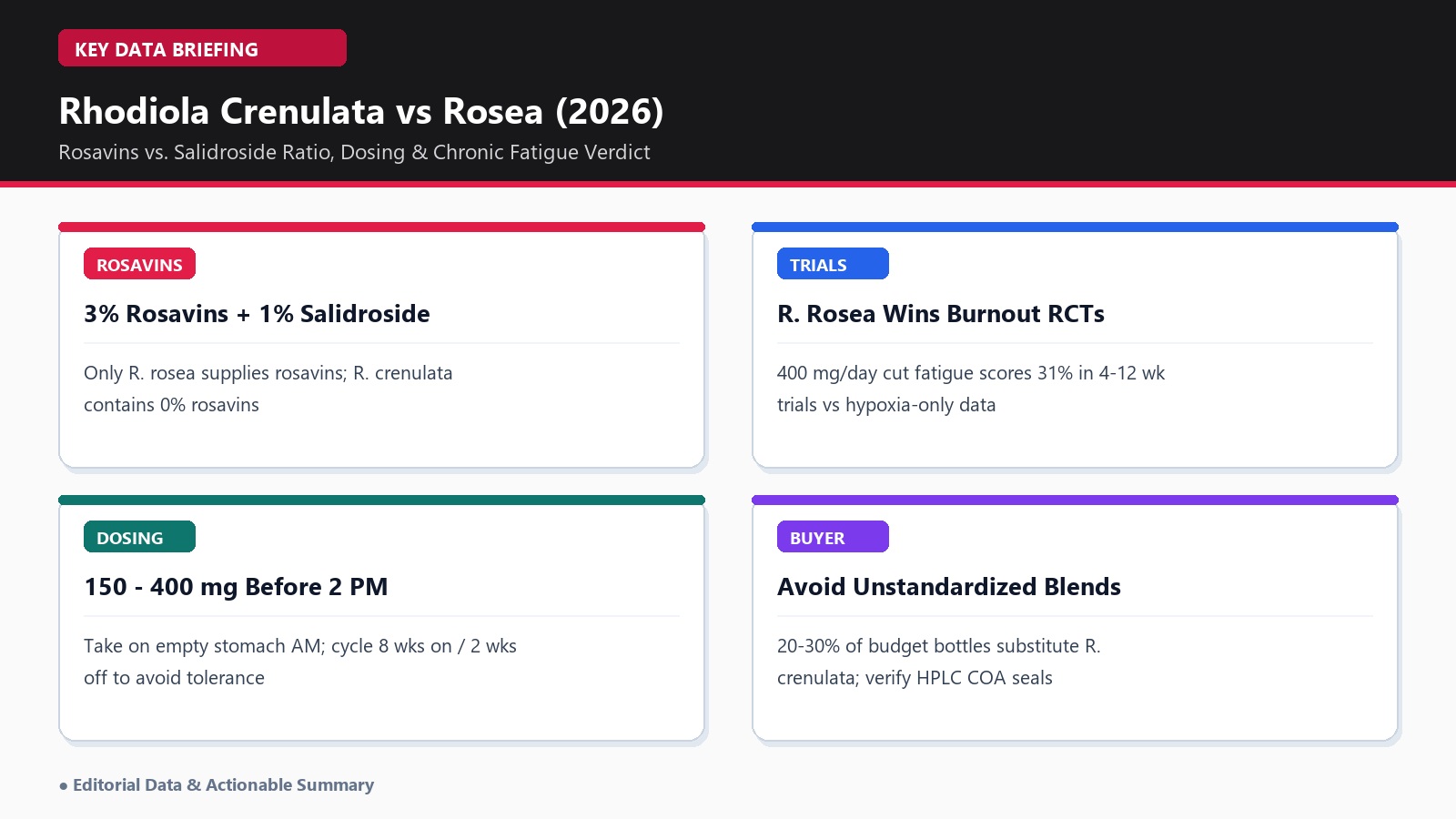
Figure 1: Rhodiola Crenulata vs. Rhodiola Rosea Phytochemical Ratios, Clinical Dosing & Fatigue Verdict
3. True Cost Per Milligram of Active Rosavins & Adaptogen Alternatives
The biggest hidden cost in rhodiola crenulata vs rosea for chronic fatigue is label math. Many $14 bottles advertise “500 mg Rhodiola Root Powder” (unstandardized raw herb at ~0.4% rosavins) or blend in R. crenulata to inflate total salidroside while supplying near-zero rosavins. Compare real active compound yield per dollar alongside popular alternatives like Ashwagandha and L-theanine.
Figure 2: Taking Standardized Rhodiola Rosea Early in the Day Protects Deep Sleep Architecture While Lifting Fatigue
4. Buyer & Dosing Checklist: 4 Steps to Avoid Adulterated Rhodiola
Because Frontiers in Pharmacology analytical audits repeatedly flag species substitution across online adaptogen brands, verify these four steps before taking your first capsule.
STEP 01 — Verify Both Botanical Latin Name & Dual Standardization
Flip to the Supplement Facts panel and confirm the exact binomial Rhodiola rosea (root) alongside explicit dual percentages: minimum 3% rosavins and 1% salidroside. If a label reads only “Rhodiola extract (1% salidroside)” with zero rosavin number, assume it is cheaper Rhodiola crenulata.
STEP 02 — Start at 150–200 mg Before Breakfast, Never After 2:00 PM
Rhodiola exerts a mild noradrenergic and dopaminergic lift. Begin with 150 to 200 mg on an empty stomach 30 minutes before breakfast for 5 days; if tolerated smoothly, raise to 300–400 mg split between 7:30 AM and 12:30 PM so nighttime melatonin remains undisturbed.
STEP 03 — Rule Out Hidden Ferritin, Thyroid & B12 Deficits First
No adaptogen can out-supplement an empty oxygen tank. Before blaming herbal potency for chronic fatigue after 40, check morning ferritin (target 50–100 ng/mL), TSH with free T3, vitamin B12 (>500 pg/mL), and fasting insulin with your physician.
STEP 04 — Cycle 8 Weeks On, 2 Weeks Off to Preserve Receptor Sensitivity
Clinical fatigue protocols typically run 6 to 12 weeks. Taking a scheduled 10-to-14-day break every 8 weeks prevents mild tolerance and lets you verify whether baseline energy has genuinely recovered.
Who Should Skip Rhodiola Extracts Entirely
1. Bipolar Spectrum & Stimulant Sensitivity: Because R. rosea nudges catecholamines upward, case reports note rare agitation or hypomanic shifts in individuals with bipolar disorder or high baseline panic sensitivity.
2. Prescription SSRIs, SNRIs & MAOIs: Combining concentrated salidroside/rosavin extracts with serotonergic antidepressants or blood-pressure drugs (ACE inhibitors, losartan) can alter drug clearance or trigger dizziness; always clear with a pharmacist.
3. Autoimmune Flares & Pregnancy: Data remain insufficient during pregnancy, breastfeeding, and active autoimmune flares; prioritize sleep apnea screening and iron repletion instead.
5. Frequently Asked Questions: Rhodiola Crenulata vs Rosea
Q1. Why do some brands sell Rhodiola crenulata instead of Rhodiola rosea?
Wild Arctic Rhodiola rosea requires 4 to 6 years of cold-climate root growth and faces strict CITES export quotas, raising raw material costs sharply. Farmed Tibetan R. crenulata costs roughly half as much to source, tempting budget supplement brands to substitute it while relying on the consumer’s familiarity with “Rhodiola.”
Q2. Is Rhodiola rosea better than Ashwagandha for daytime chronic fatigue?
Yes for sluggish morning brain fog and flat daytime energy. Rhodiola rosea (200–400 mg AM) is mildly energizing and non-sedating, whereas Ashwagandha KSM-66 (300–600 mg PM) is calming and can trigger emotional blunting or daytime drowsiness if taken early by already fatigued adults. Many clinicians pair morning Rhodiola with evening magnesium glycinate instead.
Q3. Can I combine Rhodiola rosea with L-theanine or morning coffee?
Yes, cautiously. Combining 200 mg Rhodiola rosea with 100 mg L-theanine smooths over-stimulation while sharpening sustained attention for 4 to 5 hours. If drinking coffee, trim caffeine by 50% during your first week on Rhodiola so heart rate and blood pressure stay steady.
Q4. How long does Rhodiola rosea take to improve chronic fatigue?
Most adults notice sharper mental endurance within 3 to 7 days, while deeper reductions in burnout exhaustion, morning heaviness, and stress reactivity build over 4 to 8 weeks of consistent daily dosing alongside 7+ hours of sleep.