
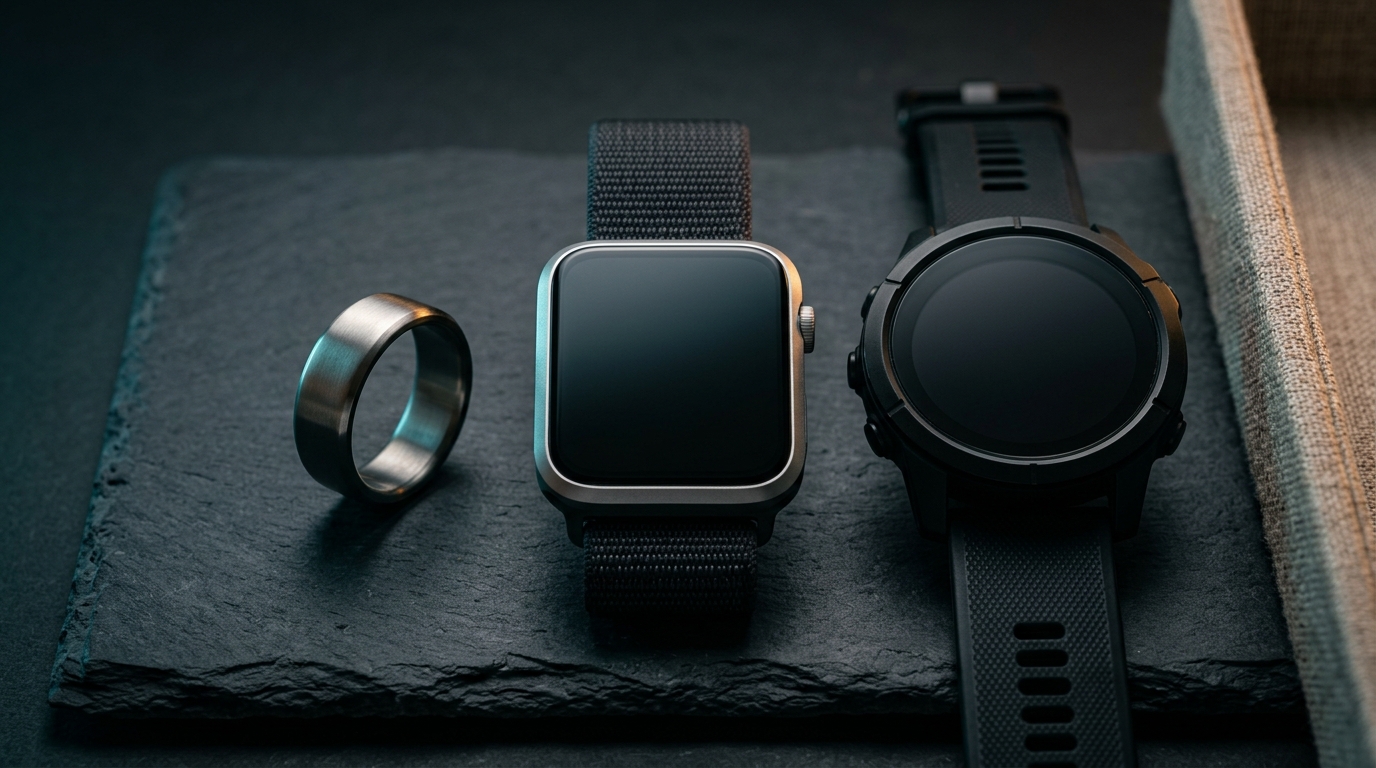
Editor’s 1-Minute Briefing
Polysomnography (PSG) Wearable Benchmark Verdict (2026)
Polysomnography (PSG) Wearable Benchmark Verdict (2026)
Apple Watch vs Oura Ring vs Garmin Sleep Tracking Accuracy: Which Wearable Wins?
1. Binary Sleep vs. Wake Accuracy: In peer-reviewed polysomnography (PSG) comparisons published on PubMed clinical validation trials, modern Apple Watch, Oura Ring, and Garmin sensors all achieve 85% to 92% sensitivity for detecting total sleep time—yet still misclassify 35% to 55% of quiet awake-in-bed minutes.
2. Deep & REM Staging Leader: For 4-stage sleep architecture (Awake, Light, Deep N3, REM), Apple Watch (watchOS machine-learning staging) and Oura Ring Gen 4 (palmar finger PPG) lead at roughly 70% to 78% agreement with lab EEG, while Garmin trails slightly on Deep vs. Light separation (~55% to 68%) in single-night tests.
3. Fast 1-Second Buyer Rule: Pick Oura Ring for invisible comfort and circadian temperature trends ($5.99/mo subscription), Apple Watch for highest raw staging precision with $0 monthly fee (requires daily charging), or Garmin for 10–14 day battery endurance and athletic HRV recovery.
Spending $350 to $500 on the wrong wearable only to discover a dead battery at 2:00 AM or wildly inaccurate deep-sleep scores wastes both money and diagnostic insight. Evaluating Apple Watch vs Oura Ring vs Garmin sleep tracking accuracy against clinical polysomnography (PSG) exposes exactly where each optical sensor shines—and where marketing hype falls short.
Clinical sleep specialists at the American Academy of Sleep Medicine (AASM) and NIH sleep research divisions emphasize that no wrist or ring sensor measures brain waves directly. Instead, they infer sleep stages from heart rate variability (HRV), pulse-wave morphology, respiratory rate, and movement—making sensor placement and algorithm calibration decisive.
1. Apple Watch vs Oura Ring vs Garmin Sleep Tracking Accuracy: 7-Metric Matrix
Before paying extra for titanium rings or monthly memberships, compare all three platforms across clinical polysomnography agreement, physiological sensors, battery endurance, and hidden subscription fees.
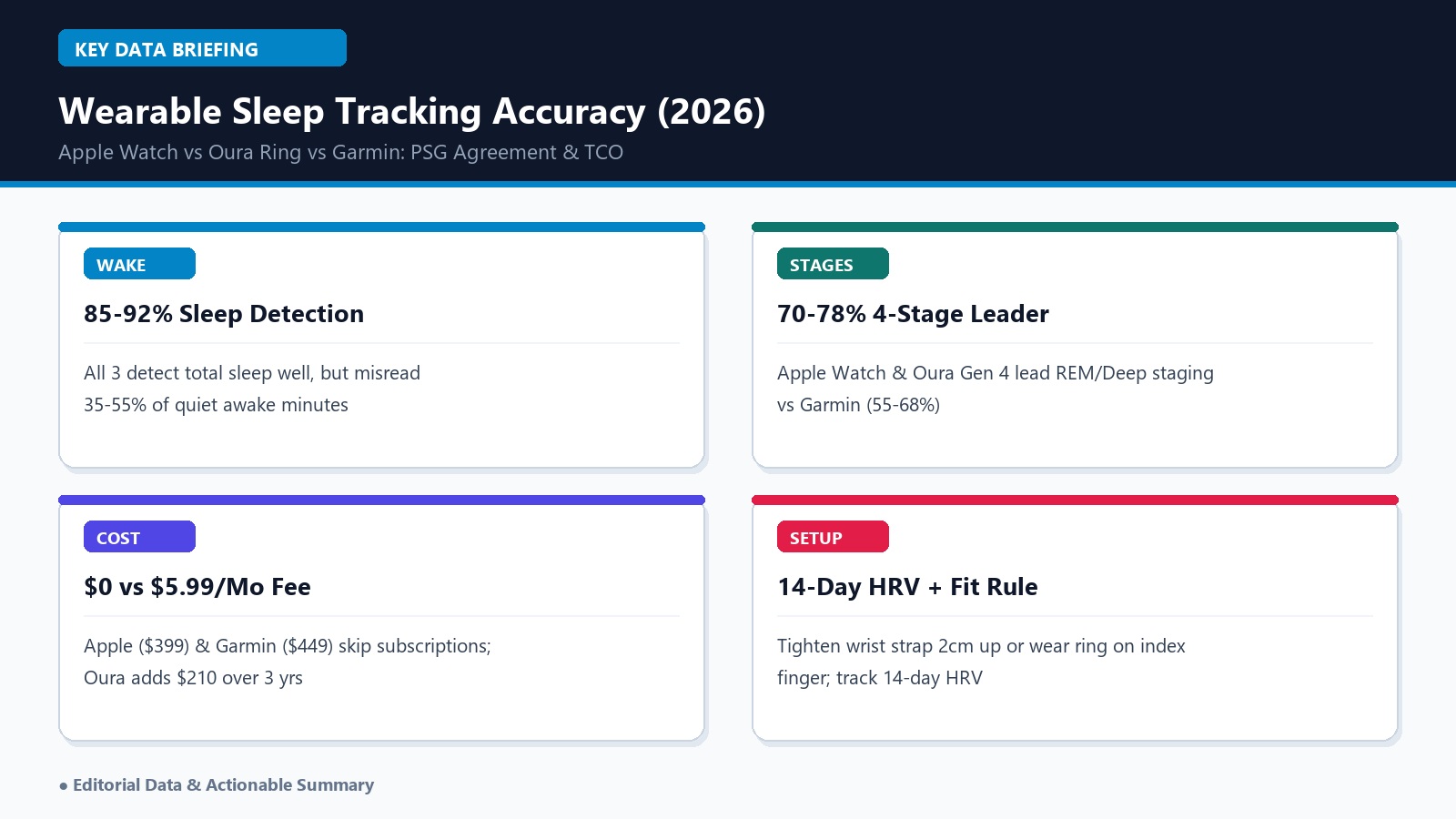
Figure 1: Clinical PSG Accuracy, Sensor Anatomy & Total Cost Summary Across Apple Watch, Oura Ring, and Garmin
2. Which Sleep Tracker Fits Your Life? Persona-Based Winner Verdict
No single device wins for every sleeper over 40. An athlete training for a half-marathon faces different nocturnal constraints than a light sleeper disturbed by bulky watch cases or bright OLED screens.
Choose Apple Watch or Oura Ring If:
Pick Apple Watch if you already own an iPhone, want the highest clinical agreement on REM and deep sleep stages without a $5.99 monthly bill, and need FDA-cleared breathing disturbance alerts. Pick Oura Ring if wearing a watch to bed feels restrictive, you travel across time zones, or you rely on skin temperature shifts to catch early illness and hormonal hot flashes.
Choose Garmin Venu / Fenix If:
Pick Garmin if daily charging breaks your sleep-tracking habit, you alternate between iOS and Android phones, or your main goal is linking overnight HRV recovery and Body Battery readiness directly to morning Zone 2 cardio and strength workouts without paying recurring subscription fees.
Why Finger PPG Beats Wrist Sensors During Micro-Movements
According to biomedical engineering trials indexed by Mayo Clinic and clinical sleep laboratories, the palmar digital arteries beneath a ring deliver 3 to 5 times stronger optical pulse amplitude than the top of the wrist. That cleaner signal makes Oura exceptionally reliable for overnight resting heart rate and HRV—even though Apple Watch’s newer watchOS staging model closes the gap on 4-stage sleep classification.
3. Hidden 3-Year Cost & Accuracy Trade-Offs (2026 Simulation)
Sales reps rarely mention how recurring app memberships and battery degradation alter your real 36-month cost per tracked night. Examine the full 3-year ownership math before checking out.

Figure 2: Optimizing Your Bedroom Thermal & Light Environment Alongside Wearable Sleep Tracking Calibration
4. 4-Step Calibration Checklist to Boost Sleep Tracking Accuracy by 15%
Most “bad sleep tracker” complaints stem from loose optical contact, wrong bedtime schedules, or single-night obsession rather than faulty hardware. Run these four quick setup steps tonight.
STEP 01 — Optimize Sensor Contact Two Fingers Above the Wrist Bone
Slide your Apple Watch or Garmin 1.5 to 2 cm above the ulnar wrist bone using a breathable nylon loop so the green/infrared LEDs never gap when you turn over. For Oura Ring, wear it on your index or middle finger of your non-dominant hand with zero rotation gap.
STEP 02 — Lock Realistic Bedtime Windows & Disable Late Notifications
If you read quietly in bed from 9:30 PM to 10:30 PM, Garmin and older watch profiles can mistake stillness for Light sleep. Set your official Sleep Schedule to match true lights-out timing and turn on Cinema/Sleep Mode so screen glow never suppresses evening melatonin.
STEP 03 — Anchor a Consistent 30-Minute Evening Top-Up Charge
Apple Watch users frequently miss sleep data because the battery hits 5% at midnight. Place your magnetic puck charger in the bathroom and charge for 25 to 30 minutes during your nightly shower and teeth-brushing routine to guarantee 80%+ battery before bed.
STEP 04 — Track 14-Day HRV & Resting HR Baselines, Not Single REM Minutes
Instead of panicking if one night reports 14% Deep sleep instead of 20%, compare your 14-day rolling overnight HRV (ms), resting heart rate (bpm), and respiratory rate. Two glasses of wine at 8 PM reliably raise sleeping heart rate by 5 to 9 bpm across all three wearables.
When Wearables Cannot Replace a Medical Sleep Study
Consumer wearables cannot diagnose obstructive sleep apnea, periodic limb movement disorder, or central hypersomnia—and arrhythmias such as atrial fibrillation (AFib) distort HRV-based sleep staging. If you experience loud gasping snores, morning headaches, or daytime microsleeps, schedule a formal home sleep apnea test (HSAT) or lab polysomnogram.
5. Frequently Asked Questions (FAQ): Apple Watch vs Oura Ring vs Garmin
Q1: Which is most accurate for REM and deep sleep: Apple Watch, Oura Ring, or Garmin?
Independent PSG validation trials place Apple Watch (72%–78% 4-stage agreement) and Oura Ring (70%–76%) in a virtual tie at the top of consumer wearables, ahead of Garmin (55%–68%) on single-night REM and N3 deep sleep boundaries.
Q2: How do Apple Watch vs Oura Ring vs Fitbit compare for sleep tracking?
Modern Google Fitbit models (Charge 6, Pixel Watch 3) reach roughly 70% to 75% sleep-stage agreement—closer to Apple Watch and Oura than Garmin—but lock historical Readiness and long-term trend tools behind Fitbit Premium ($9.99/mo), whereas Apple Watch and Garmin charge $0 monthly.
Q3: Does Oura Ring work well if I lift weights or wear a Garmin during the day?
Many fitness-focused adults over 40 pair a Garmin watch for daytime barbell training and GPS runs (removing an Oura Ring during heavy knurled barbell lifts to avoid scratching titanium) while wearing the Oura Ring overnight for comfortable, unobtrusive sleep and skin temperature tracking.
Q4: Can Apple Watch or Oura Ring detect sleep apnea accurately?
Apple Watch Series 9, Series 10, and Ultra 2 hold FDA clearance to screen for moderate-to-severe sleep apnea patterns over 30-day breathing disturbance logs. Oura tracks overnight blood oxygen (SpO2) and breathing regularity, though neither wearable replaces a physician-ordered polysomnogram for diagnosis.
Q5: Why did Garmin improve its sleep tracking accuracy recently?
Garmin integrated Firstbeat Analytics algorithms alongside its newer 5th-generation optical heart-rate array, automatic nap detection, and Sleep Coach recommendations. While its 4-stage classification still trails Apple Watch slightly, its 7-day HRV Status and 14-day battery reliability make longitudinal trend tracking remarkably consistent.
Related Clinical Protocols & Evidence Guides
Medical Disclaimer: This comparison is provided for educational and consumer decision-making purposes only and is not a substitute for clinical sleep medicine evaluation. Consult a board-certified sleep specialist if you suspect chronic insomnia, restless legs syndrome, or obstructive sleep apnea.