
Editor’s 1-Minute Briefing
Cardiometabolic Biomarker & Red Blood Cell Lipid Analysis (2026)
Cardiometabolic Biomarker & Red Blood Cell Lipid Analysis (2026)
Omega-3 Index Blood Test Optimal Target: The 8%–12% Longevity Standard
1. Optimal Blood Target vs. Average Adult Score: Research cohorts indexed by the National Library of Medicine (PubMed) and NHANES blood surveillance show the average U.S. adult sits at just 4.2% to 4.8%, well below the cardioprotective 8.0% to 12.0% Omega-3 Index blood test optimal target.
2. Why Total Fish Oil Milligrams Mislead Buyers: A standard “1,000 mg fish oil” softgel often supplies only 300 mg combined EPA + DHA—requiring 5 to 6 capsules daily to push red blood cell (RBC) membranes from 4% up to 8%, whereas concentrated rTG formulas reach the same threshold in 2 capsules.
3. Fast 120-Day Action Rule: Measure your baseline via a dried-blood-spot (DBS) or venous RBC fatty acid test, take 1,200 to 2,000 mg combined EPA + DHA with your highest-fat meal, and retest after 16 weeks (120 days) to match red blood cell turnover.
Consider a 53-year-old executive who eats grilled salmon every Sunday and swallows a $14 warehouse-club fish oil capsule each morning—only to see his Omega-3 Index blood test return at 4.6%. Because standard serum triglyceride panels miss cellular membrane incorporation, millions of adults over 40 assume they are protected while silently staying in an elevated cardiovascular risk zone.
Cardiovascular biomarkers reviewed by the American Heart Association (AHA) and the NIH Office of Dietary Supplements demonstrate that the Omega-3 Index—defined as the exact percentage of eicosapentaenoic acid (EPA) plus docosahexaenoic acid (DHA) inside red blood cell membranes—reflects 3 to 4 months of tissue integration rather than yesterday’s dinner.
1. Omega-3 Index Blood Test Optimal Target: Risk Zones Before vs. After 8%
Originally validated by Harris and von Schacky, the Omega-3 Index stratifies adult populations into three distinct clinical risk tiers. Moving from the deficient red zone (<4.0%) into the optimal 8.0%–12.0% band correlates with significant shifts across cardiac electrical stability, brain gray-matter retention, and systemic inflammation.
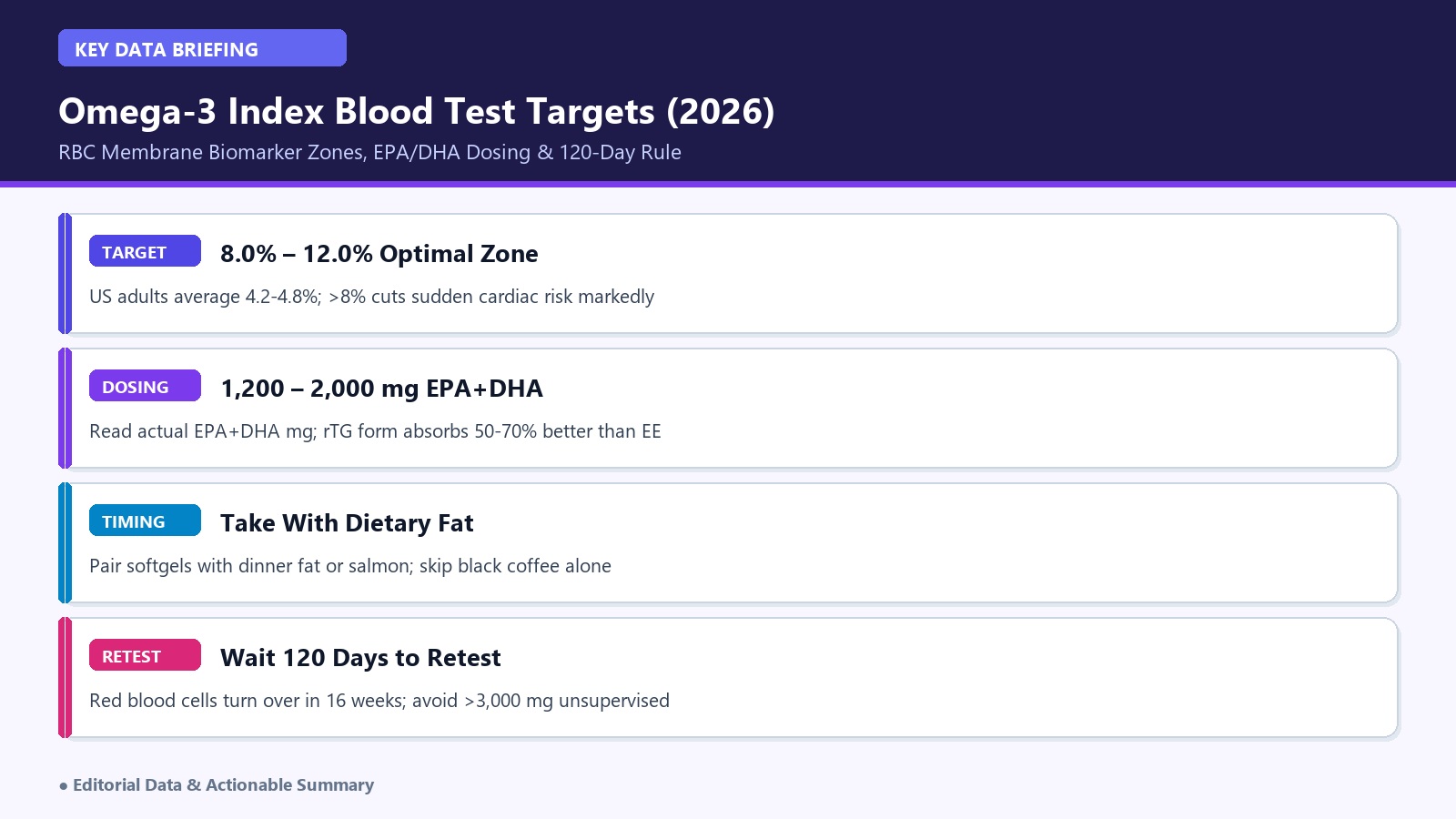
Figure 1: Omega-3 Index Blood Test Risk Zones, EPA+DHA Dosing Targets & 120-Day Red Blood Cell Turnover
2. How to Calculate & Dose EPA+DHA for Your Baseline Omega-3 Index
Published dose-response equations from randomized feeding trials allow clinicians to predict how much combined EPA and DHA is required to raise a patient’s Omega-3 Index blood test from baseline to 8.0%. Body weight and chemical form—re-esterified triglyceride (rTG) versus ethyl ester (EE)—dramatically change the pill count and monthly budget.
Why Weight & Absorption Form Shift Your Real Dose
A 210 lb (95 kg) adult dilutes the same daily capsule across roughly 30% larger blood and adipose volume than a 145 lb (66 kg) adult, often requiring an extra 300 to 500 mg of combined EPA+DHA to reach 8.0%. Furthermore, human bioavailability trials confirm that natural or re-esterified triglyceride (rTG) oils absorb 50% to 70% better than synthetic ethyl ester concentrates when taken with lighter meals.
3. How to Test and Optimize Your Omega-3 Index in 4 Steps
Guessing your dose blindly wastes months and risks rancid oil oxidation. Follow this four-step clinical workflow to measure, adjust, and lock in an 8.0%–10.0% membrane score reliably.
STEP 01 — Choose a Validated Dried-Blood-Spot (DBS) or Venous RBC Test
Confirm that your lab measures erythrocyte (red blood cell) membrane fatty acids—such as OmegaQuant’s validated DBS finger-prick kit ($49–$79) or Quest/Labcorp RBC OmegaCheck—rather than plasma fatty acids, which spike falsely for 12 hours after a single fish meal.
STEP 02 — Add the Exact EPA + DHA Lines on the Supplement Facts Panel
Ignore front-label claims like “1,200 mg Fish Oil” or “2,400 mg Omega Complex.” Flip the bottle and sum only the EPA (eicosapentaenoic acid) and DHA (docosahexaenoic acid) rows—aiming for at least 750 to 1,000 mg combined per 1–2 softgels so you hit clinical thresholds cleanly.
STEP 03 — Take Softgels With Dinner Fat, Never With Black Coffee Alone
Pancreatic lipase and bile salts surge only when dietary fat enters the duodenum. Swallowing omega-3 capsules on an empty stomach wastes up to 60% of ethyl ester absorption and causes fishy reflux; pair them with eggs, avocado, olive oil, or salmon instead.
STEP 04 — Retest at Day 120 and Trim to Maintenance Dosing
Human red blood cells circulate for approximately 115 to 120 days. Retesting at 4 weeks underestimates your true steady state; wait 16 weeks, confirm your score sits between 8.0% and 11.5%, and step down to a maintenance dose if you overshoot 12%.

Figure 2: Pairing EPA/DHA Intake With Dietary Fats Like Wild Salmon, Avocado & Olive Oil Maximizes Cellular Incorporation
4. Upper Safety Limits, AFib Nuance & Rancidity Red Flags
More is not endlessly better once your Omega-3 Index blood test crosses 12%. Large randomized cardiovascular outcome trials over the past five years uncovered two distinct upper-limit boundaries that adults over 40 should respect before megadosing.
3 Clinical Guardrails Before Taking High-Dose Omega-3
1. Avoid Unsupervised 3,000–4,000 mg/day Megadoses: Trials such as REDUCE-IT and STRENGTH noted a modest relative increase in atrial fibrillation (AFib) incidence (roughly 1%–2% absolute rise) among high-risk cardiac patients prescribed 4,000 mg/day purified omega-3 therapy; stay in the 1,000–2,000 mg/day dietary sweet spot unless your cardiologist directs otherwise.
2. Check Anticoagulants & Upcoming Surgery: Review doses above 2,000 mg with your physician if you take warfarin, apixaban, clopidogrel, or daily aspirin.
3. Demand IFOS / TOTOX < 26 Verification: Oxidized fish oil delivers zero vascular benefit and can worsen lipid peroxidation—store softgels away from heat and check batch certificates for peroxide (<5 meq/kg) and total oxidation (TOTOX <26).
5. Frequently Asked Questions (FAQ): Omega-3 Index Blood Test
Q1: How do you measure and calculate the Omega-3 Index blood test?
Gas chromatography quantifies all fatty acids in red blood cell membranes, and the Omega-3 Index is calculated as (EPA + DHA) divided by total RBC fatty acids × 100%. If 8 out of every 100 membrane fatty acid molecules are EPA or DHA, your index is exactly 8.0%.
Q2: Do you need to fast before an Omega-3 Index blood test?
No fasting is required for a true red blood cell or dried-blood-spot Omega-3 Index test. Unlike blood glucose or plasma triglycerides, red blood cell membranes incorporate fats slowly over months, so a morning breakfast or previous night’s meal changes your percentage by less than 0.1%.
Q3: Why won’t flaxseed, chia, or walnuts alone raise my Omega-3 Index to 8%?
Plant seeds supply alpha-linolenic acid (ALA), not EPA or DHA. In adult humans, liver desaturase enzymes convert only 5% to 8% of ALA into EPA and typically less than 1% to 3% into DHA, leaving strict plant-seed eaters near 3.5%–4.5% unless they add direct microalgae EPA/DHA oil.
Q4: How long does it take to raise an Omega-3 Index from 4.5% to 8.0%?
Taking 1,500 to 1,800 mg of rTG EPA+DHA daily with meals raises most adults from 4.5% to 8.0% within 12 to 16 weeks. Waiting the full 120-day red blood cell lifespan before retesting prevents premature dose increases.
Q5: Is an Omega-3 Index above 12% harmful or better for longevity?
Most population cohorts—including Japanese and Korean fish-eating populations with high cardiovascular longevity—cluster comfortably between 8.0% and 11.5%. Pushing far beyond 12.0% offers no proven extra mortality benefit while potentially prolonging minor bleeding time and increasing AFib vigilance in susceptible patients.
Related Clinical Protocols & Evidence Guides
Medical Disclaimer: This biomarker guide is for educational purposes and does not substitute for individualized cardiology or primary-care advice. Discuss high-dose omega-3 therapy (>2,000 mg/day) with your clinician if you have atrial fibrillation, bleeding disorders, seafood allergies, or take prescription anticoagulants.