

EDITOR’S 1-MINUTE DIAGNOSTIC RUNBOOK
Probiotic Side Effects Triage: Normal Adjustment vs. Stop Immediately
- Normal Transient Adjustment (Days 1–10): Mild gas or softer stools during the first 7 to 10 days as microbial fermentation shifts pH in the colon. Resolve by cutting your CFU dose by 50%.
- Stop & Skip Immediately if bloating peaks within 60 minutes of eating accompanied by post-meal brain fog (a classic sign of SIBO / D-lactic acidosis) or if you develop flushing, nasal congestion, or insomnia (histamine intolerance).
- Absolute Medical Contraindications: Never take live multi-strain probiotics during severe acute pancreatitis, active central venous catheter use, or profound neutropenia/immunosuppression.
More than 38% of adults over 40 take a daily probiotic capsule expecting smoother digestion, yet gastroenterology clinics routinely see patients whose chronic abdominal distension, post-meal fatigue, and skin flushing are actually caused by their daily probiotic. Understanding probiotic side effects when to skip taking them safely is essential because adding 50 billion live bacteria to a slow-moving small intestine can pour fuel on the fire.
Clinical guidelines from the American Gastroenterological Association (AGA Clinical Practice Guidelines) emphasize that probiotics are strain-specific biological agents—not one-size-fits-all multivitamins. Below is the complete diagnostic matrix to distinguish harmless gut remodeling from conditions that require pausing or switching strains immediately.
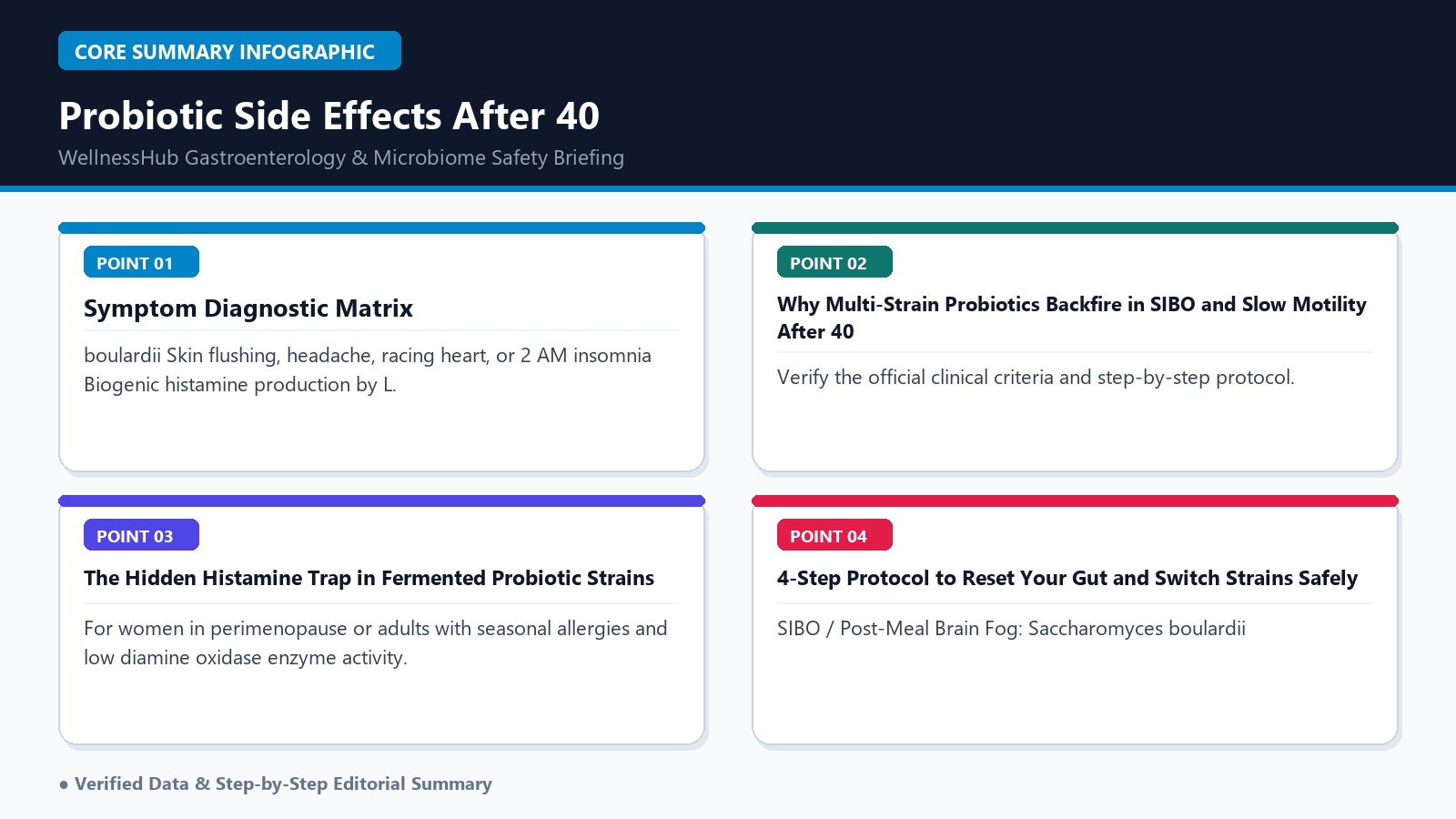
1. Symptom Diagnostic Matrix: Normal Adjustment vs. Clinical Intolerance
When you introduce new Lactobacillus or Bifidobacterium strains, they compete with existing microbes and produce short-chain fatty acids (butyrate, acetate, and propionate). While mild changes fade within 10 to 14 days, persistent symptoms beyond Day 14 point to a mismatch between the bacterial strain and your gut motility or histamine clearance.
| Digestive or Systemic Symptom | Underlying Biological Mechanism | Immediate Clinical Action |
|---|---|---|
| Mild evening gas for 5–10 days | Transient colonic fermentation shift & prebiotic inulin breakdown | Continue at 50% dose (every other day) with food for 7 days |
| Severe upper-belly bloating within 30–60 mins + brain fog | Small Intestinal Bacterial Overgrowth (SIBO) & D-lactate production | STOP Lacto/Bifido blends; switch to non-colonizing S. boulardii |
| Skin flushing, headache, racing heart, or 2 AM insomnia | Biogenic histamine production by L. casei, L. bulgaricus, or L. reuteri | SKIP histamine-producing strains; use B. infantis or B. longum only |
| New onset constipation after starting spore probiotics | Excessive methane-archaea cross-feeding or insufficient hydration | Pause for 7 days; switch to B. lactis HN019 + 300 mg Magnesium Citrate |
| Fever, chills, or severe abdominal pain in immunocompromised host | Rare mucosal bacterial translocation across leaky gut barrier | DISCONTINUE immediately and seek urgent medical evaluation |
2. Why Multi-Strain Probiotics Backfire in SIBO and Slow Motility After 40
Your small intestine is designed to hold relatively few bacteria—fewer than 1,000 CFU per milliliter—compared to the trillions residing in your large colon. After age 40, hypothyroidism, GLP-1 weight loss medications, chronic stress, or past food poisoning can slow down the migrating motor complex (MMC), the electrical cleansing wave that sweeps bacteria down into the colon every 90 minutes between meals.
When you swallow a 50-billion CFU capsule packed with Lactobacillus acidophilus plus prebiotic chicory root (inulin) or FOS, those bacteria can get trapped in the upper small intestine. Even worse, certain Lactobacillus species ferment carbohydrates into D-lactic acid—an isomer human cells metabolize poorly—triggering acute abdominal distension, slurred concentration, and heavy brain fog 45 minutes after eating.
3. The Hidden Histamine Trap in Fermented Probiotic Strains
For women in perimenopause or adults with seasonal allergies and low diamine oxidase (DAO) enzyme activity, certain probiotic bacteria possess the histidine decarboxylase gene, converting dietary histidine from protein meals directly into histamine inside the gut.
If your probiotic supplement contains Lactobacillus casei, Lactobacillus bulgaricus, Lactobacillus helveticus, or Streptococcus thermophilus, it can quietly overload your histamine bucket—causing unexplained nighttime waking, itchy skin, sinus pressure, or heart palpitations.
4. 4-Step Protocol to Reset Your Gut and Switch Strains Safely
If you suspect your current bottle is causing bloating or histamine symptoms, follow this 4-step clinical washout and strain-selection protocol:
STEP 01
Execute a 10-Day Complete Probiotic & Inulin Washout
Stop all multi-strain capsules and check protein powders or fiber bars for hidden chicory root fiber, inulin, or fructooligosaccharides (FOS). Most probiotic-induced bloating drops by 60% to 80% within 7 to 10 days of washout.
STEP 02
Space Meals 4 Hours Apart to Reactivate Small-Bowel Motility
Avoid grazing on snacks between meals. Leaving a clean 3.5- to 4-hour fasting window between breakfast, lunch, and dinner allows your migrating motor complex (MMC) to sweep excess bacteria out of the small intestine naturally.
STEP 03
Match a Single Targeted Strain to Your Exact Gut Goal
Instead of 15-strain “kitchen sink” blends, use a single clinically validated strain free of prebiotic fillers: Saccharomyces boulardii CNCM I-745 (5 billion CFU) for SIBO/antibiotic recovery, or Bifidobacterium infantis 35624 (1 billion CFU) for IBS bloating.
STEP 04
Prioritize Soluble Polyphenols & Low-Histamine Whole Foods
Feed your native beneficial Akkermansia and Bifidobacteria using gentle soluble fibers and polyphenols—such as partially hydrolyzed guar gum (PHGG, 5g/day), cooked cooled oats, wild blueberries, and extra-virgin olive oil.

| Digestive Sensitivity Profile | Strains & Prebiotics to SKIP | Safe Clinical Replacement (Strain & Dose) |
|---|---|---|
| SIBO / Post-Meal Brain Fog | L. acidophilus, L. delbrueckii, Inulin, FOS | Saccharomyces boulardii (250–500 mg / 5–10B CFU daily) |
| Histamine Intolerance / Perimenopause Flushing | L. casei, L. bulgaricus, L. reuteri, Kombucha | Bifidobacterium infantis & B. longum (D-lactate & histamine free) |
| Slow Transit / GLP-1 Constipation | High-dose 50B+ CFU unbuffered multi-strains | Bifidobacterium lactis HN019 (5B CFU) + Ginger root extract |
5. Frequently Asked Questions (FAQ)
Q1. Will stopping my probiotic suddenly cause rebound digestive problems?
No. Most commercial probiotics do not permanently colonize the adult gut lining; they act as transient visitors for 5 to 14 days before passing through the stool. Stopping abruptly is completely safe and does not trigger withdrawal or rebound dysbiosis.
Q2. Should I take probiotics during or after a course of prescription antibiotics?
Rather than taking a generic 10-strain bacterial capsule (which can actually delay native microbiome recovery according to Cell journal studies), gastroenterologists recommend taking the beneficial yeast Saccharomyces boulardii (5–10 billion CFU) spaced 2 hours apart from your antibiotic dose. Because it is a yeast, antibiotics cannot kill it, and it cuts antibiotic-associated diarrhea risk by more than 50%.
Q3. Why does my probiotic label say 50 Billion CFU—is higher CFU always better?
Higher CFU counts are largely a marketing arms race. Clinical trials show that 1 billion to 10 billion CFU of a well-studied, delayed-release strain (such as B. infantis 35624 or L. rhamnosus GG) delivers superior symptom relief with a fraction of the gas and bloating caused by 50–100 billion CFU megadoses.
RELATED CLINICAL LONGEVITY GUIDES
- How to Read a Comprehensive Metabolic Panel (CMP) Blood Test After 40
- Berberine vs. Inositol for Insulin Resistance After 40: Clinical Comparison
Medical Disclaimer: Content on WellnessHub.center is reviewed by the WellnessHub Editorial & Clinical Research Team for educational purposes only and does not substitute for personalized medical advice. Always consult your physician before changing supplements or medications. View our Medical Disclaimer & Privacy Policy.