

Editor’s 1-Minute Briefing
2026 Clinical Micronutrient Synergy & Bone-Arterial Protocol
Vitamin D3 and K2 Dosage After 40: Optimal Lab Targets, Ratio & Absorption Guide
1. The Core Daily Ratio: Most adults over 40 maintain an optimal 25(OH)D blood level of 40–60 ng/mL on 2,000 to 5,000 IU of Vitamin D3 paired with 90 to 200 mcg of Vitamin K2 (MK-7)—roughly 45 mcg K2 per 1,000 IU D3.
2. Why Pairing Matters: Per NIH Office of Dietary Supplements and PubMed calcium-metabolism trials, Vitamin D3 boosts intestinal calcium absorption by up to 30%–40%, while Vitamin K2 activates osteocalcin and Matrix Gla Protein (MGP) to steer that calcium into bone rather than arterial walls.
3. Critical Timing & Safety Rule: Always take fat-soluble D3+K2 with a breakfast or lunch containing 10–15 g of dietary fat (increasing uptake by 32%–50%), stay below the 4,000 IU/day non-monitored ceiling without lab testing, and never combine K2 with prescription warfarin without physician INR oversight.
Roughly 35% to 42% of U.S. adults carry insufficient serum 25-hydroxyvitamin D levels below 30 ng/mL—a gap that deepens sharply between November and March as UVB sunlight drops. Yet dialing in the right vitamin d3 and k2 dosage is not as simple as grabbing a generic 10,000 IU mega-capsule off a pharmacy shelf.
Clinical endocrinology summaries from Harvard Health Publishing and the Endocrine Society emphasize a two-part equation: Vitamin D3 raises circulating calcium, while Vitamin K2 acts as the traffic controller ensuring that mineral binds to bone collagen instead of calcifying soft tissue. Use the lab-tiered dosing tables and four-step titration protocol below to match your bloodwork precisely.
1. Vitamin D3 and K2 Dosage Chart by Baseline 25(OH)D Blood Level
Blindly dosing 5,000 IU daily when your baseline blood level already sits at 55 ng/mL pushes you toward unnecessary excess, whereas 600 IU barely moves a deficient 16 ng/mL lab score. Match your current 25-hydroxyvitamin D blood test to the clinically calibrated vitamin d3 and k2 dosage tiers below.
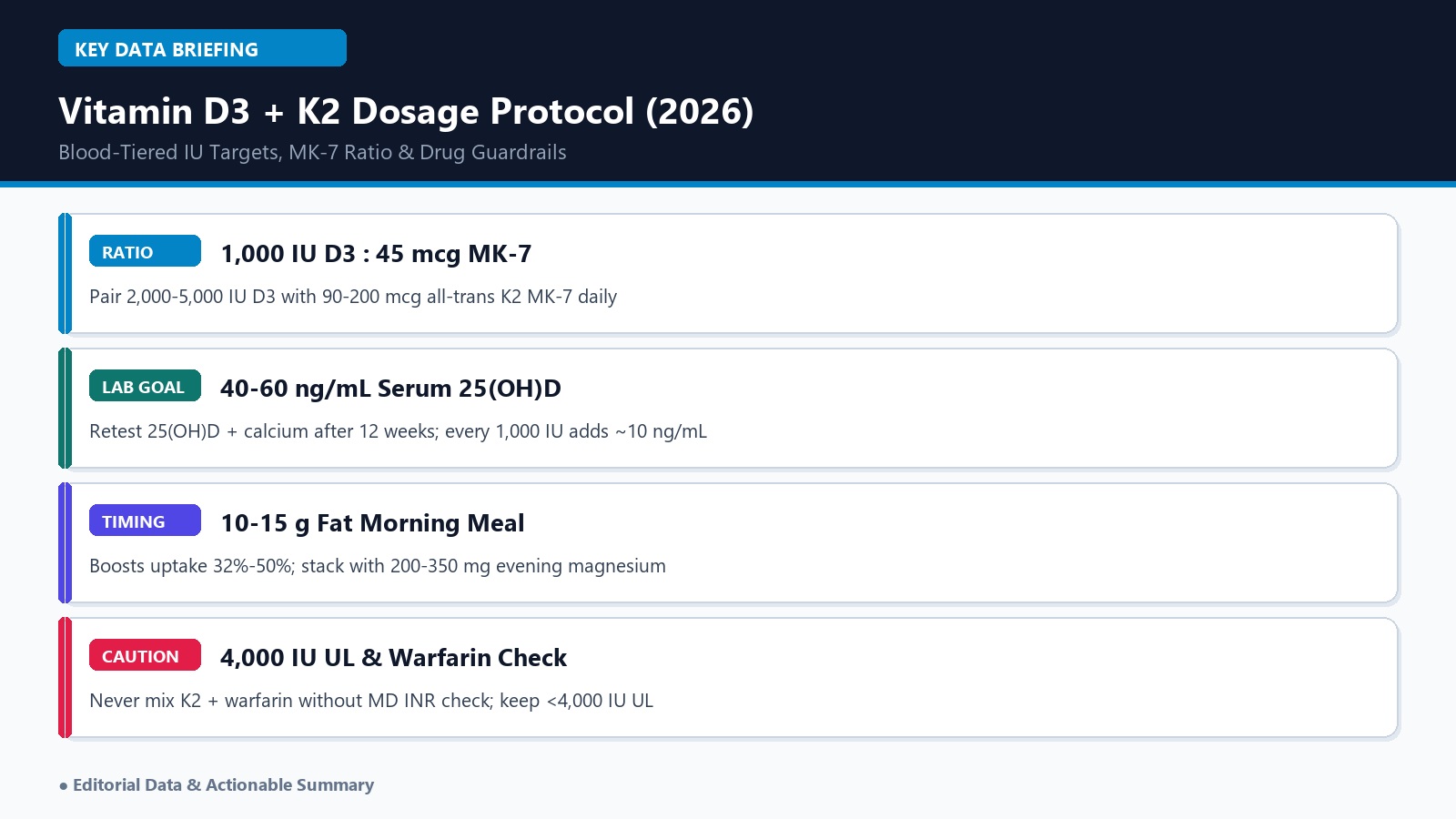
Figure 1: Vitamin D3 and K2 Dosage — Blood-Tiered IU Targets, MK-7 Ratio, Dietary Fat Rule & Drug Safety Guardrails
2. How to Take Vitamin D3 and K2: 4-Step Clinical Protocol
Even a perfectly formulated supplement wastes up to half its active dose if swallowed on an empty stomach with black coffee or taken without adequate magnesium cofactor levels. Execute these four practical steps to lock in steady absorption and clean arterial safety, referencing our detailed Vitamin D blood level 50 vs 80 ng/mL safety guide.
STEP 01 — Order a 25(OH)D + Serum Calcium Panel Before High Dosing
Ask your clinician for a 25-hydroxyvitamin D [25(OH)D] test alongside basic serum calcium (and Vitamin B12 if over 50). Most adults add roughly 10 ng/mL for every 1,000 IU of daily D3 taken consistently, though adipose tissue sequesters fat-soluble cholecalciferol in higher-BMI bodies.
STEP 02 — Apply the 1,000 IU D3 : 45 mcg K2 MK-7 Synergy Ratio
Match every 1,000 IU (25 mcg) of cholecalciferol with 40 to 50 mcg of all-trans Menaquinone-7 (MK-7), capping total daily MK-7 around 180–200 mcg. If a combo capsule supplies 5,000 IU D3 with only 45 mcg K2, add a standalone 100 mcg MK-7 softgel to keep carboxylation of bone-building osteocalcin complete.
STEP 03 — Take With a 10–15 g Fat Morning Meal (Not Late at Night)
Clinical pharmacokinetics reported in the Journal of Bone and Mineral Research show taking Vitamin D3 with your largest fat-containing meal boosts serum absorption by 32% to 50% versus fasting. Dose at breakfast or lunch with eggs, salmon, avocado, or olive oil—evening dosing can blunt melatonin onset in light sleepers.
STEP 04 — Supply Magnesium Cofactors & Retest at Week 12
Every hepatic and renal enzyme converting Vitamin D3 into active calcitriol requires magnesium. Pair morning D3+K2 with 200–350 mg of evening magnesium glycinate and repeat your 25(OH)D blood draw after 12 weeks to step down from loading doses to a steady 1,000–2,000 IU maintenance plan.

Figure 2: Pairing Oil-Based D3+K2 Softgels With 10–15 g of Whole-Food Breakfast Fats Maximizes Micellar Absorption
3. MK-7 vs. MK-4 & Capsule Forms: Bioavailability Comparison
Not every label listing “Vitamin K2” behaves identically in human blood plasma. Before choosing a bottle, compare half-life, carrier oil, and third-party purity markers across the four common market formats—and review our deep dive on Vitamin K2 MK7 vs MK4 arterial half-life.
4. Vitamin D3 and K2 Side Effects, Upper Limits & Drug Interactions
Three Non-Negotiable Safety Guardrails Before Starting
1. Warfarin (Coumadin) & Anticoagulant Conflict: Vitamin K2 directly antagonizes vitamin K-epoxide reductase—the exact clotting pathway warfarin blocks. Even 45–100 mcg of MK-7 can destabilize INR scores; patients on warfarin must obtain cardiologist clearance first (newer DOACs like Eliquis or Xarelto act on Factor Xa/thrombin instead, but always verify with your prescriber).
2. Hypercalcemia & Granulomatous Risk: The Institute of Medicine sets the adult Tolerable Upper Intake Level (UL) at 4,000 IU/day without lab supervision. Exceeding 10,000 IU/day long-term or supplementing blindly with sarcoidosis, primary hyperparathyroidism, or advanced chronic kidney disease can trigger nausea, excessive thirst, and kidney calcification.
3. MK-7 Palpitations & Calcium Supplement Stacking: Roughly 2%–4% of adults notice mild nighttime restlessness or rapid heartbeat on high-dose MK-7 (180+ mcg); switching to morning dosing or MK-4 typically resolves it within 48 hours. Additionally, avoid stacking 1,000 mg calcium carbonate pills on top of D3+K2 unless dietary calcium is clinically deficient.
5. Frequently Asked Questions: Vitamin D3 and K2 Dosage
Q1. What are the main benefits of taking Vitamin D3 and K2 together?
Taking D3 alone elevates gut calcium uptake, whereas K2 carboxylates osteocalcin (locking minerals into bone trabeculae) and Matrix Gla Protein (inhibiting vascular calcification). Postmenopausal and 40+ bone-density trials show combined D3+K2 improves lumbar bone mineral density more reliably than either vitamin solo.
Q2. When is the best time of day to take Vitamin D3 and K2?
Take your vitamin d3 and k2 dosage with breakfast or lunch alongside 10–15 g of healthy fat (eggs, Greek yogurt, nuts, or olive oil). Morning dosing aligns with natural daylight circadian signaling and avoids rare sleep fragmentation reported with bedtime doses.
Q3. What are the side effects of taking too much Vitamin D3 and K2?
Vitamin K2 itself has no established upper toxicity limit in healthy adults not taking warfarin, though high MK-7 occasionally causes mild GI upset or palpitations. Excess Vitamin D3 (blood 25(OH)D >100–150 ng/mL) causes hypercalcemia symptoms including constipation, fatigue, frequent urination, and elevated blood calcium.
Q4. Should I test Vitamin D alongside Vitamin B12 and magnesium?
Yes—adults over 45 with winter fatigue or taking metformin or acid blockers often carry overlapping low 25(OH)D (<30 ng/mL) and low Vitamin B12 (<400 pg/mL). Checking 25(OH)D, serum calcium, and B12 on one annual morning lab draw lets you calibrate your exact daily supplement stack without guesswork.
Related Clinical Protocols & Evidence Guides
Medical Disclaimer: This article is written by the WellnessHub Editorial & Clinical Research Team for educational purposes only and does not replace individualized physician evaluation or lab monitoring. Consult your doctor or pharmacist before adjusting Vitamin D3 or K2 if you take warfarin, thiazide diuretics, or digoxin, or if you have kidney disease or parathyroid disorders. View our Medical Disclaimer & Privacy Policy.