
Editor’s 1-Minute Briefing
Clinical Pharmacology & 40+ Cardiometabolic Protocol (2026)
Clinical Pharmacology & 40+ Cardiometabolic Protocol (2026)
Statin Muscle Pain CoQ10 Dosage and Protocol: Quick Clinical Summary
1. Why Statins Trigger Aches: Prescription statins block the hepatic mevalonate pathway, cutting LDL cholesterol while reducing circulating Coenzyme Q10 (CoQ10) by 25% to 50% within 30 days and starving skeletal muscle mitochondria of ATP.
2. Evidence-Based CoQ10 Dosage & Form: Adults 40+ absorb reduced ubiquinol (100 to 200 mg/day) up to 2x to 3x better than standard ubiquinone powder when taken with a fat-containing meal.
3. Safe Medical Action Plan: Never stop a statin abruptly without consulting your cardiologist; pair an 8-week ubiquinol trial with Harvard Health & ACC/AHA lab checks (creatine kinase, vitamin D, and TSH).
Consider a 56-year-old engineer starting 20 mg of atorvastatin after a high calcium score: by Week 4, both thighs feel heavy and sore walking up a single flight of stairs, even though he has not changed his workouts. When patients hit this wall, searching for a reliable statin muscle pain coq10 dosage and protocol becomes the difference between abandoning lifesaving heart protection and restoring daily mobility.
Roughly 5% to 15% of patients in observational cohorts report statin-associated muscle symptoms (SAMS), ranging from mild calf tightness to deep proximal thigh weakness. Clinical trials indexed on PubMed and NIH Office of Dietary Supplements monographs reveal why targeted ubiquinol dosing works for specific patients—and when lab work or statin rotation is mandatory instead.
1. Statin Muscle Pain Location & Cause: Why Lipophilic Statins Drain CoQ10
Statins lower LDL cholesterol by inhibiting HMG-CoA reductase in the liver, the exact upstream enzyme your cells also require to manufacture Coenzyme Q10. Because CoQ10 shuttles electrons inside mitochondrial complexes I, II, and III, a 25% to 50% drop in serum and muscle ubiquinol leaves high-energy leg and shoulder fibers sluggish under load.
Knowing classic statin muscle pain location helps separate drug myalgia from a pulled tendon. True statin myalgia is almost always bilateral and symmetrical, targeting large proximal muscle groups—front thighs (quadriceps), calves, glutes, hip flexors, or upper shoulders—typically starting 2 to 8 weeks after beginning therapy or doubling a dose.
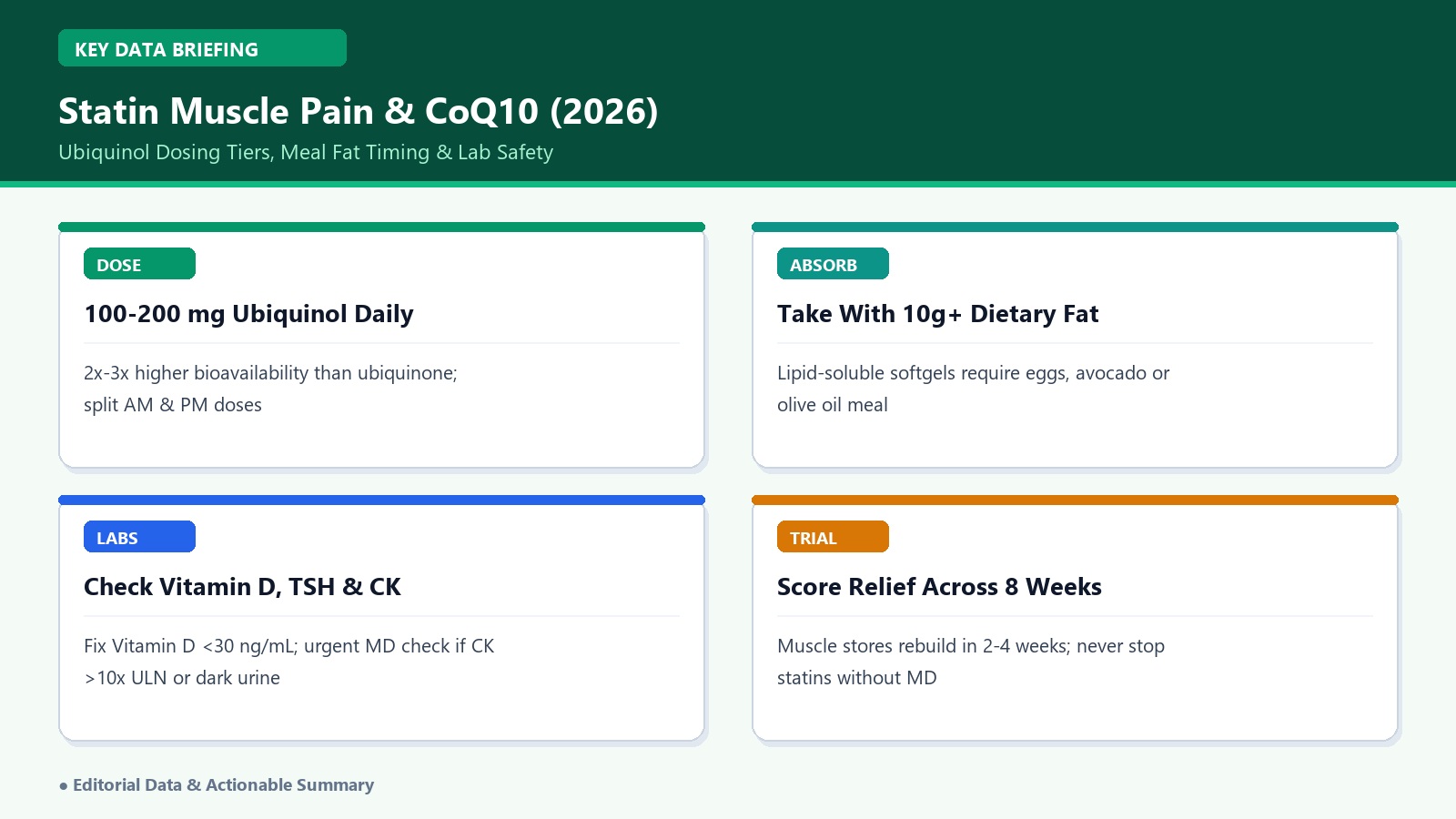
Figure 1: Clinical Statin Muscle Pain & CoQ10 Dosing Protocol — Ubiquinol Ranges, Co-Factors & Lab Safety
2. CoQ10 Dosage and Protocol: Ubiquinol vs. Ubiquinone for Adults Over 40
Picking the wrong CoQ10 capsule explains why many trials report mixed results. Dry crystalline ubiquinone (the oxidized form) has poor intestinal solubility—often absorbing at under 3% to 5%—and requires healthy enzymatic conversion into active ubiquinol inside your enterocytes and liver, a conversion pathway that declines sharply after age 45.
A 2018 meta-analysis in the Journal of the American Heart Association (JAHA) covering 12 randomized controlled trials (575 patients) found CoQ10 supplementation significantly reduced statin-associated muscle pain, weakness, cramping, and tiredness compared with placebo. Use the tiered dosing table below to match severity and age.

Figure 2: Restoring Pain-Free Leg Mobility and Mitochondrial Recovery During Long-Term Cardiovascular Therapy
3. How to Reduce Statin Muscle Pain Safely: 4-Step Clinical Protocol
Clinical guidance from Mayo Clinic cardiovascular specialists stresses that up to 70% of statin-intolerant patients can remain protected on therapy once hidden nutrient deficiencies, absorption errors, and drug selection are addressed systematically. Follow these four steps over 8 weeks.
STEP 01 — Rule Out Low Vitamin D3 (<30 ng/mL) & Thyroid Mimics First
Observational studies show patients with serum 25-hydroxyvitamin D below 20 to 30 ng/mL are nearly twice as likely to develop statin myalgia. Ask your doctor to draw a baseline 25(OH)D, TSH, and creatine kinase (CK) panel; correcting vitamin D toward 40–55 ng/mL often cuts muscle aches before touching your statin prescription.
STEP 02 — Split 200 mg Ubiquinol Across Two Fat-Containing Meals
CoQ10 is strictly lipid-soluble with a molecular weight of 863 Da, meaning intestinal transporters saturate around 100 mg per sitting. Take 100 mg ubiquinol with breakfast (eggs, yogurt, or walnuts) and 100 mg with dinner (salmon or olive oil) rather than swallowing 200–300 mg on an empty stomach—and take it in the morning or noon if late-evening doses cause mild alertness.
STEP 03 — Score Your Muscle Pain Weekly From 0 to 10 Over 8 Weeks
CoQ10 takes 14 to 28 days to rebuild intracellular skeletal muscle concentrations. Keep a 1-line Sunday log rating stair-climb thigh soreness (0–10) and afternoon fatigue; if your pain drops 40%+ by Week 6, maintain 100–200 mg/day alongside gentle resistance training and adequate hydration.
STEP 04 — Discuss Hydrophilic Switch or Non-Statin Options if Unresolved
If bilateral soreness persists past 8 weeks despite 200 mg ubiquinol and normal vitamin D, ask your physician about a 2-week supervised washout followed by switching to low-dose hydrophilic rosuvastatin (5 mg every other day), pitavastatin, or adding ezetimibe / bempedoic acid so LDL stays controlled without muscle pain.
Urgent Safety Warnings: When to Call Your Doctor Immediately
1. Rhabdomyolysis Red Flags (<0.1% Risk): Severe, disabling muscle weakness paired with dark brown or tea-colored urine, fever, or creatine kinase (CK) above 10x the upper limit of normal requires stopping the statin immediately and seeking urgent medical evaluation.
2. Warfarin & Blood Pressure Drug Interactions: CoQ10 shares structural similarity with vitamin K2 and can mildly lower INR in patients taking warfarin (Coumadin), and may lower systolic blood pressure by 4–8 mmHg; inform your anticoagulation clinic before starting 200+ mg/day.
3. Hidden CYP3A4 Boosters: Grapefruit juice, clarithromycin, and certain calcium-channel blockers spike simvastatin and atorvastatin blood concentrations up to 3x—check every new antibiotic with your pharmacist.
4. Frequently Asked Questions: Statin Muscle Pain & CoQ10 Protocol
Q1. How to treat statin muscle pain—does CoQ10 work for everyone?
No single supplement works for 100% of patients, because statin myalgia also stems from vitamin D insufficiency, SLCO1B1 genetic variants, and altered sarcoplasmic calcium leak. However, an 8-week trial of 100 to 200 mg/day ubiquinol is low-risk, improves mitochondrial ATP output, and meaningfully lowers pain scores in a substantial subset of adults over 40.
Q2. Should I take CoQ10 at the same time as my statin, or space them apart?
CoQ10 does not interfere with statin LDL-lowering efficacy, so taking them at different times is mainly about absorption and sleep. Take ubiquinol with your fat-rich breakfast or lunch for maximum absorption and zero nighttime insomnia, while taking short-acting statins like simvastatin or pravastatin at bedtime as prescribed.
Q3. Where is statin muscle pain located vs. regular arthritis or exercise soreness?
Statin myalgia causes symmetric aching, cramping, or heaviness in the belly of large muscles—both quadriceps, hamstrings, calves, or upper shoulders—rather than inside a single knee joint or lower spine. Joint-only pain on one side usually points to osteoarthritis or tendonitis rather than your statin.
Q4. Can I take 400 mg or 600 mg of CoQ10 for severe statin aches?
Doses above 300 mg/day rarely add extra muscle relief for statin myalgia and increase mild digestive side effects (nausea or loose stools). If 200 mg/day of emulsified ubiquinol fails after 8 weeks, switching to an alternative statin regimen with your cardiologist is far more effective than megadosing CoQ10.
Related Clinical Protocols & Evidence Guides